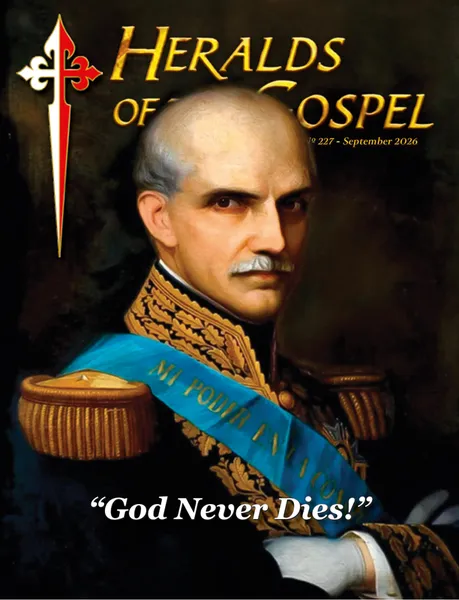
 Heralds of the Gospel Magazine, Vol. 20, nº 227, September 2026
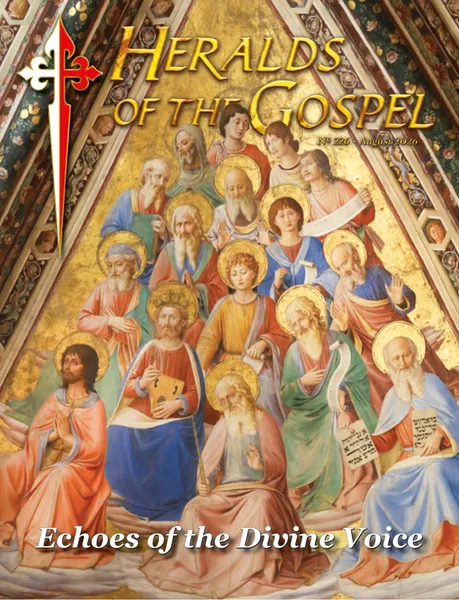 Heralds of the Gospel Magazine, Vol. 20, nº 226, August 2026
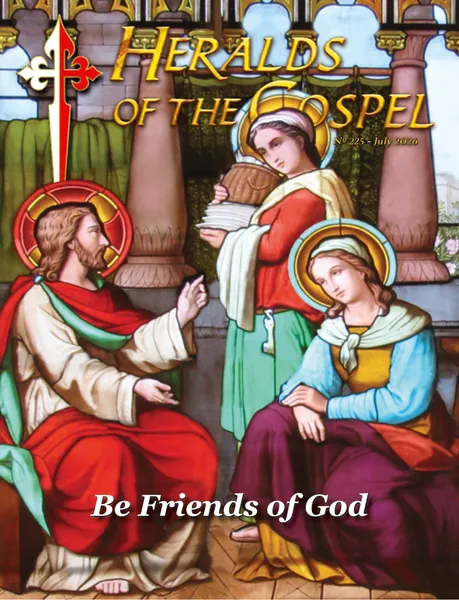 Heralds of the Gospel Magazine, Vol. 20, nº 225, July 2026
 Who are the Heralds of the Gospel?
 Help of Christians
 Christmas Carols







Every human being longs for God. Like a deer parched for water, the human soul yearns for the Creator (cf. Ps 41:2). Original sin, however, introduced an interior disorder that distorts this natural longing, leading the children of Adam to seek other “gods”: fame, material possessions, pleasures… culminating in the desire to kill the Immortal One. Thus the fool rages: “‘There is no God’ (Ps 53:1), for if He existed, I would be allowed nothing!”
The Old Testament epitomizes this contradiction: the Tower of Babel defies the Most High (cf. Gn 11:4); Sodom prefers debauchery to conversion (cf. Gn 19:4-9); and the people, by exchanging “He who is” (Ex 3:14) for the golden calf (cf. Ex 32:1-6), choose “he who is not.” The wickedness of this “people who err in heart” (Ps 94:10) knows no bounds: they even kill the prophets (cf. Mt 23:37) in an attempt to eliminate the Author of Life.
In response, the Word Himself becomes flesh and dwells amongst men. The Eternal One lives amongst us! And what is humanity’s reaction? They call Jesus a glutton and a drunkard for dining with simple folk, a friend of sinners for offering salvation (cf. Mt 11:19), and “Beelzebul” for casting out demons (cf. Mt 12:24). The hostility of the Sanhedrin culminates in deicide: “Crucify Him!”
Yet death has no power over Him (cf. Rom 6:9). Identifying Himself as “the Resurrection and the Life” (Jn 11:25), Christ vanquishes death. After the Ascension, the Redeemer does not abandon us, but transfigures His presence, continuing to live in His Mystical Body, the Church, which is immortal like Him by divine promise: “The gates of hell shall not prevail” (Mt 16:18).
Moreover, the Almighty dwells in the soul of the righteous, the abode of the Trinity. Convinced of this, a multitude of martyrs preferred death to losing their friendship with God. Whether Lawrence on the gridiron or Ignatius devoured by wild beasts, their testimony cries out in unison: God does not die! And the saints, likewise, live forever, interceding for the Church and serving as examples; for them, “to die is gain” (Phil 1:21).
Throughout the centuries, countless imposters have tried to expel God from society. The de-Christianization that began in the late Middle Ages led to a growing change in mentality, whose values, no longer imbued with the Most Precious Blood of Christ, became increasingly steeped in an unprecedented paganism.
From this followed the three great revolutions and their slogans. From the Protestant Revolution, which proclaimed “Christ yes, the Church no,” the process advanced on to the French Revolution, with its “God yes, Christ no,” then arrived at the Communist Revolution, which finally unleashed “the impious cry: God is dead; and even, God never existed!” (Pius XII. Speech, 12/10/1952).
But how can man presume to substitute the Church? To guillotine the Immortal? To decree God’s interment? Let it be noted that this is not a thing of the past: we still witness the banishment of the Divine Teacher from schools, of the Supreme Legislator from the courts and, finally, of the King of the Universe from the entire public sphere…
Faced with those who, with Luciferian hatred, aim to extirpate the sacred, there will always be faithful men who will continue to echo the imprecation of St. Michael: “Who is like unto God?” If death approaches, the cry of Ecuadorian President García Moreno will also resound: “God never dies!” And when their hearts no longer beat, their inert bodies will silently exclaim: “God is invincible!”