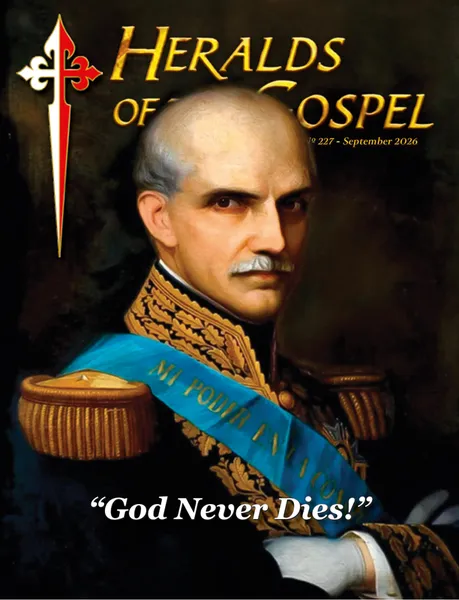
 Heralds of the Gospel Magazine, Vol. 20, nº 227, September 2026
 Heralds of the Gospel Magazine, Vol. 20, nº 226, August 2026
 Heralds of the Gospel Magazine, Vol. 20, nº 225, July 2026
 Who are the Heralds of the Gospel?
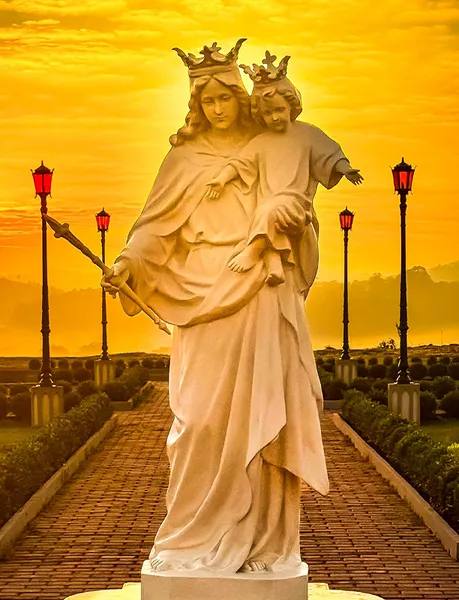 Help of Christians
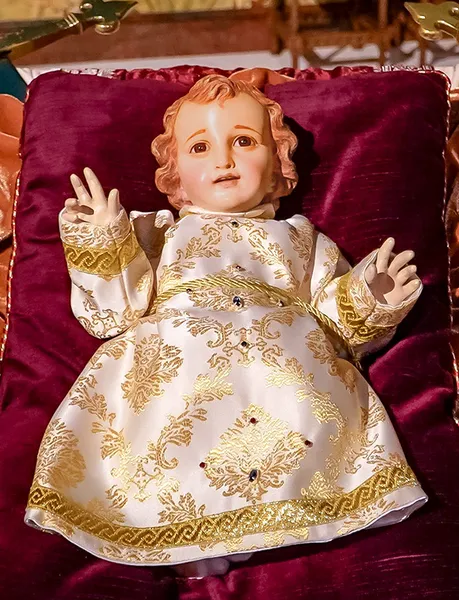 Christmas Carols






The fifteen hundred metres of wall have been scaled. The very heart of the fortress remains to be conquered. The prudent desist. Only two brave men dare to advance: Wisse and Gabriel.
Storm the heights! The Pichincha volcano, the last bastion of mystery in Ecuadorian geography, is about to be taken on this January 15, 1845.
But the crater does allow itself to be surmounted without resistance, and lets loose its volatile nature. Suddenly, a gigantic boulder hurtles towards young Gabriel. It is his last second of life!
* * *
It would be his last second of life… if a promise far grander than all the incandescent rocks hurled by that volcano did not rest on him.
On January 16, 1599, in fact, the Blessed Virgin Mary had prophesied, at the foot of that same Mount Pichincha:
“In the 19th century there will live a truly Christian president, a man of character, to whom God Our Lord will give the palm of martyrdom in the square where this convent of mine is located. He will consecrate the Republic to the Divine Heart of my Most Holy Son.”1
Gabriel was unaware of these words of the Virgin. However, on that day, the promise and the volcano contended. And the promise won! From then on, however, it would be up to the daring young man to fulfil, despite all menacing volcanoes, this promise, albeit unknown to him.
Youth erupts!
Gabriel García Moreno lived his vibrant twenty-third year in Quito, the capital of Ecuador.2 He was already teaching and practising law; he studied Physics and Mathematics, experimented with Chemistry, mapped out active volcanoes…
As can be seen, he possessed a multifaceted and prodigious intelligence. It was in favour of it, in fact, that he had left Guayaquil – the city where he was born on Christmas Eve of 1821 – to study at the country’s only institution of higher education, today the Central University of Ecuador.
It was then that he faced alone the inevitable volcanicity of young manhood. Far from his parents, living his youth with free time and intellectual prestige, he had everything to be swallowed by the lava of concupiscence. But this is not what happened. When the inevitable youthful passions arose to steal his heart, it had already been captivated by knowledge.
There were no vacations in his student schedule. He would wake up at three in the morning to peruse his books on law – the degree he was pursuing– as well as his books on Natural Sciences and Mathematics. Did he rest? Yes, by learning languages…
The volcano of his flourishing years had erupted, but upon the fields of knowledge, fertilizing them. The promise prevailed.
The young volcano
However, another, far riskier passion emerged in García Moreno’s spirit: politics. The year was 1843, and the student was participating in a conspiracy to overthrow the autocratic regime. It is rumoured that, dagger in hand, he even waited on a street corner in Quito at night for the head of state, Juan José Flores. This is not entirely improbable, given the character that inflamed him.
A volcanic temperament burned within him – tireless, magmatic, and productive – which perfectly fulfilled Mary’s promise of a “man of character”… The problem is that such a disposition caused worrisome effects, such as challenging a soldier to a duel, or publishing an extraordinarily aggressive newspaper on his own, of whose well-amied barbs several personalities of the Government – and the Church!– became the target.
Let us recall that this young man lacked any political or economic support, thus being at the mercy of prison or exile, if not the scaffold. But only until 1847, the year he married Rosa Ascásubi, from an influential and wealthy family of Quito. Everything was resolved. In a short time, he was responsible for important government positions.
He was safe from poverty. Not from politics, nor from his temperament, two constant volcanoes.
Defeated…
These explosive factors remained extremely active: in just over two years, seventeen revolutions broke out in the country, and in Quito, three new newspapers by García Moreno appeared, each more relentless than the last: El zurriago, El vengador, El diablo…3
Who was more active: restless Ecuador or the unsettling Ecuadorian? It is difficult to answer…, but the day came when politics defeated the politician: when he founded his fourth newspaper, in 1853, to challenge the authorities which – wrote Gabriel – used and abused the “right of oppression” and the “shameful privilege of embezzlement and theft.”4
The Government then forced him to cross the border. García Moreno was defeated. However, it would be in the land of his exile, Peru, that the war of his life would begin: the ascent of the inner volcano.
…he conquered himself!
At that time, was he Catholic? “I am Catholic,” he once stated, “and I pride myself for being so, although I cannot count myself among the devout.”5 A non-practising Catholic, to use the paradoxical term of our day. But Our Lady had prophesied that he would be “truly Christian,” and She would make her word prevail.
Extensive reading in scholastic philosophy and theology, combined with the enforced solitude of Paita, the small Peruvian town to which he had withdrawn, gradually opened up the horizons of the Faith to García Moreno. Perhaps spurred on by these luminous impulses, at the end of April 1855 he left for Europe, heading to Paris. His aim was to deepen his scientific knowledge. God, however, had other plans.
The South American leads a scandalous life in Paris! He studies for about twelve hours a day, scorns the refined Parisian balls, and preserves his marital fidelity intact, despite the distance. A rock of scandal, or, in other words, a steadfast Catholic… although “not counted among the devout.”
But one day everything changed.
Gabriel was debating about the efficacy of the Sacraments, fervently defending these wonders of grace. Suddenly, a colleague of his dismantles the defence:
“You speak very well, but it seems to me that you neglect the practice. How long has it been since your last Confession?”
“You answered me with a personal argument that may seem excellent to you today, but that will no longer be valid tomorrow.”
That same afternoon, Gabriel went to Confession. From that day forward, he will attend Mass every morning and pray the Rosary daily. He was “truly Christian.”
Upon defeat, he conquered himself.
March 10, 1861
Meanwhile, Ecuador continued with its political eruptions. In one of them, García Moreno was granted amnesty and returned to his homeland in December 1856. His prestige had grown during his absence, and he was promptly appointed mayor of Quito. A few months later, he assumed leadership responsibilities in the triumvirate – a provisional government formed by three members – after a serious crisis.
But a new uprising broke out, during which our protagonist had his powers usurped and was put behind bars. His personality, however, proved more solid than the bars:
“To whom did you swear allegiance?” – he asked the prison guard.
“To the Head of State.”
“I am the Head of State.”
The sentry saluted the prisoner, who, with a solemn bearing, escaped from the prison through the main door. The authority he had claimed would be ratified on a national scale less than two years later.
March 10, 1861. In Quito, the Convention elects Dr. Gabriel García Moreno as President of the Republic, by thirty-seven votes to one. At last, that enormous volcano, Ecuador, had been vanquished.
“Tyrant! Dictator!”
This is the moment for the greatest accomplishment of this Roman Catholic. But before we recall the progress he spearheaded, we must dispel certain calumnies that portray him as a tyrant and a dictator. Could they be justifiable?
Can a man be called an opportunist who impoverishes himself when he is in office, who does not appoint family members as ministers, who punishes the guilty even when they are his friends? Is a man a dictator who, elected and re-elected almost unanimously, tries to resign from the presidency and is impeded from doing so, whose Constitution is acclaimed by all the people? What an unprecedented “dictatorship”…
Tyrant: this is the title given to him for approving capital punishment at a time when it was included in the laws of all countries – the first nation to abolish the death penalty was Venezuela, in 1863. A tyrant who, only after repeatedly pardoning a general guilty of recurrent crimes of high treason, finally decrees his execution. A soldier is arrested and refuses to flee, despite the negligence of the guards, paid by García Moreno to let the traitor escape… The criminal is taken to the scaffold, but the president does not attend the execution. What was he doing? He was praying for the condemned man, as he had done all night – a truly original “tyrant,” it must be admitted… The Archbishop interrupts the president’s prayers to plead for clemency for the defendant. And he receives the reply of a man with a conscience that is both delicate and strong:
“If you assure me that I am guilty of venial sin by this death sentence, I pardon the condemned man, even if it compromises the peace of the Republic.”
The prelate had nothing to incriminate.
Developments in a Catholic nation
Leaving aside the slander, let us move on to the facts.
The years of García Moreno’s government were the setting for great developments in Ecuador. This land, in thirty-nine years, had generated no less than fifty revolutions. Stability was finally achieved and, with it, the annual revenue multiplied sevenfold, the railroad, the telegraph, seven hundred kilometres of roads, more than one hundred schools, nation-wide education… and so many other improvements that defy a biographer’s capacity for abridgment.
This magnificent work can be summarized by its crux. García Moreno sought above all to “reestablish the reign of morality, without which,” he explained, “order is nothing more than a truce or weariness, and outside of which freedom is deception and chimera.”6 How did accomplish this? By irrigating society with the spirit of the Church.
His Constitution, approved by the votes of more than 95% of the population, is iconic. In it we can read: “To be a citizen, one must be Catholic.”7 Given all that follows from this premise, what was the result? Quito’s main jail, with room for three hundred prisoners, had only fifty occupants, from the entire country.
With Ecuador thus prepared, the time had come for the prophecy to be fulfilled: “He will consecrate the Republic to the Divine Heart of my Most Holy Son.” On March 25, 1874, Ecuador was finally dedicated to the Sacred Heart of Jesus. Standing, after the carillon and cannon salvos, before the nation, García Moreno addressed the Eternal King: “This, Lord, is your people!”
These were the fruits of Gabriel’s fertile interior life. His efforts were generating the new Ecuador, because he himself was transformed.
The volcano produces vineyards
The new Gabriel of fifty years of age is no longer the former Gabriel of his youthful days. His temperament, always volatile, now obeys the dictates of reason. His humility makes him ask for corrections and avoid honours. And the people, admiringly, even witness their president visiting lepers, teaching Catechism to farmers, attending Mass every day and praying the Rosary at length.
His spiritual program, written on a piece of paper, is more than expressive: to always maintain the presence of God, to do the opposite of what his choleric temperament demands, to perform an examination of conscience three times a day, not to talk about himself, to master his senses of sight and taste. These are some of the resolutions carried out by the busiest man in Ecuador.
The Gabriel who climbed Pichincha before the age of twenty-five would only reach his own summit after half a century of life. Commenting on one of his photographs from his later years, Dr. Plinio Corrêa de Oliveira observes:
“Using his flaws like extinct volcanoes, on whose slopes vineyards grow – more or less like Vesuvius which, when well-managed, produces splendid vineyards – there is in him something of a superior and magnificent coherence, of a superior and magnificent rectitude, […] which makes him not look at anything or anyone in particular, but contemplate something that exists far above himself.”8
What did he glimpse far above himself? Perhaps a promise that whispered: “a president to whom God will give the palm of martyrdom in the square where this convent of mine stands” …9
The final victory
August 6, 1875, the first Friday of the month, the day of the Transfiguration of the Lord. The President of Ecuador is on a balcony of the Government Palace, above the square that extends from this building to the Royal Monastery of the Immaculate Conception, of the Conceptionist nuns, where there is a beautiful image of Our Lady of Good Success, who prophesied marvels in 1599.
He has just finished praying in the cathedral, where perhaps he repeated to God the plea he had addressed to the Pope: to die in defence of the Faith and the Church.
Suddenly, a cry:
“Tyrant!”
A machete blow strikes García Moreno on the back of the neck. He defends himself with his cane, but other young murderers appear, certainly instigated to the crime by higher authorities. The president, after being shot and stabbed, is thrown from the balcony to the square below.
One of the assassins rushes up to him and stabs his face repeatedly, while shouting:
“Die! Die!”
Between blows, García Moreno still manages to find the strength for a final cry of faith:
“God never dies!”
* * *
Over Gabriel, on that day, the Virgin’s promise clashed with the volcano of the infernal Serpent. And the promise triumphed!
Yes, it triumphed! It had taken the Pichincha, dominated Ecuador, mastered Gabriel. All that remained was to overcome God… And God is overcome only by the Cross!
While the people gathered relics of their beloved leader, the Mother of Good Success presented Gabriel García Moreno, her fulfilled promise, to the God who does not die, but triumphs in His martyrs.
Notes: