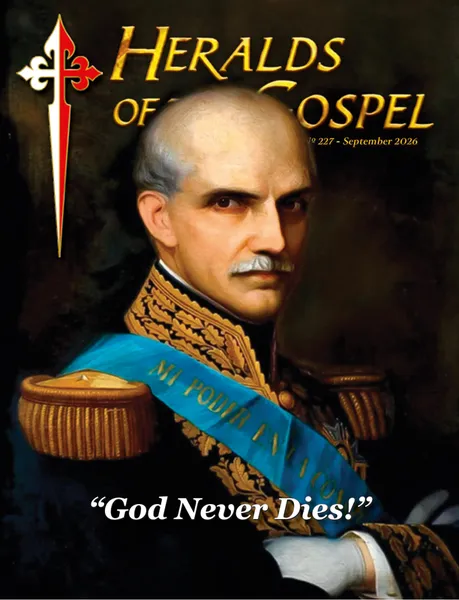
 Heralds of the Gospel Magazine, Vol. 20, nº 227, September 2026
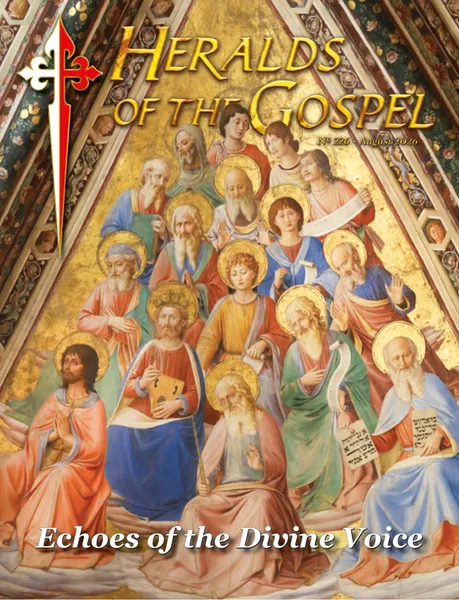 Heralds of the Gospel Magazine, Vol. 20, nº 226, August 2026
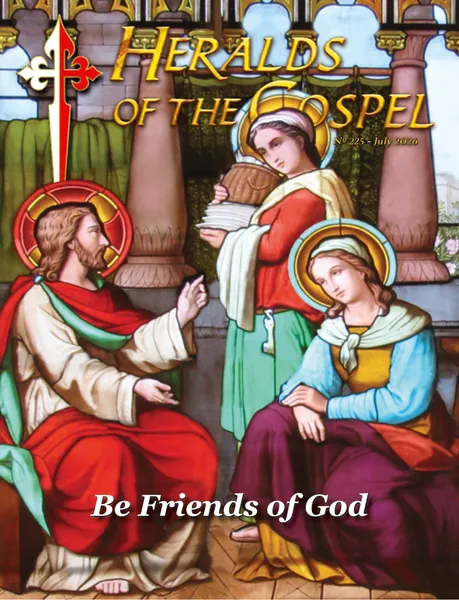 Heralds of the Gospel Magazine, Vol. 20, nº 225, July 2026
 Who are the Heralds of the Gospel?
 Help of Christians
 Christmas Carols








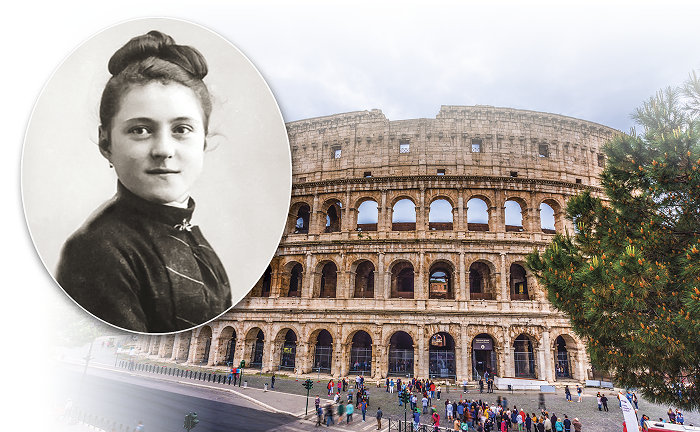
The year was 1887. Two young French girls were strolling through the city of Rome on a pleasant November morning, accompanied by their father. They were on a pilgrimage to the famous and emblematic Colosseum, which soon appeared before them, harmonious, imposing, serious, and at once light and monumental… a true silent witness, defeated, but persevering against the outrages of the centuries.1 At the sight of it, both trembled: they were before the place where so many martyrs had sacrificed their lives for Our Lord Jesus Christ!
They approached to kiss that ground sanctified with so much blood when they encountered a barrier that prevented them from entering… They then set about trying to discover a way to get in. Regarding that moment, the youngest sister, Thérèse Martin, later recounted: “Seeing a worker passing by with a ladder, I almost asked him for it. Luckily, I did not put my idea into practice, because I would have been taken for a fool!…”2
Shortly afterward, however, Thérèse found a spot where the rubble touched the fence, making it passable. She quickly called her sister, Celine, and the two fearlessly began to scale the sacred ruins.
“Father looked at us, astonished by our audacity, and immediately ordered us to return. But the two fugitives heard nothing more. Just as warriors feel their courage increase in the midst of danger, so our joy increased, in proportion to the effort we made to achieve the object of our desires. […] Soon after, […] having knelt on that sacred ground, our souls united in the same prayer… My heart was beating very strongly as my lips drew near the dust stained crimson by the blood of the early Christians. I asked for the grace to be a martyr for Jesus too, and I felt, deep within me, that my prayer was being heard!…”3
“This is the dream of my youth”
Anyone who has discovered the life of St. Thérèse of the Child Jesus and come to know of her doctrine of the Little Way will have witnessed the authenticity of this exclamation: “Martyrdom! This is the dream of my youth,”4 a dream that grew with her in the Carmelite cloister as one of the most salient features of her spirituality.
In fact, her entire existence exudes the precious fragrance of the holocaust that so many Christians suffered for the Faith at the dawn of Christianity. During her journey through this land of exile, for example, she often uttered sayings like these:
“As for me, what does it matter to live or to die! […] The joys of the earth are over! There can be nothing but heavenly joys for me. […] O Jesus! May I be [Your] happy victim! Consume Your little host in the fire of divine love! […] I want to be fascinated by Your divine gaze, I want to become a prey to Your love!”5
These fervent and authentic thoughts are as worthy of a martyr as were the paradigmatic words of the great St. Ignatius of Antioch:
“I am God’s wheat, and I shall be ground by the teeth of beasts, that I may be presented as pure wheat of Christ. […] I seek Him who died for us; I desire Him who rose again for us. […] My earthly desire has been crucified, and there is no longer in me fire to love matter. Within me there is a living water, which murmurs and says: ‘Come to the Father.’”6
Transcending the seventeen centuries that separated the lives of these two Saints, their aspirations reveal the same spirit, the same love.
On the other hand, however, attributing the title of martyr to St. Thérèse may seem like superficial flattery, imbued more with sentiment than reason. After all, simple words, however sincere and ardent they may be, do not constitute martyrdom. Above all, she never suffered any religious persecution until the day she closed her eyes to this life, peaceful in her bed as a tuberculosis patient, surrounded by her sisters in habit, behind the silent walls of a Carmelite convent…
This last argument would win if Theology did not teach that religious life is a true martyrdom, although not in a strict sense, but by a profound analogy. St. Thomas Aquinas comments,7 quoting St. Gregory the Great, that when someone gives to God everything they have and their whole life, through a vow, they offer Him a holocaust. By embracing the Carmelite vocation with exquisite perfection, St. Thérèse lived out this whole to the full and shone with the virtue of fortitude more than a warrior on the battlefield,8 or as much as St. Lawrence burning on the grill.
There is no greater proof of love…
The key to understanding this holocaust of the Saint of Lisieux is her unconditional love of God. She herself referred to her spiritual path as a martyrdom of love, and in fact she achieved “the exercise and the reward of a martyr,”9 not through the same torment as the martyrs, as St. Augustine teaches,10 but for the same cause: charity.
As an immediate fruit of this virtue, she demonstrated unwavering abnegation. “If any man would come after Me, let him deny himself and take up his cross and follow Me” (Mt 16:24), taught the Divine Master. And St. Thérèse made these words the rule of her conduct, the whip with which she herself lacerated her sinful nature to offer it as a sacrifice to God. In confirmation of this truth, multiple examples from her life could be narrated, of which we have gathered only a few.
As one of her novices recounts, in her free time or even at work, she always took care to kindly attend to anyone who interrupted her, even when they abused her good will or demanded that she perform some service to which she was not obligated. For her, this was the most natural attitude, and she went out of her way to please everyone.
Regarding a fellow nun who, according to the Saint herself, had the gift of displeasing her in everything, and who caused her many violent inner struggles, she behaved with the greatest possible kindness. She always sought her company and used to smile at her with such affection that the nun came to believe herself especially loved. “Since we met,” she once said naively, “we have experienced an irresistible mutual attraction.”11 The community itself believed there was a tender friendship between the two, so great that it even provoked a certain envy in Marie, St. Thérèse’s blood sister…
Another charming example given by the Carmelite saint was her conduct with one of her novices, of tenacious nature and modest intelligence. Sister Martha of Jesus, as she was called, later declared:
“[The Servant of God] was to me of a kindness and charity that can only be revealed in Heaven […]. Indeed, I made her suffer a lot because of my difficult character; but I can affirm, with all sincerity, that she always maintained the same sweetness, the same equality of [treatment]. […] She never rejected me despite the frequency of my visits; she never showed the slightest annoyance at receiving me.”12
Sister Martha used to become annoyed with her and, on one occasion, even said things to her that certainly caused her great grief. St. Thérèse showed no displeasure and responded calmly and kindly, then inviting her to accompany her on a task. Annoyed, the novice then wanted to test the Saint’s patience and no longer responded to what she said. Finally, however, she could not help but surrender to her kindness and ask her forgiveness for her bad behaviour.
Because she had behaved like a mother in dealing with the numerous whims, extravagances, and brutalities of this nun, St. Thérèse earned her immense esteem and ended up winning her over to God, making her a good nun. “I never tired of seeing how charitably she treated me,” Sister Martha recounts; “[I would not] know how to express the great self-denial she instilled in my soul.”13
Fidelity to the Rule
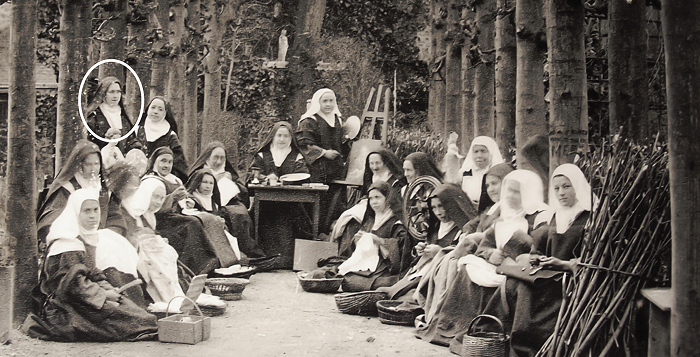
If in relation to her fellow nuns St. Thérèse proved the authenticity of her love for God (cf. 1 Jn 4:20-21), through her observance of the Carmelite rule she manifested the radical nature of that love and her audacity.
Of delicate health, she suffered constant and severe stomach ailments from the time she entered religious life. However, she never asked for exemption from common exercises and arduous work. She made it her rule to endure until exhaustion before complaining to her superior. “[If] I can still walk,” she would say, “I must continue to do my duty.”14
It is not difficult to imagine how much such ailments cost her amidst the long hours of chanting the Office, the austere diet, the short nights of sleep so often spent awake because of the cold, to which she was very sensitive… Who could calculate the value of these obscure sacrifices endured over the years? And she persevered in this purpose even after the onset of tuberculosis, the illness that led to her death…
“We must not allow ourselves a comfortable life. Since we intend to be martyrs, we must use the instruments we have for this,”15 she taught. The arduous part of this martyrdom lies in the fact that the religious must voluntarily and lovingly apply to themselves the instruments of torture, without the action of merciless executioners, and this when human nature values its own flesh too much to abhor it, and loves its life too much to lose it entirely in the service of God.16
St. Thérèse ended her days without having uttered useless words, without wasting a minute, without consenting to a single lack of charity or a single impulse of ill humour, without the slightest infidelity to the rule.
In a word, she did not let any small sacrifice escape her; and these nothings, as she considered them, are what ground her and transformed her into pure wheat of God.17
“It is only the total immolation of oneself that deserves the name of love”:18 this is the essence of martyrdom and the definition of life of the Saint of Lisieux. How many martyrs, willingly subjected to the cruelty of their executioners, would hesitate to surrender to this continuous death, at every moment. They would perhaps tire of this holocaust “by pinpricks”19 and apostatize… for it is easier to embrace death in an instant for faith in Christ than to surrender to Him day by day, part by part, the most precious gift of life.20
The perfection of all sacrifices
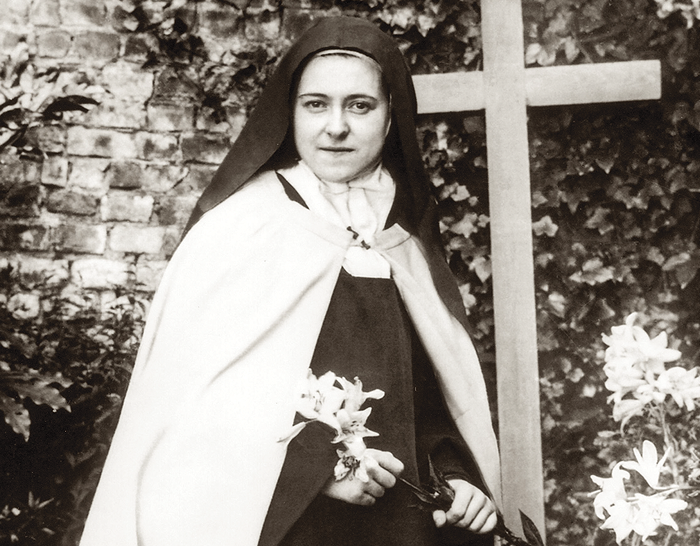
The human physiognomy is a reflection of the soul. Let us conclude, then, these considerations by contemplating for a few moments a photograph of St. Thérèse. Among the many that would lend themselves to our analysis, let us observe this one, in which she appears kneeling, holding white lilies in front of a cross.
According to Dr. Plinio Corrêa de Oliveira, the physiognomy appears indescribably sorrowful, yet smiling; she does not seek to hide her own pain, “but to stand firm through a prodigy of virtue, of fidelity to grace, despite the pain. Her lips smile only because her will wants them to smile,”21 in an attitude of profound faith.
Her luminous gaze radiates peace, only allowing a glimpse, behind it, of one of those oceans of sacrifice so great that only a Catholic and generous soul can contain them.
Contemplating her angelic demeanour, few words of praise come to our lips seeming more suitable to describe her than that of a martyr of the religious life. Let us, then, seek to admire her; but not with those fleeting and fruitless fascinations typical of today’s mindset, but rather with a Catholic spirit, which leads us to imitate the virtues we love.
And to obtain good success in this imitation, let us implore: O St. Thérèse of the Child Jesus, teach us to find in the love of our little crosses the perfection of all the sacrifices of our soul!
Notes: