 Heralds of the Gospel Magazine, Vol. 20, nº 227, September 2026
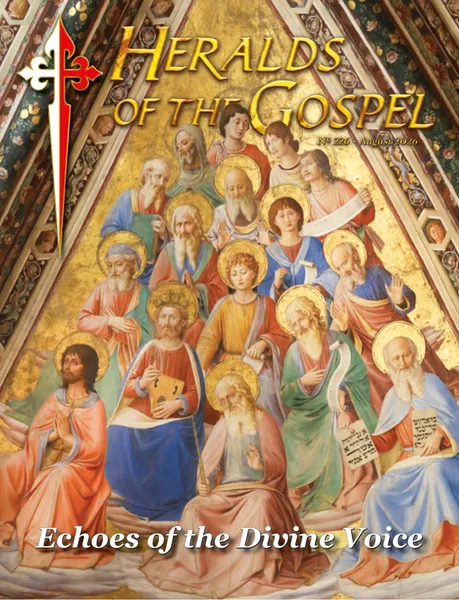 Heralds of the Gospel Magazine, Vol. 20, nº 226, August 2026
 Heralds of the Gospel Magazine, Vol. 20, nº 225, July 2026
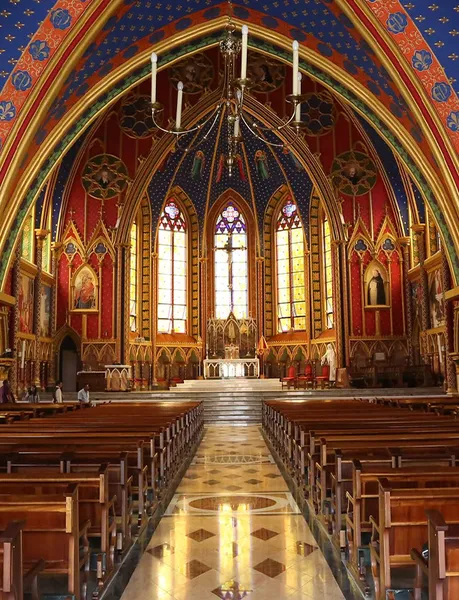 Who are the Heralds of the Gospel?
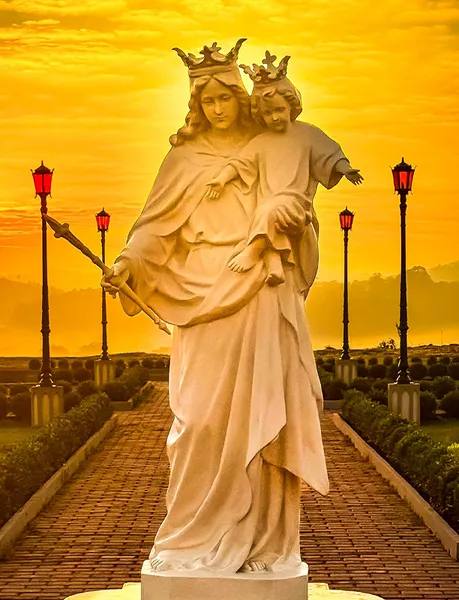 Help of Christians
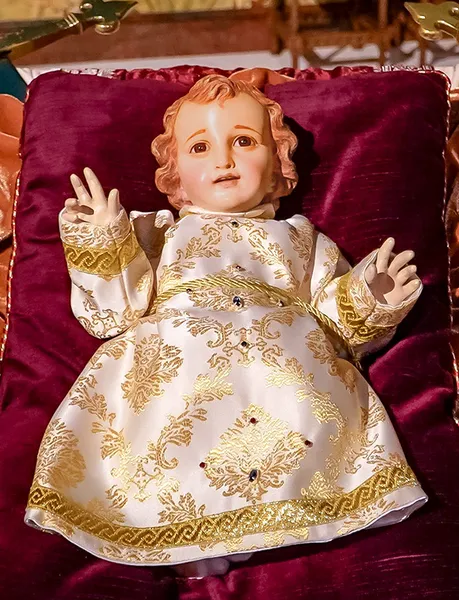 Christmas Carols







“The man called his wife’s name Eve, because she was the mother of all living” (Gn 3:20). “No longer shall your name be Abram, but your name shall be Abraham; for I have made you the father of a multitude of nations” (Gn 17:5). “So you are Simon the son of John? You shall be called Cephas (which means Peter)” (Jn 1:42).
Accustomed to considering people’s names, even our own, merely as a social convention, we may not perceive the full depth of these biblical passages. Why did the Almighty clothe with such solemnity so simple and commonplace a matter as the choice of a name?
The Hebrew people of the Old Testament did not think as we do; they “considered the name of a person to bear a transcendent meaning, especially if it were inspired by God,”1 as Msgr. João explains. Thus, when the Creator named someone, He showed that this person had been invested with a heavenly mission.
A name given by God
If the Bible presents so many providential men and women whose very name carries a supernatural purpose, it would be impossible to imagine that the Eternal Father would devote less attention to the choice of the name of His predilect one.
The Scriptures mention nothing about Our Lady’s childhood, nor the choice of her name. However, according to pious private revelations, even before the Blessed Virgin Mary was miraculously conceived, the Archangel Gabriel “communicated to Joachim in dreams that his wife had received a celestial visit, revealing to her that she would conceive a Daughter. And he told Joachim that the child should be named Mary.”2
Mary! What a universe of symbolism is hidden under this name! Dr. Plinio Corrêa de Oliveira rightly stated: “The Most Holy Name of Our Lady, like the Most Holy Name of Jesus, must be considered as a name symbolic of her sublime virtue, of her mission, of who She truly is.”3
But what aspects of the Queen of Angels’ immeasurable mission can be glimpsed through her Holy Name?
Yahweh’s Beloved
The first Mary to appear in the Holy Scriptures is the sister of Moses and Aaron (cf. Ex 15:20), probably the same one who instigated Pharaoh’s daughter to save the prophet from the waters (cf. Ex 2:4-10).
This led scholars to search the Egyptian language for the etymology of the name. One possibility is that it comes from Myr-yayam, that is, “Yahweh’s Beloved”.4 How appropriate this interpretation is when applied to the Virgin: She who was the object of divine love from all eternity bears in her very name the mark of her predestination! Moreover, the fact that this name is related to the sister of Moses – who collaborated in the liberation of the chosen people – may allude to the traditional role attributed to Mary Most Holy in the Redemption of humankind wrought by her Divine Son.
Nevertheless, however beautiful these interpretations may be, philologists and exegetes were not content with them. Perhaps impelled by the breath of grace, they continued their investigations.
Replete with gifts
After considering the Virgin as the receptacle of the Creator’s infinite love, Mariology contemplated her replete with gifts and graces, corollaries of celestial benevolence. Hence the hypothesis that the name Mary comes from mārā’, a term that can be understood as beautiful.5 Here we find Our Lady as the tota pulchra, the all-beautiful in the eyes of the Most High (cf. Sg 4:7).
Enriched with favours, She was elevated above all creation, rising “like the dawn, fair as the moon, bright as the sun” (Sg 6:10). For this reason, Mary can also mean “the exalted one.”6 Thus, just as She is the beloved and the beautiful in the sight of God, so too, in relation to the rest of creation, She appears so exalted that She has rightfully become the sovereign – hence Lady is the Syriac interpretation of that Holy Name.7
Light in the darkness of the world
The fullness of grace makes the Virgin’s soul radiant, a true source of light. As St. Thomas Aquinas affirms, “She is rightly called Mary, which means ‘enlightened in herself,’ whence applies to Mary what Isaiah said: ‘The Lord will fill your soul with splendour’ (Is 58:11).”8 Now, as with celestial bodies, so much light needs to be diffused; therefore, her name “also means ‘illuminator of others,’ in relation to the whole world; therefore, Mary is compared to the Sun and the Moon.”9
Mary is, therefore, like a celestial body illuminating us in the darkness of this world. Hence the interpretation, very widespread in the Middle Ages – although philologically imprecise – of Mary meaning star of the sea: She who guides us amidst the tribulations of the mare magnum in which we live.
In this regard, it is fitting to quote the celebrated excerpt from the Abbot of Clairvaux:
“She is that noble star born of Jacob, whose rays illuminate the whole earth, whose brightness both shines forth in the heavens and penetrates the depths. […] O you, whoever you may be, who feel far from land, tossed about by the waves of this world in the midst of storms and tempests rather than walking upon the solid ground, keep your eyes fixed on the glow of this star if you would not be overwhelmed by the floods.”10
A drop of divinity
We mentioned that the translation star of the sea is not entirely correct from a linguistic point of view. In fact, it comes from a slip, perhaps due to a copyist’s error, in the interpretation of St. Jerome: from stilla maris – drop of the sea – came stella maris – star of the sea.11
Although the mistake was, in a way, providential, we cannot fail to contemplate Mary as a “drop” of the sea of divinity.
If a “drop of grace” is worth more than the entire work of creation – as Msgr. João liked to paraphrase St. Thomas12 – how much more valuable is this divine “drop” that is Mary? To such an extent is She full of God that the Archangel Gabriel, at the Annunciation, replaces her name with the title “Full of Grace” – kecharitomene – (Lk 1:28), revealing that this designation identifies her from eternity and that from her holiness come all the graces we receive.
A battle cry
If the name Mary signifies beauty and predilection before the Lord, as well as light and grace for her children, what will it represent to the enemies of God?
The answer this time does not lie in philology, but in history. Indeed, Pope Innocent XI instituted the celebration of the Most Holy Name of Mary on the occasion of the victory at the Battle of Vienna, on September 12, 1683. This miraculous triumph, which saved Christendom from the Mohammedan invasion, was attributed to the invocation of the name of Mary, to whom the unfolding of the battle was consecrated. There, near the Vienna Woods – Wienerwald –, for Christians the name of Mary proved strong and encouraging, and for the infidels, “terrible as an army set in array” (Sg 6:3).
This reminds us of the words of St. Bernard: “If the winds of temptations surge, if you run aground on the shoals of troubles, look to this star, call upon Mary!”13 In whatever difficulty we find ourselves – especially when confronted with the snares of the devil, the attractions of the world, and the tyranny of the flesh – let us always remember that the Most Holy Name of Mary is for us a battle cry and a sure pledge of victory.
A name laden with blessings
Mary! A most holy name, perfectly suited to the unique mission of the Mother of God. It reveals to us that Our Lady has been loved from all eternity, showered with the most distinguished graces and elevated above the Seraphim; Queen and sovereign, She exercises her rule with mercy and, illuminating the sinners who walk in this vale of tears, guides their steps like a celestial light, until, protected from the attacks of the enemy, they reach the ocean of divinity.
If this name is so laden with blessings and its invocation so powerful, how can we not place all our hope in it? Whoever invokes Mary obtains from God everything they need. And, if anyone still hesitates, let them put it to the test. For this person, St. Bernard’s assurance is fitting: “Thus you will see, by your own experience, how rightly it was said: ‘And the Virgin’s name was Mary.’”14
Notes: