 Heralds of the Gospel Magazine, Vol. 20, nº 227, September 2026
 Heralds of the Gospel Magazine, Vol. 20, nº 226, August 2026
 Heralds of the Gospel Magazine, Vol. 20, nº 225, July 2026
 Who are the Heralds of the Gospel?
 Help of Christians
 Christmas Carols
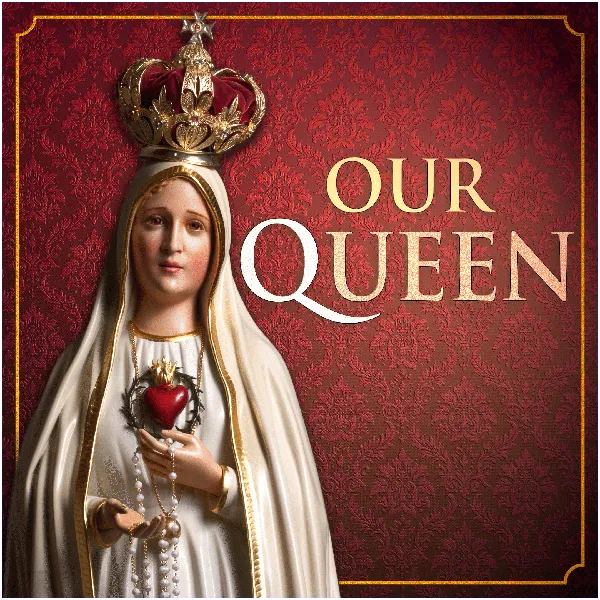








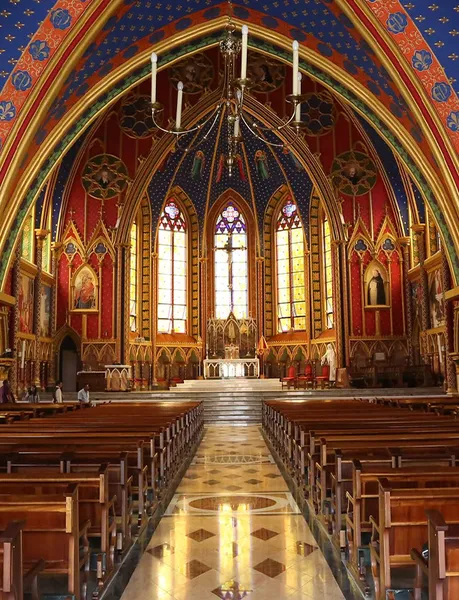
The church1 has the classic cruciform layout. In the right-hand transept of the church – that is, to the left as you enter – above the altar in the side aisle, there is an image of the Immaculate Conception. Needless to say, I went straight over to visit her.
It is a fine statue, of reasonable quality and worthy of a place in that church, though of a rather ordinary beauty. I knew this, but I felt great joy at being there, close to her, and when I prayed I had the impression that Our Lady was answering my plea and conveying my request to God Our Lord.
At the same time, I also sensed something of her purity, and something by which She is immensely superior to every possible and imaginable degree and form of holiness. My soul was lifted to a higher order of realities which I was unable to articulate.
A young Roman martyr
A little further on, near the altar of Our Lady of the Immaculate Conception, there is a very parochial and provincial imitation of what would be a Roman sarcophagus. It is a kind of well-made little tomb, of good white marble – I believe from Carrara –, all polished, with a large transparent glass cover with bevelling, where a wax figure lies, complete with hair, representing St. Donata, a Roman girl of twelve or thirteen years old, who died a martyr.
Inside this figure are placed the relics – I suppose they are the bones – of St. Donata herself. Displaying bones could horrify human sensibilities, of which the Holy Church is not an enemy, but, on the contrary, a friend. The result: a graceful wax sculpture was made to cover them.
When I was little – therefore before the events I am narrating – I once approached that figure, very curious, and someone gave me a brief explanation, as normally given to children: “That is St. Donata.”
However, being so young, I initially couldn’t quite distinguish whether she was alive or dead… And, if she was dead, I wondered how long she had been. But I felt a certain shyness to ask. So, I kept looking to see if St. Donata was breathing, full of suspicions and uncertainties in view of the situation. On the other hand, although I knew what the word martyr meant, I didn’t have that concept as firmly ingrained in my mind as the idea of holiness, and I thought: “She is a saint! Oh! That is so wonderful!”
Even later, during the time when I started attending the Church of St. Cecilia more often, I was not sure if that figure was the little Saint herself, her incorrupt body, or if it was an image containing her relics. There was a plaque written in Latin, which I tried to read and partly understood, but not entirely. Even so, I had the idea that it was not exactly her body.
She is dressed in a beautiful Roman garment or, at least, as someone from early 20th-century São Paulo might imagine – without archaeological concerns – as the clothing of an ancient Roman demoiselle,2 still very young. A tunic down to her feet, made of common silk, but very well-arranged, all adorned with embroidery that seemed to me to be gold and some pretty stones sewn on it – which I only much later realized were only glass beads – giving me the idea of a noble and wealthy girl, whose parents buried her wearing these jewels.
Ornaments that shone like a mystical book
I looked very attentively at the embroidery, the beads, the silk, and the Carrara marble, with the idea that they were telling me something and explaining to me who the martyr St. Donata was. Those stones applied to the little dress gave me the impression that they shone with something of her holiness and the very holiness of the early Church.
It was, therefore, as if each ornament were a word in a sentence, which, in turn, would be a set of ornaments and would represent the definition of St. Donata.
On the dress there is a sash that covers part of it, and which displays, at the centre of the design, a sort of lily of cut glass, imitating a large topaz or some other semi-precious stone. It is in fact similar to an authentic topaz, therefore of a very beautiful light golden-yellow.
I looked with special attention at that coloured stone, for it seemed to me the focal point of the ornaments and, therefore, the most intelligible and availing part of the garment. Not that I analysed it with the eyes of a greedy jeweller, for the value of the stone. That never even crossed my mind! It was the colour that produced a certain effect on my soul.
Generally, at the time I used to go there to pray, the light entered through the stained glass windows and illuminated the sarcophagus of St. Donata, reflecting on the bevelled glass. And more than once it coincided that the sun’s rays struck that pseudo-topaz. I saw the light wander on the jewel and shine with beautiful reflections in that warm colour. That caused me an intense impression and a religious emotion, leading me to have greater admiration and respect for St. Donata, for the special luminosity of that glass ornament was like the expression of the martyr’s heroism. I understood that it symbolized her virtues in a magnificent way! In my mind, the colour of the topaz also had some kind of connection with the glory of her soul and led me to understand the kind of happiness the martyr was enjoying. It was as if her Heaven was lived within a topaz.
It was a mystical touch, a work of grace, which used ponderable material realities – a piece of glass or a stone – to make me intuit, through their symbolic value, through the discernment of spirits, something imponderable and sublime that simple reasoning would not make me understand: what is grace like in a person who has a moral analogy with topaz?
At the same time, it kindled in me love and devotion to these imponderables in the spirit of a little saint and, in that sense, her body, for me, was like a mystical book!
However, my emotion was not so much caused by St. Donata herself. It was, above all, an idea of virtue and righteousness that touched me deeply, and even if she did not actually possess the characteristics I saw, God wanted me to understand how much holiness encompasses all of that.
Thus, my respect for holiness as such increased, in contemplation of that stone.
St. Expeditus and the dignity of the Roman Empire
In front of the relic of St. Donata, there is a very common image of St. Expeditus, depicted with a cross in his hand and dressed as a Roman legionary. The idea of a Catholic warrior enthused me, and armour always held a true fascination for me. So, I looked at that figure with extraordinary interest.
These images of St. Donata and St. Expeditus presented me with a certain notion of the dignity of the Roman Empire, with much colour.
The following thought came to mind: “How well dressed they are!” And I reasoned somewhat childishly:
“Naturally! They had to appear before the Emperor to be judged, and even as defendants, out of respect they had to present themselves like this. They are in a kind of court attire, with which they were martyred.”
In fact, the word Roman seemed to me one of the most beautiful titles there could be. It was like a kind of predestined word, containing all the sounds…
The life of St. Cecilia
I also used to pay close attention to a series of paintings around the main altar, works by the painter Benedito Calixto, which focus on the main episodes of the life of St. Cecilia, patron saint of that church.
One of the scenes, for example, is the conversion of Valerian, whose story is as follows:
St. Cecilia’s parents forced her to marry this man, but she converted her husband. They both resolved to maintain perfect chastity after marriage, and so she preserved her virginity.
The painting then depicts a room where St. Cecilia and Valerian – who was also a martyr – are kneeling, praying or conversing, after their marriage. A radiant Angel appears, carrying in each hand a crown of white lilies for them both, symbolizing their resolution.
The scene is partially veiled by a curtain, and hidden behind it, there is a man watching. It was Tiburtius, the husband’s brother, who noticed something extraordinary happening in the place where the newlyweds were, and he wanted to see what it was.
He went on tiptoe, without them noticing, pulled back the curtain revealing the scene, at the exact moment when the Angel was descending with the crowns, radiating beams of light. Then, the two gaze at the apparition with an ecstatic air, while Tiburtius is frozen in a stance of astonishment, like someone who is very shocked…
Seeing that grandiose representation and guided by the discernment of spirits, I had an idea of the different “layers” of graces they received, and of what grace was proper to each one. The couple was much higher and the other was just beginning. That enchanted me!
I learned that St. Cecilia later converted her brother-in-law Tiburtius, who was also a martyr. Thus, all three followed the path of martyrdom.
Scenes of the martyrdom
In another scene, St. Cecilia is seen making a proclamation of Faith that is also an invective against idols, and refusing to worship them. I had the impression that she was already before the executioners, but then, looking closer, I realized it was a tribunal.
I also looked at the representation of the martyrdom, in which she appears beheaded and prostrate, with blood gushing from her neck. It seemed to me that it was a common decapitation, but, some time later, reading a life of St. Cecilia, I verified something that gave me a horrible chill: this decapitation was poorly done, because the executioner did not sever the entire neck, and her head remained partially attached to the torso, therefore, in the most atrocious circumstances. Still alive, she was in this situation for three days and, no longer able to speak to express her belief in the Holy Trinity, she responded to the executioners by showing three extended fingers. And so the virgin remained until her death, defying her very executioners.
The graces of the early Church
The next scene shows a Mass in the catacombs, and light can be seen filtering in.
These paintings by Benedito Calixto representing the life of St. Cecilia, although very common and even imperfect in terms of perspective, are pleasant and have a kind of provincial innocence, as well as a certain characteristic, not from an artistic point of view, but a social one: they reveal the consensus that existed, at the end of the last century, about the environment of the early Church.
In fact, they express in a dignified – although not entirely accurate – way the graces of the early Church.
Taken, with adaptations, from: Notas autobiográficas [Autobiographical Notes]. São Paulo: Retornarei, 2014, v.IV, p.33-53
Notes: