 Heralds of the Gospel Magazine, Vol. 20, nº 227, September 2026
 Heralds of the Gospel Magazine, Vol. 20, nº 226, August 2026
 Heralds of the Gospel Magazine, Vol. 20, nº 225, July 2026
 Who are the Heralds of the Gospel?
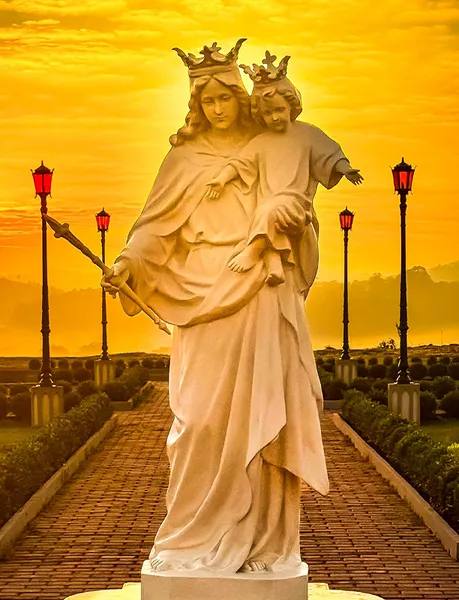 Help of Christians
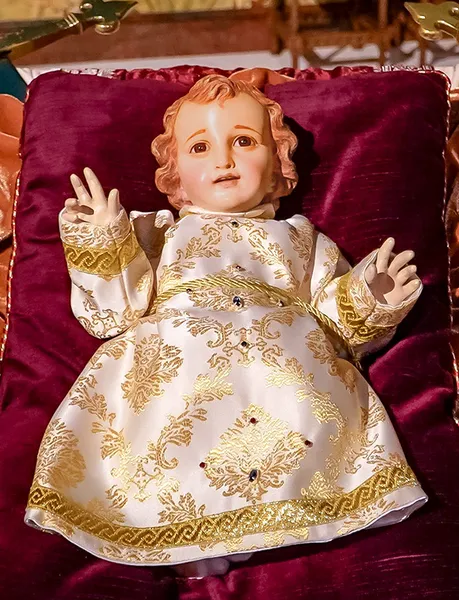 Christmas Carols






We know that in the Old Testament, the way to make amends for offenses against God consisted of offering a victim, immolating it with the shedding of blood, a symbol of life. This sacrifice appeased divine wrath and resulted in the reparation of the acquired stain (cf. Lev 5:15-26).
In the Holy Scriptures, we find many figures in this regard, from Genesis, in the episode where Abraham, upon untying Isaac and removing him from the altar, sees a lamb caught by its horns in a bush and sacrifices it in place of his son (cf. Gn 22:3-13), to the glorification of the slain Lamb narrated in Revelation (cf. Rev 5:9-14).
However, in the Book of Leviticus (cf. Lev 16, 10, 20-22) there is a description of another ceremony that the Law imposed on the Jews, from the time of Moses, and which had to be repeated every year on the Day of Atonement. The assembly would gather and present a bound goat. The high priest would approach and, placing his hands on the animal’s head, confess all the sins committed by the people of Israel during the entire year. The goat would then be led to a secluded place in the desert, where it was released and left free as a cursed creature, laden with ignominy.
Our Lord, the Victim par excellence
We should keep in mind that all the customs and rites of the Old Law were in some way prefigurative of the great and unique Sacrifice of Our Lord Jesus Christ (cf. Heb 9:8-12).
The scene of the expiatory goat also suggests a highly expressive idea to the mind, through metaphors: the God of all purity, without any guilt, presents Himself no longer as the purest white Paschal Lamb, clean, fragrant and adorned with ribbons, sacrificed to save our lives, but under the horrendous image of an ugly, dirty and smelly animal, with the characteristics of the infamy of sin, overwhelmed by the curses hurled upon it.
Much more than Atlas of Greek mythology, supporting the celestial vault on his shoulders, Jesus shows Himself to us, His shoulders oppressed under the sad, heavy, and repugnant burden of so many crimes, accumulated not only by the Jewish people, but by humanity of all times and places… Without uttering a single complaint, the Redeemer submitted Himself to all the torments imposed upon Him by His adversaries, who hated Him.
Far be it from us, however, to be astonished by this aspect of Our Lord, thinking it to be an exaggeration, for all this is still inferior to reality: there are no words to express the infinite gravity of every mortal sin, because it constitutes a formal disobedience to the Eternal Being. Thus, once sin entered the world, we needed a victim whose merits were also infinite, “For it is impossible that the blood of bulls and goats should take away sins” (Heb 10:4). How could this reparation de made?
It was necessary that the Son of God, the Second Person of the Holy Trinity, taking on our flesh and uniting divine and human nature, assume upon Himself the miseries of humanity and shed His own Blood to repair the offense committed against the Father, reintroduce supernatural life into us, and open the gates of Paradise for us.
Offering at the Incarnation and Presentation in the Temple
From the first instant when the shadow of the Holy Spirit enveloped Mary and the Soul was infused into the embryo being formed in her blessed and maternal womb, Jesus already possessed the highest and most elevated understanding of the entire past, present, and future, for His Soul was created in the beatific vision. And, seeing God face to face, He knew His mission as Victim and accepted it in the freedom of His human will, in a lucid and conscious holocaust.
The Saviour renewed this act countless times throughout His life, but the culminating moment occurred in the mystery of the Presentation. When His parents prepared Him to take Him to the Temple, and He entered there in Our Lady’s arms, His tiny heart, that of a forty-day-old baby, may have palpitated faster, because it burned with emotion and the desire to give Himself.
Indeed, since the exodus of the Jews from Egypt, the Law required that firstborn males be presented to the priest as an offering to God, who had a right of ownership over them, having saved them from the exterminating plague that killed the Egyptians (cf. Ex 13:2, 14-15). Therefore, from the hands of His Mother the Child passed to those of aged Simeon who, by revelation of the Holy Spirit in the depths of his soul, waited to see the Messiah.
There, in the Temple of Jerusalem, two priests met: Simeon and Jesus; not only did the venerable elder, as a minister of the Old Covenant, officially offer Him, but the Child Jesus also consecrated Himself as an expiatory Victim to the Father.
Now, if He already belonged to God the Father, why did He wish to submit Himself to this ceremony? Because He desired, from His earliest age, to seal the Redemption of humankind and the defeat of evil.
Our Lady understood perfectly what was happening and She also offered Him, knowing that on that occasion it was possible to redeem her only Son for five shekels of silver (cf. Ex 13:13; Num 8:17; 18:15-16) and receive Him back, but that the moment would come when She herself would consent to deliver Him on Calvary.
This was a magnificent and moving scene, witnessed by all those who were present, who heard Simeon’s words and realized that something completely unusual was transpiring.
Of what does the vocation of an expiatory victim consist?
The example of Our Lord Jesus Christ, Archetype of expiation in favour of souls, opens the way for us, inviting us to also expiate with Him. This is a duty about which we rarely meditate and often forget: that of voluntary penance for our own sins and those of our brothers and sisters throughout the world, mingling, in some way, a drop of our blood in the chalice of the Redeemer.
How many souls have been purified through penance, like David, the king-prophet, St. Peter, St. Mary Magdalene and St. Augustine! Others, innocent and ardent, like St. Thérèse of the Child Jesus, immolated themselves with a view to praising God and dedicating themselves entirely to Our Lady!
The expiatory victim par excellence is one who, faced with a need pertaining to God’s cause and the benefit of souls, consciously and voluntarily gives up one’s own life to produce that desired effect. This is a very specific and sublime vocation, which Providence makes clearly felt in the depths of the soul. Not everyone is called to follow this path; it is up to one to discern whether the inspiration comes from grace or not, and to seek the guidance of a superior.
However, according to Theology,1 for a person to be considered an expiatory victim, it is not necessary for the offering to be explicit and formal; it is enough to state it in a generic way, conforming to God’s will and leaving it in His hands to do with them whatever He wants: to take their life, to have them become bedridden, paralyzed, blind, mute, deaf…
But, in general – as theologians also say – all those who make a genuine and valid offering, and are accepted by Providence, do not associate the torments they endure with the offering they have made, and even forget all about it! Then they suffer with doubt and, in the honesty of their conscience, believe they deserve this “punishment” because of the faults committed in their past life.2
Providence allows this because, if the person had a clear understanding here on earth that their offering had been accepted, everything would become easy, the trial would cease, and such relief would greatly diminish their merits, possibly even constituting a temptation to vanity. Only when they see God face to face in Heaven will everything become clear!
We all have something to offer
Someone might ask: since this calling is a special and unequivocal invitation, and nothing indicates that grace has touched the depths of my soul in this direction, should I then cross my arms, thinking that I have nothing to offer? Is it perhaps a matter of putting on a hair shirt and flagellating myself with disciplines? Or, if I have already renounced material possessions, my career, and even the possibility of organizing my own time through a vow of obedience, what more can I give?
Let us not deceive ourselves! However excellent a man may be, while he lives on this earth, he always has something to improve, for according to St. Thomas Aquinas,3 only the humanity of Our Lord Jesus Christ, Our Lady, and the beatific vision could not have been made better than they are.
Let us take the historical example of the Apostles: when they met Our Lord, they left behind their family, their boats, nets, and their entire lives, and followed Him. Wherever He slept, they also camped; They lived on alms from the public, they no longer possessed any goods, they had given absolutely everything.
Did they have nothing left to give?…
The Gospels recount that, as Our Lord went up to Jerusalem for the last time, He categorically announced to them that He would be arrested, judged, condemned, and killed there, but on the third day He would rise again (cf. Mt 20:17-19). It was after this conversation that the mother of James and John, relatives of Jesus, prostrated herself before Him, asking that her sons sit one at His right and the other at His left in the Kingdom that He was about to establish (cf. Mt 20:20-21). The scene was such that the other Apostles began to argue among themselves which of them deserved such a prestigious place…
Therefore, they had given up everything that was easy. But did they understand that the Kingdom of the Messiah was not of this world? Did Peter, who had proclaimed the divinity of the Master (cf. Mt 16:16), grasp this?
The Apostles had mindsets, principles, ways of analysing things and understanding Our Lord from which they did not want to detach themselves, because they would cease to participate in the delightful worldview in vogue in Hebrew society at that time.
And what about us? Do we also have a vision of the universe that is not according to Our Lord Jesus Christ? How much indecision, how much temporization, how much liberalism and lack of absolute surrender! Why? Because we like to keep our own criteria.
We need to know how to offer expiatory acts, even simple and common ones, and place our contribution on the altar of holocaust, because this struggle lasts a lifetime and always presents new aspects. Each one has to discover the points to be corrected, and it is certain that Providence, through our Guardian Angel, will inspire us with the appropriate sacrifice to achieve it.
For one, for example, it will be a curiosity that until then was irrepressible. For another, a feeling of honour so ingrained in their interior that they revolt when unjustly accused. For yet another, the struggle against self-love, vanity, and pride, the difficulty of placing one’s own failure in the hands of Our Lady…
If God is delighted with the offering that comes from an innocent soul and receives it, so it is with us: “a contrite and humbled heart” (Ps 50:19) moves the Heavens and is like the rain watering this earth, so that from the planted seeds may sprout gigantic trees, which will develop over the centuries and millennia, producing extraordinary effects and reaching the fullness of their fruits.
Therefore, the most sacred hour of our existence occurs when trial and temptation assail us, because we approach Our Lord Jesus Christ in the Garden of Olives. As long as we suffer in union with Him, walking towards suffering as true “strong men”4 – as to St. Teresa recommended to her nuns – then we will become sacral.
And, if it is true that Catholics are called to guide the heart of Public Opinion through example and customs, we must understand that without martyrdom nothing is done, nothing is moved, nothing is achieved.
The core of social transformation and the foundation of a new civilization called the Reign of Mary has its root in the holocaust of the expiatory victims. “My Immaculate Heart will triumph!” – who does not realize that this triumph has already begun to be established on the face of the earth? Only one who is either blind and deaf, or does not know how to interpret the future by looking at the present…
Excerpts from oral expositions given between 1992 and 2010
Notes: