 October 2026, No. 228
 September 2026, No. 227
 August 2026, No. 226
 Who are the Heralds of the Gospel?
 Help of Christians
 Christmas Carols







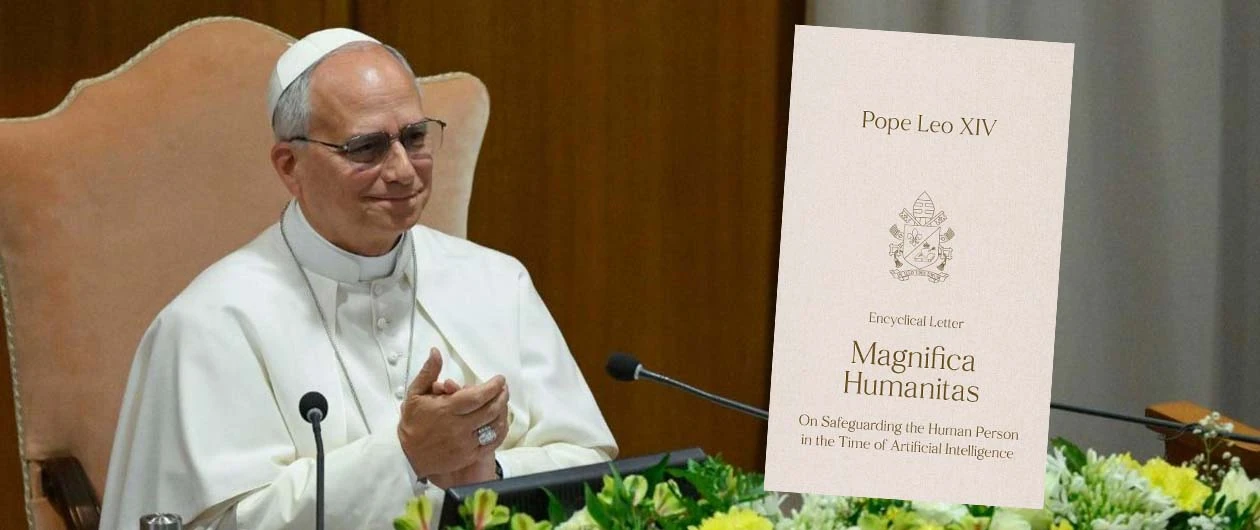


At a time when Artificial Intelligence (AI) is advancing rapidly, permeating everything from intellectual production to the very heart of the decisions that govern social life, the Holy Father offers a reliable compass, avoiding both the naive optimism of those who deify progress and the paralyzing technophobia of those who flee from the challenges of the times.
The End of Demonization and the Beginning of Discernment
Many sectors of society and even the clergy awaited, with some apprehension, a summary condemnation or absolute demonization of new technologies by the Holy See. However, Pope Leo XIV surprised everyone with his lucidity and assertiveness. In his analysis, technology is not, in and of itself, an evil—far from it. It is a human creation, a manifestation of the ingenuity that God has placed in the human spirit. While the Pontiff recognizes the potential of AI as a powerful tool, he warns that such an instrument is never neutral. On the contrary, it “takes on the face, the intentions, and the limitations of those who finance, program, and regulate it.”
Therefore, the debate is not about technology in the abstract, but on the intentionality hidden beneath the codes and algorithms. The Pope invites us to understand that AI is the mirror of a culture that has often forgotten to place the human person as an end, treating them instead as a means or, worse, as statistical data.
The Call for Algorithmic “Disarmament” and the Autonomy of War
The most emblematic image in the document is the forceful call for the “disarmament” of Artificial Intelligence. Just as the Church has for decades advocated for nuclear disarmament, Pope Leo XIV now calls for the logic of domination, exclusion, and surveillance to be removed from computer systems.
The document denounces the “technocratic paradigm,” where power is concentrated in private entities operating above national sovereignty, transforming critical decisions into mere automated processes.
The Pontiff is particularly severe when addressing the autonomization of conflict. He denounces the proliferation of drones and weapons systems that, operating through algorithms, can identify and eliminate targets without the direct intervention of human conscience. For Leo XIV, war, which is already in itself the failure of reason, becomes an act of technological barbarism when delegated to machines.
The Pontiff affirms that no technical efficiency or military precision is capable of making the act of taking a life morally acceptable if that act is devoid of a human ethical decision. The machine has no scruples, knows no mercy, and therefore can never be authorized to wield the power of life or death over one’s neighbor. When an algorithm’s error dictates a man’s fate, justice loses its human character.
A Construction Site for the Common Good
Drawing on the biblical figure of Nehemiah—who, in rebuilding the walls of Jerusalem, sought not the destruction of the surrounding area but the restoration of trust—the Pope calls on humanity to view technology as a “construction site.” Nehemiah teaches that reconstruction is possible when the focus is on the common good.
Similarly, the encyclical proposes that algorithms, patents, and the entire technological infrastructure be subject to the principle of the “universal destination of goods.” Machine intelligence must serve to reduce poverty and help repair social bonds, not to replace the human presence. Technology should not be the wall that isolates us, but the scaffolding that supports us in building a more just society.
Responsibility, Ecology, and the Face of God
The Pontiff extends his reflection beyond the immediate, warning of the environmental impact of large data centers and the energy consumption required by AI, reminding us that humanity cannot ignore its “common home.” Progress is not true if it consumes the future of coming generations.
Furthermore, there is a key point regarding integral formation. Faced with the voracity of AI, the Church proposes an education that cultivates virtue and prudence. It is reaffirmed that the human heart remains the sanctuary where technology must be subjected to love, and never the other way around. AI is incapable of experiencing faith, hope, or charity; therefore, entrusting it with decisions that touch the essence of human dignity is a metaphysical error.
Conclusion: Being Human in the Age of Machines
Progress that does not aim at the glory of God and the good of one’s neighbor risks becoming a new form of servitude. Being a Christian today demands attentive vigilance: it is not a matter of rejecting the tools of our time, but of ordering technical reality under the primacy of the spirit. It is up to man, created in the image and likeness of the Creator, to always be the conscious master of technology, never its slave. Machines must be extensions of our capacity to serve, and never substitutes for our moral responsibility.
The encyclical Magnifica Humanitas concludes with an invitation to hope that transcends the horizon of the present time. Technology is not the end of history, but a new chapter that demands that we be, more than ever, profoundly human.
May the wisdom of Pope Leo XIV guide us to build a future where the machine serves man, but where the human voice—that voice that echoes creation itself—continues to be the instrument par excellence of God’s will in the transformation of the world. For, on the construction site of history, the greatest project is, and always will be, the salvation of souls.