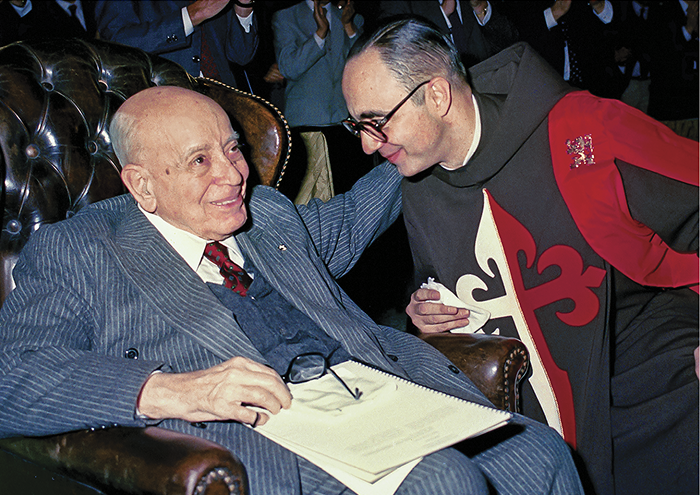
 Heralds of the Gospel Magazine, Vol. 20, nº 226, August 2026
 Heralds of the Gospel Magazine, Vol. 20, nº 225, July 2026
 Heralds of the Gospel Magazine, Vol. 20, nº 224, June 2026
 Who are the Heralds of the Gospel?
 Help of Christians
 Christmas Carols









When we look up at the sky and see the stars, they look like an immense collection of tiny lights, very similar to each other.
However, if we observe them through a telescope, we realize the great variety that exists among the stars, as St. Paul affirms: “Stella enim a stella differt in claritate – “for star differs from star in glory” (1 Cor 15:41).
The same is true of people: although all belong to the human race, are physically constituted of head, trunk, and limbs, and have a soul with its powers, the diversity that exists among them is great!
Each human being constitutes a small “universe.”
Consequently, a curious phenomenon occurs: the closer an individual – or a human group – comes to a high degree of perfection, the more differences we find among them.
There are people who have little expressiveness, are sparing in gestures and attitudes, and, above all, possess only one type of affection. In an artist’s brush or pencil, they would be depicted in just a few strokes, given their simplicity.
At the opposite extreme, someone who is very rich in personality, full of gifts and characteristics, will appear polymorphic, profuse in facial expressions, in ways of being and acting; and, in their affectivity, will be able to establish completely different forms of friendship.
Imbalances in human relationships
Each human being, because of the instinct of sociability, is constantly searching for someone who understands them deeply, loves them completely, and is totally loyal to them.
God placed this desire in the soul to facilitate mutual understanding between people, reciprocal support, and the pursuit of the common good by all.
However, most of the time, a person does not find what they expected and begins to experience disappointments and violent clashes!
Indeed, after original sin, man’s inclinations became unbalanced, and, whether hereditary or due to bad habits acquired throughout his life, he has the tendency to establish himself as the centre of attention at all costs, considering himself superior to others, if he does not practise virtue aided by grace.
This is why he establishes misguided and distorted friendships, based on self-love, pragmatism, and personal advantages. Hence arise envy, criticism, mistreatment, fights, dissension…
There also arise misunderstandings between those who marry for financial gain or seeking projection in their social sphere, or even for romantic and superficial reasons, attracted merely by physical beauty.
Sentimental affection is that which unites two people through merely human affinities, and one contemplates the other in the illusion that the centre of friendship exists in them, forgetting to admire supernatural qualities.
This alliance between two who walk towards evil and appreciate each other because of sin is never stable: the next step will consist of wanting the spouse’s esteem in order to feel adored, imagining that they will reciprocate in kind.
After some time, the result will always be betrayal and enmity, and both will become unfaithful to the sacred oath of matrimony, made before the minister, before the altar, and which could not have be broken until death.
How many disappointments in the lives of those who trust in friendships forged outside of God’s grace! Self-love and sentimentality cause all the disasters and deviations that have existed in human relationships throughout history!
Contemporary society is going through an “earthquake” whose cause lies in relationships founded on selfishness and impurity.
Dealings worthy of hell have taken over the face of the earth, and this modern world is falling apart because true friendship has disappeared and people wish the worst for each other, that is, condemnation.
Gone are the altruistic, idealistic, supernatural relationships; and with them, holy friendships.
What constitutes true friendship?
What does it mean to be a friend?
The word friend has been greatly besmirched throughout the centuries and still is today; but it has a profound meaning, as considered in Theology to designate the presence of the Holy Trinity in the human soul through Baptism: God relates to us as Father and Friend.
It could be said that the Father loved us madly, to the point of giving His Son as an expiatory Victim to buy us at the infinite price of His Most Precious Blood! “Greater love has no man than this, that a man lay down his life for his friends” (Jn 15:13).
If even one man had committed a single sin, the Word would have become incarnate and suffered the entire Passion to save this friend and deliver him from slavery to the devil, giving him freedom within His ranks.
Now, there must be reciprocity in this love. If Our Lord gave His life for us, what should we give? Love is proven by deeds.
We are invited to friendship with Jesus through the fulfilment of the Commandments and love for one another, as He said: “You are my friends if you do what I command you. […]
This I command you, to love one another” (Jn 15:14, 17). The measure of whether we enjoy full friendship with the Lord lies in our commitment to favouring others out of love for Him.
We must love God above all things, with a radical and absolute love, even more than ourselves.
The inclination to love the Creator more than oneself is inherent in human nature – as well as in angelic nature –; and not even original sin managed to destroy this tendency completely.
Therefore, selfishness is a horrendous sin, for it rises up against this instinct and crushes it, to replace it with exaggerated self-love.
We cannot fail to love one another, but it is necessary to do so for the love of God, aspiring to fulfil our mission to give Him all the glory He deserves.
And so it is with our neighbour: we must love them as ourselves, that is, desire the total fulfilment of their vocation so that God may be glorified.
This is the standard of true friendship: it is not found in romanticism and sentimentality; nor is it just a simple benevolence.
Friendship goes far beyond that, it is on a higher plane; it is closeness, it is enjoying the same trust, it is loving unpretentiously, with abnegation and selflessness, with angelic purity, respect and elevation of spirit.
Perfect fellowship presupposes having God at the centre; then all inclinations are well-ordered; the defects, bad temper and bitterness of others are forgotten; wounds go unheeded in the pursuit of admiring the virtue and the divine design regarding each individual.
Wishing the other well is an essential element for friendship to be pure, authentic and full of consolations.
It does not mean wishing for a tourist vacation for your friend, where he stays in excellent hotels and frequents good restaurants, because that would be a worldly friendship, unless this were with the intention of bringing him closer to Heaven.
But the best thing to wish for someone – especially a very close friend, whom we warmly esteem – is, rather, eternal salvation, in the enjoyment of God’s presence, knowing Him face to face and loving Him as He is.
Therefore, true friendship sometimes involves saying difficult things because, seeing someone in danger or finding a fault in him, one must seek to correct him, with the aim of helping that soul to be entirely in accordance with God.
Just like the doctor who takes the scalpel and makes an incision to remove an infected abscess, in order to cure the patient.
A good wine, when tasted, leaves its flavour lingering on the palate, where it refines and intensifies, to the point of causing fond longings…
Similarly, a true friend is one whose company makes us forget everything else, so captivated are we by their presence, feeling their willingness to endure whatever is necessary for us, as well as their commitment, affection, and care in achieving our utmost sanctification.

Dr. Plinio: the best friend
Anyone fortunate enough to have known a man like Dr. Plinio could attest to the incalculable intricacy and richness of these principles regarding friendship practised by him.
While we have highlighted aspects of his vocation, his paternal nature, his prophetic vision, or his wisdom on other occasions, it is also fitting to focus on a little-analysed aspect of his personality: the way he made friends.
Dr. Plinio was the best friend of all who approached him.
But, since he was just, he established a different kind of friendly relationship with the people around him, adapted to what each one deserved, according to the light placed by the finger of God in every soul.
Therefore, although I often saw him worried about the problems and complications his friends presented, I never noticed him downcast or shaken, because he confided that, despite the flaws, the divine plan would somehow be fulfilled.
His affable and affectionate manner was a constant invitation for a person to leave behind their flaws and embrace virtue, with a view to that purpose for which they were called to complete the greatness and beauty of the Creator’s work.
The depth of Dr. Plinio’s friendships was unfathomable. At times with the nurse, at others with the barber – paid for specific services – he showed a courtesy that neither of them would ever find from anyone else, anywhere on earth.
He had a fraternal and specific esteem for his relatives, until the end. As for those to whom he was bound by a supernatural connection, he maintained a lifelong boundless friendship, until death, willing to do everything necessary for them.
Even when his friendship was not reciprocated, he did not break it. With regards to a person who was so bold as to make disproportionate expenditures with Dr. Plinio’s funds, he continued his dealings without any friction, despite the damage suffered.
He endured another, a petty and sentimental soul, as not even a mother would, abandoning his own occupations and carving out a space in his scarce time to attend to him.
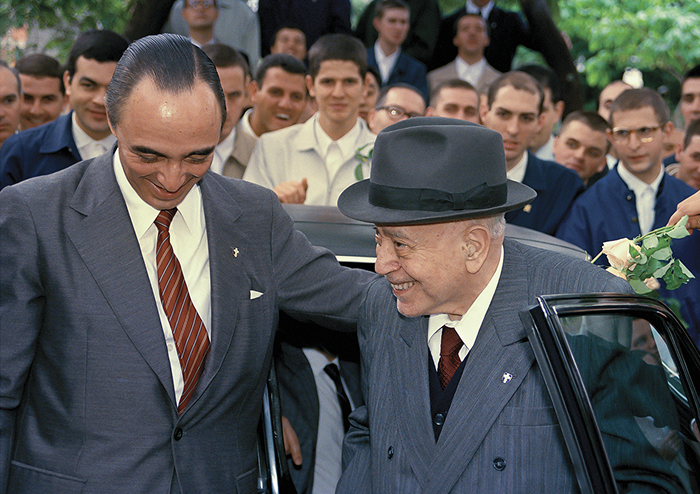
A lifelong friendship
I was close to Dr. Plinio for forty years, and I can say that our relationship was filled with extraordinary expressions of esteem, consideration, and goodwill.
Given the profoundly magnanimous nature of his soul, he possessed a very strong sense of reciprocity, demonstrating his contentment for any benefit received, remaining grateful until the end of his life.
On the other hand, from the moment I met him, I felt completely understood by him and was drawn to this friendship. He showed complete solidarity with me, adapted to my temperament, and liked my way of being.
He also perceived that I was one with him, to the point of doing everything he asked of me.
Such a bond could be defined by what the Germans call zusammen sein, literally translated as being together, but which encompasses a richer meaning and signifies the gladness of participating in a fellowship where all are united, and in which one intensely experiences a profound union of souls.
How many episodes I could tell from the history of this lifelong friendship!
A true friend is proven especially in times of difficulty, and I knew perfectly well that I could turn to him in the most varied circumstances and confide all my secrets to him – both my weaknesses and my successes – placing everything I had in his hands.
During my travels, he was ready to answer my calls for as long as necessary, at any time of day or night, without showing the slightest sign of weariness.
In humiliating situations or in cases that I, distressed, did not know how to resolve, he was there, watching over me to support and protect me.
And even if I were to commit the greatest mistake, I was certain that he would forgive me – even beforehand – and be willing to help me, unreservedly associating himself with my situation, as if it were his responsibility, like the priest who absolves all sins in the confessional.
I remember, for example, that I once received a very unpleasant fifteen-page letter in which the sender judged that, according to his criteria, I had not proceeded correctly.
Perplexed, and unsure of what effect a reply from me might cause, I consulted Dr. Plinio, asking him for guidance. After reading the letter, he dictated the reply as if it were me, using my own language and style of writing!
This thoughtfulness was evident even in the smallest things. One day, I got caught in a heavy downpour as I got out of the car, arriving at his apartment for lunch.
As I sat down at the table, he noticed the wet sleeve of my jacket; so he asked for a towel to be brought, and told me to move a little closer so that he could dry me off himself, saying:
“My son, if you stay wet, you might catch a cold!”
On another occasion, when I was a law student in 1962, it so happened that, due to a series of commitments that day, I had gone without food from six in the morning until four in the afternoon.
As I had no money with me to buy anything, and there was no one else to turn to – for Dr. Plinio was the only other person where I was – I asked him to lend me some money for lunch. He immediately replied:
“Take my wallet and spend whatever you need.”
When I returned to give him back his wallet and thank him, he said:
“My son, it is I who must thank you, because today you have given me the great joy of showing that I am your father!”
However, more than a father, he was a friend with a capital “F” – his was friendship that was boundless, unrivalled, endless, and beyond measure… I always sensed in him an immense commitment to helping me attain the highest gifts and reach the pinnacle of perfection.
In my spiritual life, in my perseverance and devotion to Our Lady, and in all that is good about me, he played a fundamental role.
Therein lies the joy, in accordance with the words of Our Lord to the Apostles: “These things I have spoken to you, that my joy may be in you, and that your joy may be full” (Jn 15:11).
“Full joy” lies in loving what is superior and giving of oneself to the one who is greater, with a view to total surrender to God. A soul that lives in this perspective possesses true happiness.