 Heralds of the Gospel Magazine, Vol. 20, nº 226, August 2026
 Heralds of the Gospel Magazine, Vol. 20, nº 225, July 2026
 Heralds of the Gospel Magazine, Vol. 20, nº 224, June 2026
 Who are the Heralds of the Gospel?
 Help of Christians
 Christmas Carols







Who would not want to kneel beside the manger in Bethlehem to adore the Infant Jesus?
Or hear a sermon from the Divine Master, receive a glance from Him during His passage through a village in Galilee, see Him arguing with the Pharisees or driving out the money changers in the Temple? Or even be at the foot of His Cross with Mary, His Mother?
Those who think we are deprived of this ineffable company are mistaken. If we truly knew who is enclosed in the tabernacles of our churches, we would exclaim like Jacob: “Surely the Lord is in this place; and I did not know it!” (Gn 28:16).
Yes, God is with us and we do not know it. Or rather, we forget…
Having promised to remain with us always, until the end of the world (cf. Mt 28:20), Our Lord fulfilled this promise in an unprecedented way by instituting the Blessed Sacrament of the Altar.
And just as the Redeemer “earnestly desired” (Lk 22:15) to give Himself as food to us when He instituted the Eucharist at the Last Supper, it was likewise with no small benevolence that He prepared a surprise for His children: the adoration of the Sacred Host.
Preparing the ground
Despite being so precious, this treasure remained practically hidden until the 11th century, when the heresy of Berengarius arose, who opposed the reality of the Sacrament of the Altar.1
Then, as an enthusiastic response to this error, Christendom saw the beginning of a true surge of devotion to the Real Presence of Jesus in the Eucharist.
It was at this time, for example, that the elevation of the consecrated Species during the Mass was given its due importance: everyone wanted to see the Divine Bread and the chalice of the New Covenant at that most sacrosanct of all moments.
In a field so well prepared for Eucharistic devotion, Divine Providence raised up a herald of this renewed piety surrounding the Sacrament of Love.
The messenger of the Eucharist
The envoy was Juliana, born near Liège, Belgium, in 1193.
Orphaned at a young age and taken in by the Augustinian nuns of Mont-Cornillon, the girl not only flourished in terms of intelligence and mortification, but became herself a living tabernacle of love for the sacred mysteries.
Around the age of sixteen, while immersed in contemplation, a mysterious vision came to her mind: the moon, in all its silvery splendour, bore a small dark crack that split the celestial body in two.
Amazed by that unusual scene, the image frequently returned to her mind during prayer, leading her to think it was a temptation.
After years of trial, Christ finally revealed to her that “the moon was the present Church, while the breach in the moon symbolized the absence of a feast, which from now on He desired His faithful on earth to celebrate.”2
Then, the Redeemer revealed to her that a commemoration of the institution of the Sacrament of His Body and Blood was needed once a year, in a more solemn way than on Holy Thursday, when the Church gathers to remember the washing of the feet and prepares for the Passion.3
For more than twenty years, St. Juliana resisted the divine mission to promote the institution of the feast dedicated to the Eucharist, moved not by negligence, but by a profound awareness of her own unworthiness.
Demonstrating exemplary prudence and avoiding any haste, the nun sought the discernment of the Church before publicizing her visions.
Hidden under the veils of anonymity, she entrusted those revelations to Fr. John of Lausanne, whom she considered to be a saint, requesting that he submit them to the scrutiny of eminent theologians.
In this way, the holy virgin followed the apostolic model of St. John, who submitted the truth of the spirit to the counsel of others (cf. 1 Jn 4:1).
The ecclesial validation had the favourable opinion of illustrious figures, among them the then Archdeacon of Liège, James of Troyes, versed in divine law and adorned with the merits of holiness, who would later ascend to the pontifical throne as Urban IV.
The convergence of opinions among bishops, doctors of the law, and prelates confirmed the inspiration of the Paraclete, who does not contradict Himself when speaking through the mouths of His servants.4
Urban IV, moved by the memory of that revelation, as well as by the miracle of Bolsena, promulgated the Bull Transiturus de hoc mundo, instituting the feast of the Body and Blood of Christ on August 11, 1264.
Thus, the harmony between the mystical experience of St. Juliana and the discernment of the authorities ensured that the proposal for the new solemnity was received as doctrine for the good of the entire Church.
The feast of Corpus Christi then spread throughout the Catholic world and erased the stain that appeared on the luminous face of the Mystical Body of Christ. It then began to shine like a host without wrinkle or blemish.
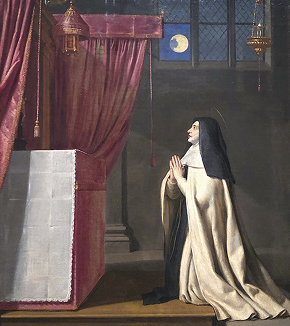
Champaigne - Barber Institute of Fine Arts, Birmingham
(England)
Heaven imprisoned on earth
In our days, almost eight centuries after those events, how is the fervour for the Blessed Sacrament?
It is quite true that most churches, scattered by the thousands throughout the valleys, islands and mountains in the four corners of the earth, house within them Him whom the universe cannot contain.
But how many souls consciously seek Him? He has filled the world with His presence, and we so often empty His sanctuaries with our indifference…
St. Peter Julian Eymard, in his time, lamented the absence of worshippers of Jesus in the Blessed Sacrament: “Our century is sick because there is no adoration.”5
The same Jesus who walked through Galilee preaching the Good News is present, at the moment the reader’s eyes scan these lines, in the tabernacles.
Jesus is there like a prisoner anxiously awaiting the visit of His friends, but to free them from the prison of their evils.
And we, who so yearn for eternal happiness, who mourn so much in this vale of tears, forget the place where Heaven – and the Heaven of Heavens, which is God – is imprisoned on earth.
This meeting place is called the tabernacle. Continues St. Peter Julian Eymard:
The Divine Eucharist, is it not Heaven on earth? […] Therefore, it is not in Heaven that the loving soul should seek Jesus: it is neither the time nor the place for that; but precisely in the Blessed Sacrament.6
Knocking at the door of this august Prisoner, we can receive every gift from the King of the Universe.
Just as one who stands under the sun’s rays burns without any other effort than remaining exposed to the sun, so the adorer of the Blessed Sacrament, even remaining still and silent, is transformed into an ember of a censer.
His face is illuminated, his gaze becomes clear, for Jesus in the Host lavishes all those who visit Him with benefits, and not even those who say nothing to Him can escape His goodness.
In effect, only those who do not expose themselves to the divine light emanating from the monstrance or tabernacle escape.
Jesus sleeping in the boat and its symbolism
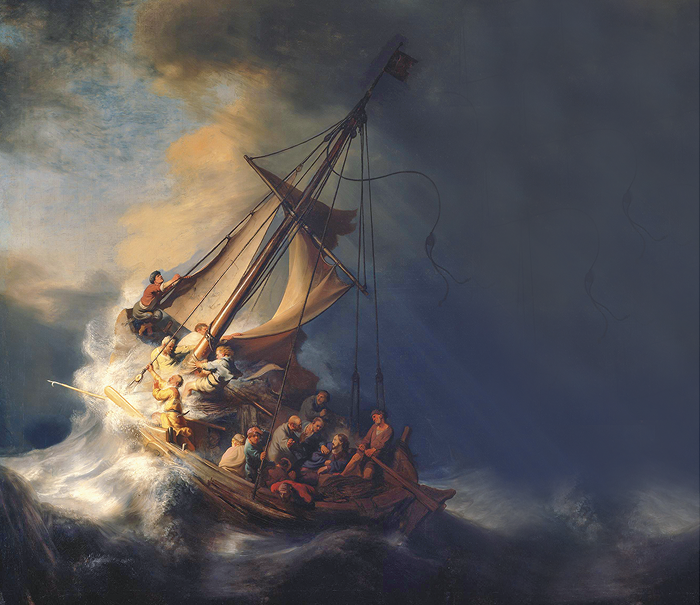
An event recorded in the Gospels (cf. Mt 8:23–27) uses a storm to illustrate the plight of those who, though the Lord is so close at hand, risk throwing everything away.
Jesus was sailing in a boat with His Apostles. Suddenly, the winds begin to whistle, the clouds become leaden and, in a short time, unleash torrents upon the turbulent waves of the sea. Woe to the poor boat! It trembles and sways, creaks and lists, becomes uncontrollable.
In the stern, the Divine Master sleeps peacefully, reclining on a pillow… His disciples, more afraid of waking the Lord than of perishing in the waves, try alone to save the vessel from shipwreck.
All in vain. They no longer slip on the deck, but swim on it. More than once one or another almost falls into the turbulent waters.
This vessel represents our soul and the Holy Church, which is the Barque of Peter. Not by the strength of the navigators, but by that of the Divine Master who dwells within it, this ship must overcome any turbulence that may come its way.
Indeed, waves of persecution assail it, the darkness of all times descends, winds of hatred and slanderous whispers fly through the air. Some disciples slip and are swallowed by dark whirlpools.
Why, in these moments, do we not turn to Jesus? Why do we not seek the solution where it is to be found? Why do we try to save threatened boats with our own strength, without having recourse to the mighty God, who has the solution for everything?
He is always waiting for us. A few minutes of adoration of the Blessed Sacrament would be enough to transform our souls and calm any storms.
The Sacred Host is like the anchor of our burdened soul and of the Church that fights. It was not without reason that St. John Bosco dreamed that the Ship of Peter was chained to the pillar of the Eucharist.
Our Lord’s command and our response
The Gospel passage continues: “And they went and woke Him [Jesus], saying, ‘Save, Lord; we are perishing.’” (Mt 8:25). He, “rose and rebuked the winds and the sea; and there was a great calm” (Mt 8:26).
They only had to seek Him, and a word of His dispersed those waves. The disciples were amazed: “What sort of man is this, that even winds and sea obey Him?” (Mt 8:27).
He is the Captain of the Church. He is the One who calls us when we struggle in the waves; He is the One who, when called upon, silences the storm.
“The Teacher is here and is calling for you” (Jn 11:28). This is the invitation that is continually made to us. From within the tabernacles or exposed in the monstrance, Jesus, who needs nothing, asks for our presence.
And we, shall we deprive ourselves of such august company?