 Heralds of the Gospel Magazine, Vol. 20, nº 226, August 2026
 Heralds of the Gospel Magazine, Vol. 20, nº 225, July 2026
 Heralds of the Gospel Magazine, Vol. 20, nº 224, June 2026
 Who are the Heralds of the Gospel?
 Help of Christians
 Christmas Carols









The topic of chivalrous treatment reminds me of a lot of things from my childhood, when the issues of relationships and life in society were beginning to emerge in my mind.
Friendship in the old days
My mother used to tell stories about acquaintances who were true friends, but astonishingly so. She would narrate, for example, what happened with my grandfather.
He had inherited some land in the interior of São Paulo. At that time – well over a hundred years ago – Pirassununga, Araraquara, São Carlos, those regions that are so close to us, were part of the hinterland.
My grandfather decided to establish a farm. However, he had been educated in the city of São Paulo and had no idea about rural life.
A childhood friend of his, who had business in that area, passed by my grandfather’s property, saw that it was poorly organized, and went to talk to him.
They both addressed each other by their childhood nicknames: the friend, named Estanislau, was called Lalau; and my grandfather, Antônio, Totó.
Lalau said to Totó:
Look, Totó, your farm is a disgrace! You need to give me some more labourers, and don’t even think about your farm, don’t show up there, don’t ask me anything. Just give me a cheque for this amount each year to cover expenses.
In five years, I’ll give you a fully developed farm, with a producing coffee plantation, and a bank account opened by me in your name to hold the profits.
My grandfather thought it was a very interesting idea; he provided Lalau with the necessary labourers, and did not interfere in the farm’s affairs any further. They did not even talk about the matter.
When the deadline had passed, Lalau – who, incidentally, was a baron of the empire – sought out my grandfather and said: “Look, Totó, let’s go and see your farm now. It’s ready; you’ll be pleased.”
They went together, and it was a thing of beauty, in full bloom. Then my grandfather wanted to pay him, but Lalau replied: “Don’t even mention it; it’s out of the question! Because I did this out of friendship for you.”
I looked at my companions and wondered: “Who does that these days?”
In my childhood, either you paid very well – and still checked the accounts to see if there had been any theft – or it ended in disaster. And this question remained in my mind: “Is the age of friendship over?”
Conversations imbued with a special respect
I used to watch the older generation – people the age of my parents and especially of my grandparents – and I noticed how differently they interacted: they treated one another with a respect that no longer existed in my generation.
My grandmother had a friend with whom she remained close until the end of her life. They were two exceptionally beautiful ladies, not only because they had such fine features – like porcelain dolls – but because they were so refined and elegant.
The two had met as young girls. Their homes, in the tiny São Paulinho of that time, were relatively close together. There were no telephones, and a young woman could only go out on the street with a family member; never alone.
So they – often wanting to meet up, but with no one to accompany them – would, at a set time, stand at the windows of their respective homes with binoculars, and signal to one another, communicating through gestures, chatting.
Both later lived on ranches in the countryside of São Paulo and went several years without seeing each other, as their estates were very far apart. Later, their husbands returned to live in São Paulo and they resumed their friendship.
I met them when they were already quite elderly. This lady used to visit my grandmother every week, on a fixed day. They would sit down and the conversation would begin.
Usually someone from the family would turn up and join in the conversation for a while, but would soon withdraw, because they liked to talk about matters from their own time and their memories. It was kinder to leave them on their own.
But I regretted it, because I wanted to listen to their conversation – it was entertaining the whole time! When the visit was over, they would say goodbye in such a festive, solemn and beautiful way that it was a joy to watch.
More than once I went into the room to watch the two of them bid each other farewell.
Transformations in forms of courtesy
In our family, we formed a circle of cousins and had very lively conversations, but they were not like they used to be.
I saw this difference and wondered: what has disappeared, transforming social interaction in such a way? I needed to analyse it quite a bit to know the answer.
The first notion that came to mind was that in my generation people treated each other politely, but this politeness was very common and cinematic.
Authentic courtesy was dying, giving way simply to correct treatment, but without the sweetness of yesteryear.
On one occasion, while reading a French book written by a very interesting historian, Gosselin Lenôtre, Gens de la Vieille France – The People of Old France, I found a phrase by Talleyrand: “Whoever did not live before the French Revolution did not know the sweetness of living.”
I thought to myself:
That’s right! These cities with factories, trams, cars, horns, electric lights – São Paulo already had all that, on a smaller scale, it just didn’t have airplanes – the hustle and bustle, trains and everything else… It is impossible for the old “douceur de vivre” to exist in this atmosphere.
The joy of bringing joy
However, the question arose: how did those people experience life and manage to act like that? What was their way of being? Why did it end? A boy, observing things from this side, was naturally led to ask these questions.
In my grandmother’s house there was a large garden. On Thursdays, all the children would gather there, run around, have fun, etc.
An uncle of mine would arrive when the excitement reached its peak. In those days, certain infractions of good manners were not tolerated. Then the playing would stop and all the children would go to kiss this uncle’s hand and ask him how he was doing.
He took particular pleasure in bringing back, every now and then, a few packets of delicious foreign sweets filled with fruit jelly. If he did not bring them, we would treat him the same way.
But I noticed that he felt a certain pleasure in seeing us happy. Choosing between having a few extra banknotes in his wallet or seeing the joy it brought us – and the way that joy reflected back on him – my uncle preferred the pleasure of giving, which was well worth the cost.
Sometimes I witnessed people older than me performing small acts of kindness. For example, I remember a gentleman who came to visit our house.
He entered with two beautiful cactus flowers and said, “I found these at a florist I passed. They are pretty, and perhaps you will like them,” and he gave them to the lady of the house, his sister-in-law, who was very pleased and had them placed in a small vase near her.
I noticed how he rejoiced in knowing that the lady would spend the rest of the afternoon looking at those flowers. Regardless of any reciprocation, it gave him satisfaction to see the contentment of others.
It was a feeling corresponding to a social habit, which consisted of the joy of bringing joy, the satisfaction of causing satisfaction.
It was a solidarity that bound one creature to another, whereby the pain in one hurt the other, what pleased one, pleased the other. The douceur de vivre was implanted and established.
Extinction of reciprocity and implantation of egoism
Looking to the past, I realized how great this sense of reciprocity was in previous generations, the further back in time one went.
In my generation, it was almost gone; in our days, it has completely disappeared.
On the roads, for example, when an accident occurs, drivers are sometimes asked to stop so that an injured person can be placed inside their cars.
I know of someone who gave this answer: “My car is new and his blood will dirty it. I don’t want to.” And he drove on.
So, a completely different moral climate is established, in which this reciprocity, the desire to do good for the other person’s sake, disappears.
Similarly, respect vanishes: the joy because the other is superior, because of reverence, because of honouring him.
Any contentment in doing good has been lost, which, on the contrary, has become unpleasant. Therefore, it matters little to see others wither and perish, if one obtains one’s own good.
How can a conversation between two people be pleasant if each knows that the other has these ideas of self importance? It is impossible not to perceive a certain melancholy in today’s dealings.
There is nervous excitement, but the joy for the happiness of the other has disappeared. How can it be explained that this existed for a period and then ceased to exist?
With Our Lord, joy began to radiate across the earth.
Someone entered history. When this happened, the whole world was a night like the one I have just described; He shone, and the joy of being good and doing good began to shine among men.
The pleasure of respecting and even venerating, of dedicating oneself, of sacrificing oneself; the contentment of doing good, of knowing that the other was satisfied, even when he does not realize who favoured him; all this began to radiate across the earth through someone designated by four words: Our Lord Jesus Christ.
St. Peter uses a formula that I read and that remained in my memory like a flash of light, never fading from my spirit. He described the life of Our Lord in this Latin summary: “pertransivit benefaciendo” (Acts 10:38). He went through life doing good.
The whole time, from beginning to end, doing good, without looking at anything but the joy of doing good, with the overflowing, the abundance that we know.
It reached its peak when He was arrested in the Garden of Gethsemane, and He gave the order to the executioners: “let these men go” (Jn 18:8).
It was the disciples who were fleeing! They could have refused to flee, but they chose to flee. However, the forgiveness was such that He only had the expression: “let these men go.”
Furthermore: St. Peter cut off Malchus’ ear. Jesus bent down, picked up the ear from the ground and put it back on him, who was arresting Him in order to subject Him to an unjust trial and kill Him with the most cruel death imaginable.
Our Lord taught and revealed that which He Himself exemplified: God is goodness, infinite majesty, endless splendour, unfathomable perfection and omnipotence; but also mercy, compassion and forgiveness repeatedly expressed with affection and solicitude even unto death on the Cross for us.
Jesus Christ loved us and loves us in this way. He founded a Church which is the sum of all perfections and all wonders, even amidst the sorrows of the 20th century: the more we know it, the more we admire it.
Therefore, through His teaching, He revealed to us that we have this common Father, this God who loves us in this way.
Doing good to others brings joy to Jesus Christ.
This gave men the notion that all are one in Him, participate in His feelings and dispositions, and thus, by doing good to others, we bring joy to Him.
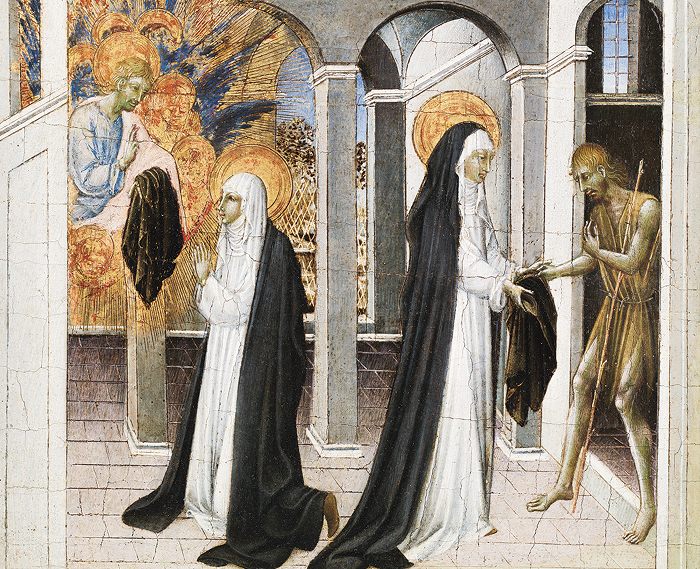
St. Catherine of Siena once needed to care for a leper.
She found satisfaction in bringing contentment to this sick woman; moreover, she knew that Our Lord Jesus Christ rejoiced in Heaven to see that miserable daughter smile happily, with her gaunt lips.
The Redeemer loved the leper daughter, felt pity for her, and was pleased when another daughter, to whom He had given health, comforted her.
Thus arises the pleasure of respect. The other woman, who was neurasthenic and had an unbearable temperament, was referred to by the Saint as “my mother”.
All this together fosters in men a well-ordered satisfaction in feeling the joy of others, the pleasure of giving, of sacrificing oneself, of laying oneself down, of loosening the grip of selfishness, self-love and pride, through a gesture, through a kindness.
A kind word can sometimes transform a person, especially when we do not feel like saying it, but do so to serve Our Lady.

A joyful fellowship, with the fragrance of Our Lord Jesus Christ
The pagans, in the time of the Roman Empire, looked at the Catholics and said to each other: “See how they love one another.” It is the good aroma, the light of Our Lord Jesus Christ that illuminates and transforms everything.
I give you this advice: do you want to have true happiness in your soul and the light of Our Lord Jesus Christ before your eyes? Do you wish to feel in the breath of your souls His aroma? Sacrifice yourselves and have the joy of seeing that others are pleased with the sacrifice.
And do not expect reward. Whoever does good to others for their own sake seeks to make a deal. Expect ingratitude, contempt, mistreatment, but say:
I did it so that he might be a little satisfied. Our Lord and His Blessed Mother were glorified, because he had a moment of good joy. This will one day redound to the benefit of his soul. I will do more!
When they come to an understanding, the fragrance of their fellowship will be sweet, perfumed and pleasant. It is Christ our Lord who will be present.