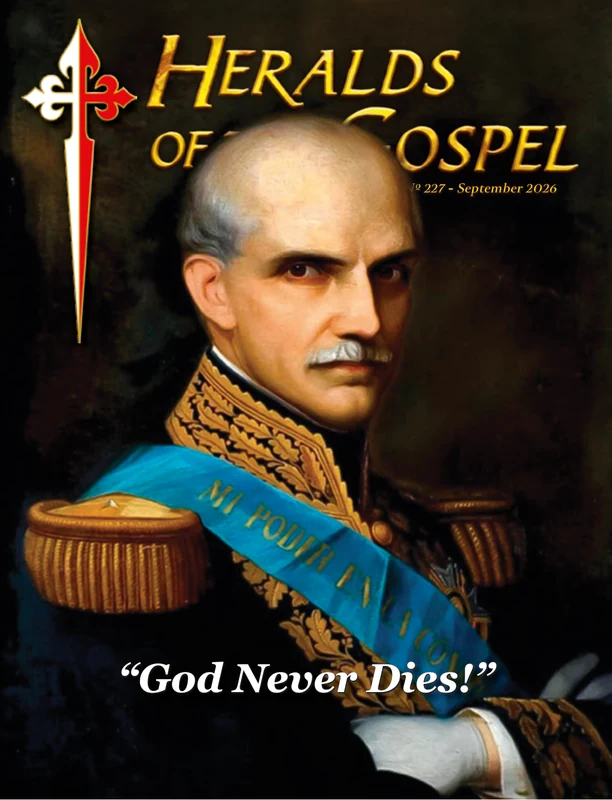
 Heralds of the Gospel Magazine, Vol. 20, nº 227, September 2026
 Heralds of the Gospel Magazine, Vol. 20, nº 226, August 2026
 Heralds of the Gospel Magazine, Vol. 20, nº 225, July 2026
 Who are the Heralds of the Gospel?
 Help of Christians
 Christmas Carols









Just like a garden, the spiritual life requires continual care, for defects can spring up in the most hidden recesses and in the most unexpected ways, choking the flowers and fruits of virtue that God wants to cultivate within us.
What distinguishes a free man from a criminal?
From a very young age, Dr. Plinio stood out for his talent as an orator, and was often called to speak in the most varied settings. On one occasion he was invited to give a lecture in preparation for Easter Communion in Carandiru, a former prison in the city of São Paulo – a rather unusual experience for a member of the high society of São Paulo, accustomed to the social life of aristocratic circles. Prison of Carandiru, São Paulo
 Prison of Carandiru:
 inmates from the 1930s
Excellent means of spiritual progress
Some might object that exercises of piety and spiritual development, such as the examination of conscience, or even the Sacraments, sound anachronistic today. However, such a judgement is most likely born of a faulty understanding of these salutary practices. In the words of a certain Jesuit priest, “to ward off death, we eat every day; to recover from fatigue, we sleep. This double remedy is very old! Are you going to dispense with it on the pretext that it is outdated?”1 Now, if we have at our disposal excellent means, of undisputed efficacy, for making progress in the supernatural life, why should we not make use of them?The human soul: with what should it be compared?
Those who think that our soul is like a vehicle that only needs a tune-up once in a while are greatly deceived… On the contrary, the spiritual life is like a garden that requires continuous care, for defects may spring up in the most hidden recesses and in the most unexpected ways. Those who have ever dedicated themselves to horticulture are very familiar with a certain type of plant that is generally detested: the weed. Especially in a tropical country like Brazil, whose extremely fertile soil seems to always yield more than expected, these “enemy” plants spread with amazing speed! We can draw a great analogy between this natural reality and the human soul. If we are not careful, vices choke the flowers and fruits of virtue and leave our souls looking like the “field of a sluggard” described in the Book of Proverbs: “I passed by the field of a sluggard, by the vineyard of a man without sense; and lo, it was all overgrown with thorns; the ground was covered with nettles, and its stone wall was broken down. Then I saw and considered it; I looked and received instruction. A little sleep, a little slumber, a little folding of the hands to rest, and poverty will come upon you like a robber, and want like an armed man” (24:30-34). Garden of the Palace of Versailles (France)
The general examination of conscience
In his book Practice of Perfection and Christian Virtues – a work which, in the words of St. Anthony Mary Claret, has led more souls to Heaven than the stars that twinkle in the firmament2 – Fr. Alphonsus Rodriguez of the Society of Jesus offers us a superb treatise on the examination of conscience, with teachings of an eminently Ignatian character.3 Among them is the distinction between the general and the particular examen. The general examen deals with all the actions of a given day or period of time. This is the one we make before sacramental Confession. It comprises five points or parts. When we recollect ourselves to make this examen, in the first place we give thanks to God for the benefits we have received, which is a very effective way to contrast Our Lord’s goodness and generosity with our own wickedness and indolence. Then we ask Him to help us to know our faults and sins. Dr. Plinio used an interesting example to highlight the importance of analysing ourselves accurately: No surgeon in the world would ever dare to perform an operation in the dark. When we examine our conscience, we are the surgeons and the patients at the same time. That is why we must ask, not only at this moment but continually, for the grace to be enlightened so as to know ourselves well: “Lord, that I may see” (Lk 18:41). For how can we correct faults that we do not perceive or only perceive poorly? The third step consists in considering the faults committed since the last Confession, and the fourth in asking God Our Lord to pardon our faults, as we are filled with sorrow for them and repent of them. We can go over the Commandments or the evangelical counsels with the help of a list outlining the faults against them, identifying where we have fallen and offended God. Finally, we make the resolution to sin no more, with the help of divine grace, and we end with a short prayer – an Our Father or a Hail Mary, for example.Hierarchy of values
It should be emphasized that the full force of this examination lies in the last two points: sincere repentance and the decision to sin no more. From these we derive the most precious fruits of perfection that this habit can bring to our soul and, it should be said in passing, they are two indispensable requirements for the Sacrament of Confession. The purpose of the general examen, as Fr. Garrigou-Lagrange maintains,4 does not lie principally in a complete and exhaustive enumeration of venial faults, but in seeing and sincerely accusing the principle from which they stem in us. In this regard, Dr. Plinio states: “A good examination of conscience must include not only the sinful acts, but the tendencies which lead us to commit those acts. For it is necessary to cut the root of the evil, so that evil does not happen.”5 Fr. Alphonsus Rodriguez6 explains – and here we refer once again to the figures of the plant kingdom – that if we pull up the bad herb by its roots, then the whole plant withers and dries up. But if we prune only the stalks and leave the roots in the earth, it will soon push up new stems and grow again.The particular examination
On the other hand, it can also be said that the broader the the vista that meets our eyes, the less accurate will be our view of the details. For this reason, St. Ignatius of Loyola laid more importance on what is called the particular examen than on the general, because it enables us to deal with our faults one by one and thus overcome them more easily. Moreover, by tackling one vice, we combat them all. When the people of Israel were challenged by enemy nations, God encouraged them by saying: “You shall not be in dread of them; for the Lord your God is in the midst of you, a great and terrible God. The Lord your God will clear away these nations before you little by little; you may not make an end of them at once” […] (Dt 7:21-22). Something similar applies to the imperfections of our soul. God wants us to fight hard against our defects, but He warns us that we will be more successful if we attack specific enemies and persevere in the fight against them until we defeat them completely: “I pursued my enemies and overtook them; and did not turn back till they were consumed. I thrust them through, so that they were not able to rise; they fell under my feet” (Ps 18:37-38).The method of action
 St. Ignatius of Loyola – Motherhouse of the Heralds of the Gospel, São Paulo