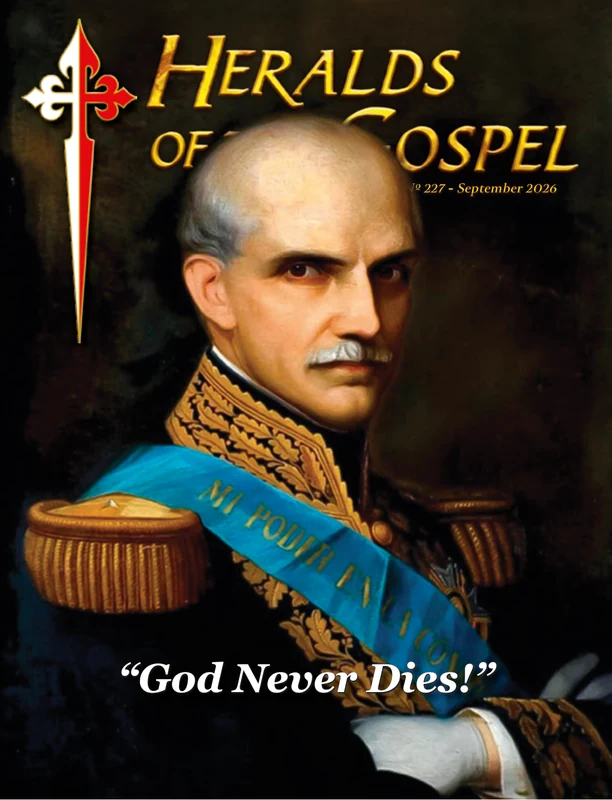
 Heralds of the Gospel Magazine, Vol. 20, nº 227, September 2026
 Heralds of the Gospel Magazine, Vol. 20, nº 226, August 2026
 Heralds of the Gospel Magazine, Vol. 20, nº 225, July 2026
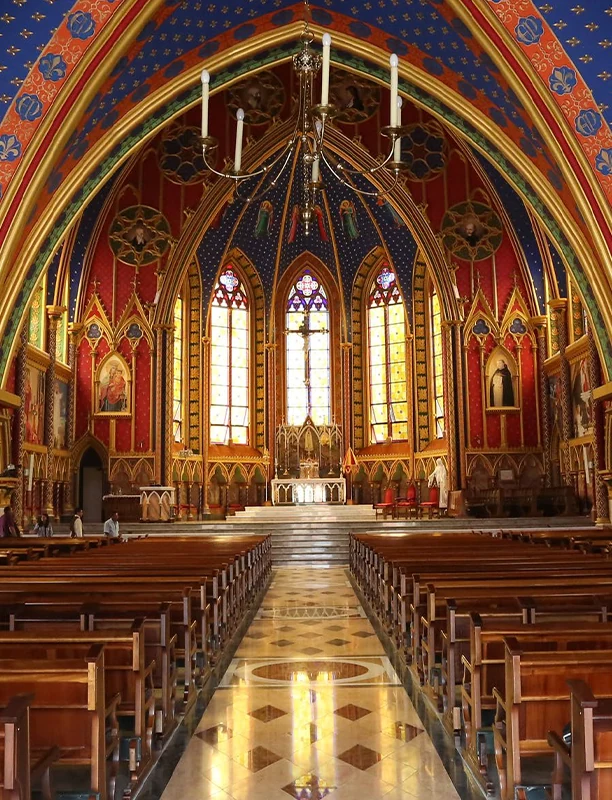 Who are the Heralds of the Gospel?
 Help of Christians
 Christmas Carols







A risky mission
It was the early hours of Sunday, May 28, 1747. In the port of the Mexican city of Veracruz, everyone was sleeping. Everyone… except the men of the intrepid Pedro Mesía de la Cerda. A navy guard in the Spanish Armada at seventeen, he was then, after a long and brilliant military career, an experienced captain of forty-seven years of age, commander of the St. Ignatius of Loyola, a seventy-gun ship nicknamed Glorioso. CAt left, Captain Pedro Mesía, by Joaquín Gutiérrez - Museum of Colonial Art, Bogotá (Colombia
After weeks of tranquillity, the first battle
The first weeks of sailing went normally, but on the morning of July 25 things changed. Near the Azores Archipelago, the sailors spotted a large number of sails in the distance. Were they British? Hours later, the bad omen was confirmed: it was a large English convoy escorted by four warships, under the command of Captain John Crookshanks. Discovering the solitary Spanish ship, the English sensed that it was easy prey and certainly well laden with treasure. The commander then ordered a warship from the small fleet to continue escorting the others, and he set out with the other three – the ship of the line Warwick, the frigate Lark and the brig Montagu – on the chase for the rich Spanish booty. The Montagu, faster than the others, managed to get close first and fired at the St. Ignatius of Loyola, aiming to reduce its speed. But Captain Mesía, foreseeing her movements, ordered several cannons to be moved aft and kept her at bay throughout the night with cannon fire. On the following day, July 26, the other two ships managed to draw close, and by nightfall they were harassing the Spanish ship, which could not avoid a confrontation. This time, however, it was Captain Mesía who would take the initiative in the attack. Detail of “The capture of the Glorioso”, by Charles Brooking
“Battle stations!”
After a few weeks without any major developments, on Sunday August 13, with only ten leagues to go before reaching Cape Finisterre, the lookout from the mainmast spotted several sails. The following day, it turned out that there were three Royal Navy vessels: the ship Oxford, the frigate Shoreham and the brig Falcon. All three were advancing rapidly towards the damaged St. Ignatius of Loyola, as if they had been waiting for it for some time. Perhaps they just wanted to settle a score. In view of the tragic scenario, the troubled expression on the Spaniards’ faces revealed the countless doubts that, like cannonballs, assailed their minds: would they come out unscathed or perish in the fight? They were so close to home that this turn of events seemed like a true nightmare. But soon the deadly silence that aroused so many questions was broken by a shout from Captain Mesía: “¡Zafarrancho! [Battle stations!]” It was not the time to speculate, but to pray and fight. The British fleet approached slowly. Finally, around four o’clock in the afternoon, the Shoreham and the Falcon crossed paths with the St. Ignatius of Loyola on one side, at a prudential distance, while the Oxford did the same on the other side, but no one opened fire. However, having their prey within reach, the English manoeuvred to begin the capture. In an instant, Captain Mesía had his ship in a favourable position to exchange fiery leaden salutes with the enemy vessels. The lopsided clash lasted almost three hours when Captain Callis, commander of the English squadron, no longer able to bear the punishment inflicted on him by the St. Ignatius of Loyola, decided to retreat. The scene was unbelievable – a real miracle! It was an extraordinary sign of the divine protection that had not abandoned them.The last enemies appear on the horizon
Finally, on August 16, they reached the port of Concurbión, Galicia, where they unloaded the valuable treasure in a safe place. Their mission was accomplished! But their odyssey continued. After making the most urgent repairs to the ship there, they set sail on October 11 for the port of El Ferrol, where they would have everything necessary to complete the ship’s restoration. Unfortunately, they were unable to reach the port due to a strong gale. Moreover, they were in the vicinity of the Coast of Death, a dreaded region where many vessels were shipwrecked. It was not prudent to continue along that route, especially in their precarious condition. Accordingly, Captain Mesía ordered them to set out towards the port of Cádiz. Commodore George Walker - National Maritime Museum, Greenwich (England)
Until the last cannonball
The next day, October 18, the St. Ignatius of Loyola was being pursued by the frigates Prince George, Duke and Prince Frederick, almost the entire Royal Family! As if that were not enough, another of His Majesty’s vessels appeared before the Spanish ship: the Darmouth, commanded by Captain John Hamilton. When the latter came within firing range, both battled at length until, suddenly, one of the shells from the St. Ignatius of Loyola hit the powder magazine of the English ship, blasting it skywards. Such was the effect of the tragic explosion that of the three hundred and seventy men in the crew, only eighteen were saved. Even so, the truce was short-lived. Around midnight, another ship opened fire on the St. Ignatius of Loyola: the Russell, Her Majesty’s mighty ship of the line, with three bridges and ninety-two cannons, which had joined the Royal Family frigates. What must the Spaniards have thought, seeing the situation go from bad to worse? At this point, perhaps for many of them it made no difference whether they faced two or four ships… Under fire from the frigates and the Russell, Captain Mesía and his men defended themselves to the last cannonball. When these ran out, they loaded their cannons with every kind of metallic material they could find. Finally, they had nothing left to load them… ““The last battle of the Glorioso”, by Augusto Ferrer-Dalmau
Living “Gloriosos”, ready to fight and resist
So unbelievable did this resistance seem that Commodore George Walker wrote: “Never did Spaniards, nor indeed men, fight a ship better than they did this.”5 At about six in the morning, when the first rays of sunlight were illuminating what still remained of the St. Ignatius of Loyola, the British entered the ship and there found one hundred and thirty wounded men and thirty-three dead. The rest of the crew were led to the British vessels, from where each Spaniard could better contemplate his devastated ship. At that tragic moment, under the sad gaze of those who had shed so much blood on it, the ship itself seemed to come to life to utter its last words to them: “What are you looking at, brothers? Take no more notice of these remains which will soon be destroyed. Material things pass, but glory descends upon those who suffered with me and fought to the end.” It would be hard to imagine a more glorious end, thought the sailors. Was it then that the nickname Glorioso was enshrined forever? Probably. What is certain, however, is that from that moment, each one of them became a living Glorioso, ready to fight and resist, in that hope of which the Apostle speaks: “we rejoice in our sufferings, knowing that suffering produces endurance, and endurance produces character, and character produces hope” (Rom 5:3-4). ◊Notes
1 In fact, from the beginning of the 18th century, Spanish ports were a veritable “anthill of British agents ready to inform Rear-Admiral Sir Chaloner Ogle, commander-in-chief of the British West Indies fleet, of the slightest movement of Spanish ships” (PACHECO FERNÁNDEZ, Agustín. El “Glorioso”. 5.ed. Valladolid: Galland Books, 2021, p.93).
2 “6,412 arrobas of fine cochineal, 2,354 of logwood, 64 of wild cochineal, 281,092 vanilla beans, 68 quintals of jalapa extract, 350 arrobas of sugar, 24 of balsam, 55 of cocoa and 300 animal skins” (Idem, p.135).
3 Cf. ROJO PINILLA, Jesús Ángel. Cuando éramos invencibles. 7.ed. Madrid: El Gran Capitán, 2017, p.147.
4 WALKER, George. The Voyages and Cruises of Commodore Walker. London: A. Millar, 1760, v.II, p.216.
5 Idem, p.231.