 Heralds of the Gospel Magazine, Vol. 20, nº 226, August 2026
 Heralds of the Gospel Magazine, Vol. 20, nº 225, July 2026
 Heralds of the Gospel Magazine, Vol. 20, nº 224, June 2026
 Who are the Heralds of the Gospel?
 Help of Christians
 Christmas Carols









In creating us with an instinct for sociability, the Divine Craftsman imprinted on the human soul the need for mutual help. In the reciprocal admiration of the gifts received by each one, we are called to better serve Him, love Him, and praise Him.
This interdependence is not reduced to a certain convenience, but reveals itself as an evident and undeniable reality. No one is, by himself, his own teacher or his own doctor; we are, by nature, contingent beings.
And this dependence transcends the material plane: in the supernatural realm, we need each other to tread the path of virtue and fulfil our vocation.
In this vast interweaving of dependencies, friendship emerges as a sublime support in the pursuit of holiness. God Himself, made man, wished to enjoy friendship with the Apostles (cf. Jn 15:15) and Lazarus (cf. Jn 11:11) as His intimates.
However, long before the Incarnation, the pages of the Old Testament already offered us luminous teachings in this regard, among which the following passage from Sirach stands out:
A faithful friend is a sturdy shelter: he that has found one has found a treasure. There is nothing so precious as a faithful friend, and no scales can measure his excellence.
A faithful friend is an elixir of life; and those who fear the Lord will find him. Whoever fears the Lord directs his friendship aright, for as he is, so is his neighbour also (6:14-17).
Let us consider each of these phrases carefully, based on three Old Testament examples of true friendship.
“He loved him as his own soul”
The loyal union between David and Jonathan stands out as the best-known example of friendship in the Old Covenant.
King Saul, Jonathan’s father, had transgressed, betraying his mission, and the prophet Samuel had warned him that God would choose another monarch in his place.
Therefore, upon perceiving evident signs of divine predilection towards David, who had indeed been anointed by the prophet, Saul became envious and harboured a mortal hatred for him.
Jonathan’s soul, however, was drawn to David, whom he loved as himself (cf. 1 Sm 18:1). Although the ascension of Jesse’s son meant that he would lose the throne, to which he would have been entitled by inheritance, at no time did he envy the one whom he had taken as a friend.
On the contrary, he told him: “you shall be king over Israel, and I shall be next to you” (1 Sm 23:17). Nor was he afraid to confront his own father, warning David of the plans and schemes plotted against him and protecting him so that he would not be killed by Saul.
Based on phrases from a dialogue between Jonathan and Saul, St. Aelred of Rievaulx highlights the beauty of the attitude taken by the former:
When he [Saul] pronounced a death sentence against David, Jonathan did not abandon his friend. “Why should David be put to death? What has he done?” […] At these words, mad with rage, the king tried to pierce Jonathan with a spear against the wall […].
Then he spewed forth all his venom upon the young man’s heart, adding encouragement for his ambition, fuel for his envy, and inciting rivalry and bitterness: “As long as the son of Jesse lives, your kingdom shall not be established.” Who would not be shaken by such words?
Who would not be filled with envy? What love, what affection, what friendship would they not corrupt, diminish, or cause to be forgotten?
Jonathan, a young man full of love, kept the pact of friendship. Strong against threats, patient against fury, he despised the kingdom because of friendship, forgetting the glories, but remembering the grace.1
Despising glory and power, he preferred the honour of his friend to his own.
“A faithful friend is a sturdy shelter: he that has found one has found a treasure” (Sir 6:14).
We can well affirm that Jonathan, whose friendship was more precious to David than any other earthly affection (cf. 2 Kgs 1:26), saved not only the life of his friend, but also his descendants, from whom the Messiah would be born centuries later.
A friendship more precious than seven sons!
Going back to the genealogy of the God-Man, as presented at the beginning of the Gospel of Matthew (cf. Mt 1:1-16), it may seem strange that Ruth, the great-grandmother of King David and one of the few women mentioned in the list, was not Jewish, but Moabite.
However, she deserved the honour of being an ancestor of the Messiah, as her story shows.
Ruth – a Hebrew name meaning “friend” – married Mahlon, the son of a Jewish widow named Naomi. Naomi also had a second son, Chilion, who was married to another Moabite woman named Orpah.
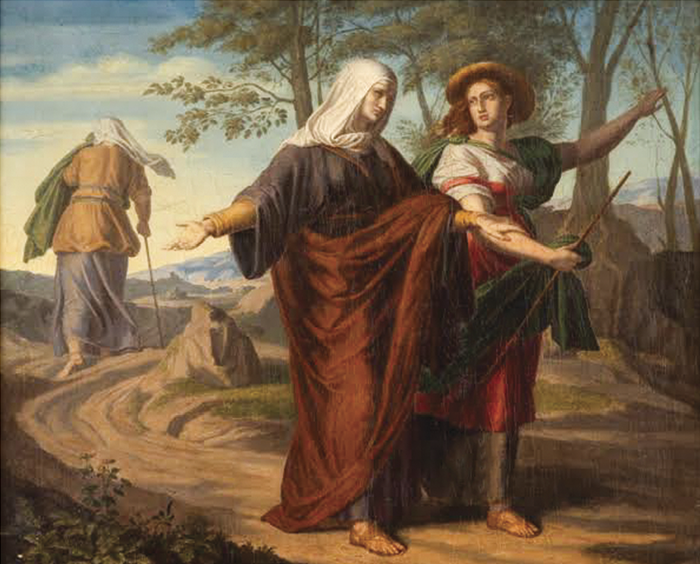
However, both of Naomi’s sons died, leaving her completely alone. Resigned to her fate, the old woman then called her young daughters-in-law and insisted that they return to their families, where they could remarry and start a new life.
Orpah was very distressed, for she cherished her mother-in-law, but in the end she left. Ruth, however, unwilling to abandon her, replied:
Entreat me not to leave you or to return from following you; for where you go I will go, and where you lodge I will lodge; your people shall be my people, and your God my God.
Where you die I will die, and there will I be buried. May the Lord do so to me and more also if even death parts me from you (Ru 1:16-17).
Leaving her nation and customs, she entered the service of Naomi.
From that moment on, Ruth’s companionship became her mother-in-law’s inheritance. And God rewarded this act of generosity by granting Ruth the opportunity to marry again, to a wealthy relative of Naomi named Boaz, and to give birth to a son.
Thus, the sorrow of the virtuous widow was transformed into consolation, as Scripture narrates:
Then the women said to Naomi, “Blessed be the Lord, who has not left you this day without next of kin; and may his name be renowned in Israel!
He shall be to you a restorer of life and a nourisher of your old age; for your daughter-in-law who loves you, who is more to you than seven sons, has borne him” (Ru 4:14-15).
Ruth’s loyal and selfless friendship lived up to the praise of Sirach: “There is nothing so precious as a faithful friend, and no scales can measure his excellence” (Sir 6:15).
“The spirit of Elijah rests on Elisha”
Going a little further through the pages of Israel’s history, we find the figures of Elijah and Elisha, not only in a bond of master and disciple, but as two souls drawn by the same fire of divine zeal, merging into an alliance of unbreakable friendship.
Regarding Elijah, Scripture affirms: “Blessed are they that saw thee, and were honoured with thy friendship” (Ecclus 48:11), which applies especially to Elisha, who not only lived with him, but also placed himself at his service in a relationship of profound affection.
The calling of Elisha to the prophetic mission, narrated in the First Book of Kings, reveals the immediacy of a spirit that, upon finding a true friend, abandons everything without hesitation.
He was working in the field when Elijah approached and threw his mantle over his chosen one.
This man, immediately abandoning his plough, ran after the one who had confiscated him and, after saying goodbye to his family, set out to serve him, embracing a communion of life (cf. 1 Kgs 19:19-21). Elisha found in Elijah an “other self.”
Walking together, three times Elijah ordered him to let him go on alone, and three times he received the same refusal: “As the Lord lives, and as you yourself live, I will not leave you” (2 Kgs 2:2, 4, 6).
Elisha’s affectionate adherence to Elijah continued to grow each day, as clearly demonstrated by the episode in which this great prophet was carried away in a chariot of fire (cf. 2 Kgs 2:11-12).
The biblical account reveals the anguish over the imminent separation of the two, who were one soul and one heart.
Because of this authentic friendship, proven in the communion of ideals, Elisha received as an inheritance a double portion of Elijah’s spirit, which is why the sons of the prophets, seeing him part the waters of the Jordan, exclaimed: “The spirit of Elijah rests on Elisha” (2Kgs 2:15).
It was a tangible seal of the union between those two souls.
“A faithful friend is an elixir of life; and those who fear the Lord will find him. Whoever fears the Lord directs his friendship aright, for as he is, so is his neighbour also” (Sir 6:16-17).
Elisha, through his zeal in love, became another Elijah, immortalizing that bond in communion with the spirit of his master.
The seriousness of human relationships
These examples of true friendship show us that it is the pinnacle of human relationships, often becoming necessary for the fulfilment of divine designs in history.
Indeed, were it not for Ruth’s faithfulness to Naomi, King David would not have been born, and the lineage of the Messiah would have been interrupted. Again, David may not even have ascended the throne if it were not for the loyal friendship of Jonathan.
And what would have become of the Israelites if there had not been Elijah and Elisha to transmit God’s word to them and free them from the sin of idolatry?
Moreover, their friendship constituted the first link in the Eliatic line which, having sprung up among the prophets of Mount Carmel, blossomed centuries later in the Carmelite Order.
We can thereby grasp the seriousness of our relationships with our neighbour, which will be of greater or lesser consequence before Providence in accordance with each person’s calling,
Through the intercession of the Blessed Virgin, may that interrelationship filled with mutual respect and loyal, vigorous affection which should characterize the Marian era promised by her at Fatima be established among men without delay.