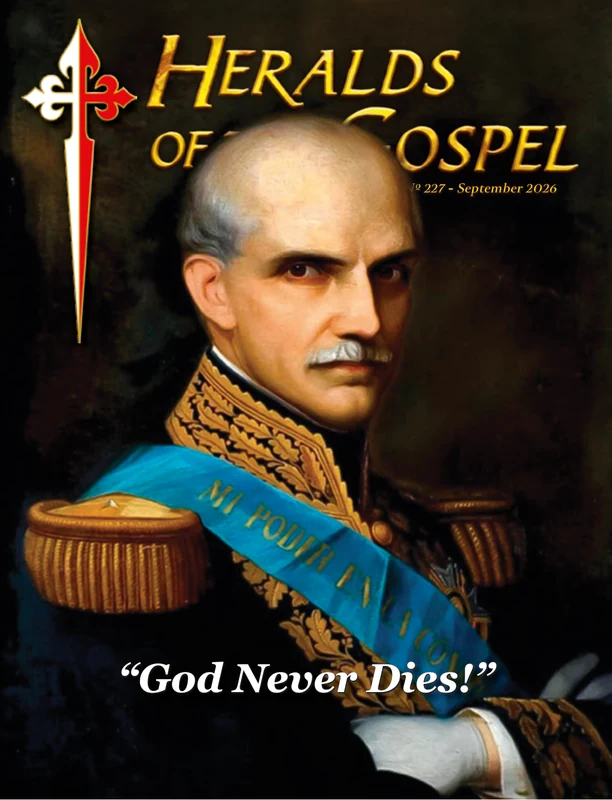
 Heralds of the Gospel Magazine, Vol. 20, nº 227, September 2026
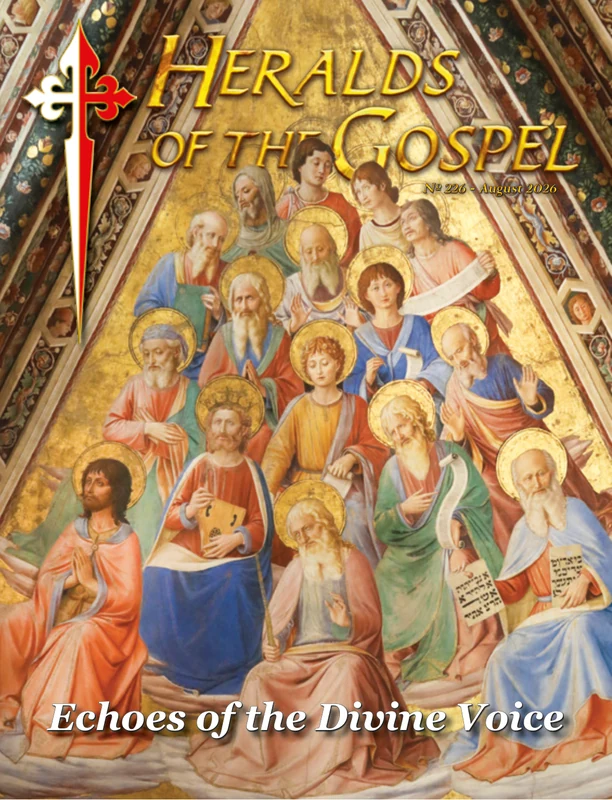 Heralds of the Gospel Magazine, Vol. 20, nº 226, August 2026
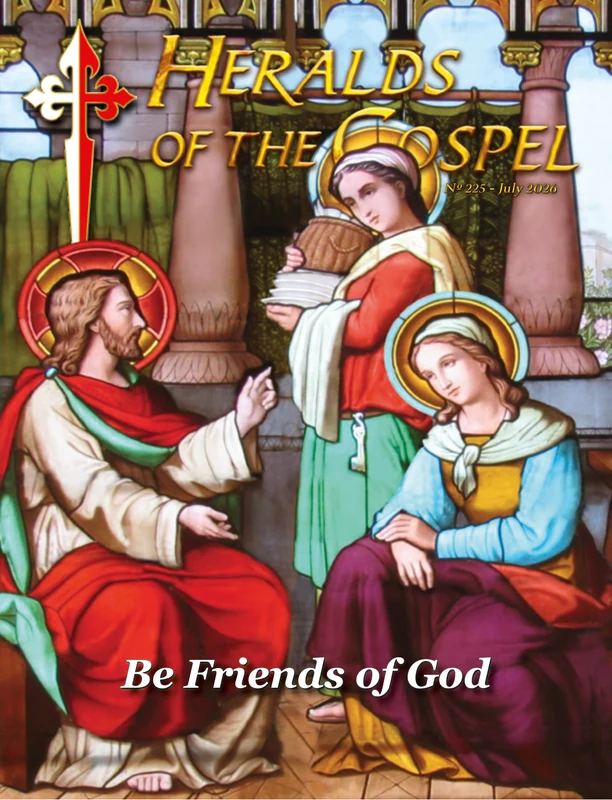 Heralds of the Gospel Magazine, Vol. 20, nº 225, July 2026
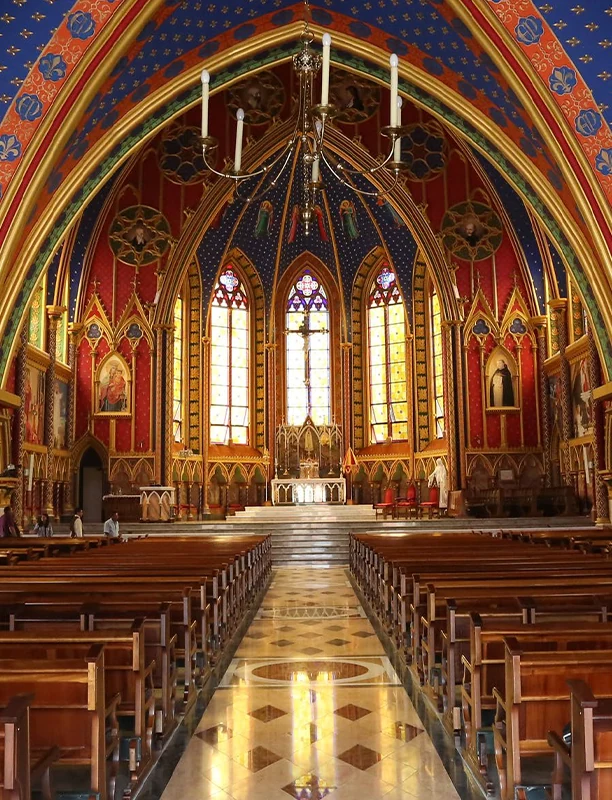 Who are the Heralds of the Gospel?
 Help of Christians
 Christmas Carols







A reality very present in our lives
Let’s look at the episode just described: together with the symbolic act of joining the two candles, St. Blaise gave a blessing to the child in need. This is a reality familiar to us, perhaps without our understanding it fully: the value of a blessing.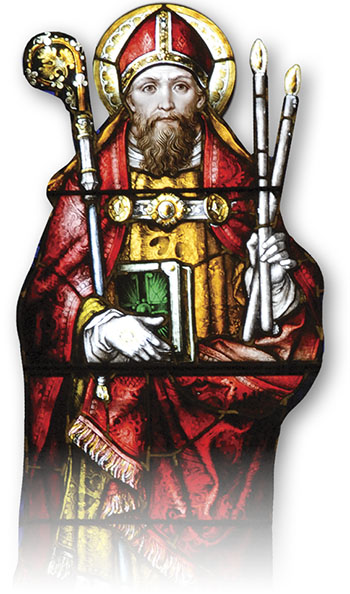 The blessing of St. Blaise obtained the cure the agonizing child, saving his life
St. Blaise - Cathedral of Salta (Argentina)
Blessings in the Old Testament
“For a father’s blessing strengthens the houses of the children, but a mother’s curse uproots their foundations” (Sir 3:9). The ancients used these terms with precision and were well aware of their reality, perhaps from personal experience. Up to the present day, the word blessing has been enriched with nuances and meanings – especially since the coming of Our Lord Jesus Christ to earth and the founding of the Holy Church – without, however, losing its original characteristics. In the Hebrew language, blessing derives from the noun berākā, which basically means the power that works salvation. From this word comes the name Baruch – the blessed one – the Old Testament prophet, disciple and helper of Jeremiah in his mission to the Israelites (cf. Jer 32:12-13). But the Eastern mentality, in its natural understanding of the symbolic value of things, discerned yet other predicates in this term. Indeed, the ideas of blessedness as happiness were present in the act of blessing or receiving a blessing. Thus, in addition to being a source of spiritual strength, the Israelites saw it as a seal on their destiny, certain that this privilege would not be cancelled, since it came from the Creator, who determines and guides the future of men: “God said to Balaam, ‘You shall not go with them; you shall not curse the people, for they are blessed’” (Nm 22:12).2 There was also a natural aspect. It was the Lord who made the fields fertile, life long and labour productive, and this too was a blessing: “You shall serve the Lord your God, and I will bless your bread and your water; and I will take sickness away from the midst of you” (Ex 23:25).With the coming of Christ, blessings were enriched
When the fullness of time had come, the blessing reserved for the chosen of the Old Testament was also granted to the new chosen people, the Holy Catholic Church. By His Birth, Death and glorious Resurrection, Our Lord Jesus Christ extended to the Gentiles the blessing of Abraham, so that by faith they might receive the promise of the Spirit (cf. Gal 3:14). The notion of blessing continued to be linked to divine protection; protection from evil, and strength and prosperity; both physical and spiritual. However, this reality had been enriched by the Incarnation of the Word, for the God-Man himself left His blessing to those who were the first living stones of the Church He founded: “Then He led them out as far as Bethany, and lifting up His hands He blessed them. While He blessed them, He parted from them, and was carried up into Heaven” (Lk 24:50-51). Our Divine Founder, desiring our holiness, made us heirs of the blessing (cf. 1 Pt 3:9) and left us the Church as a mother, endowing her with special privileges in the distribution of her riches (cf. Rom 15:29), through her sacred ministers. Thus, although the blessing is pronounced by men, it ultimately comes from God.3Healing souls and healing bodies
With the sacramental, the Holy Church has attached to certain objects and gestures, accompanied by a movement of reverence towards God and divine things, the forgiveness of venial faults and the obtaining of spiritual benefits. Unlike the Sacraments – which directly produce grace – sacramentals dispose us to receive it.4 They include priestly blessing, the use of blessed medals and scapulars, and the simple act of blessing oneself with holy water.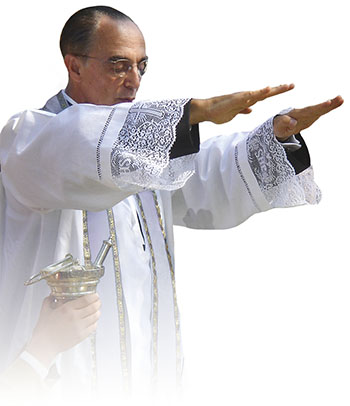 Msgr. João giving a blessing in the year 2005
The privilege of indulgences
In addition to these extraordinary benefits which blessings hold for man, they are often accompanied by indulgences. These are the remission before God of the temporal penalty attached to sins whose guilt has already been forgiven. The faithful who are duly disposed may obtain indulgences through the Church, who has the authority to apply the treasury of the satisfactions of Our Lord and the Saints. An indulgence is partial or plenary, depending on whether it remits this penalty in part or in whole. Here, more than in other cases, we see that the closer to God is the one who blesses, the richer the privilege will be: “The faithful who use with devotion an object of piety (crucifix, cross, rosary, scapular or medal) properly blessed by any priest, can acquire a partial indulgence. But if this object of piety is blessed by the Supreme Pontiff or any bishop, the faithful who use it devoutly can also acquire a plenary indulgence on the feast of the holy Apostles Peter and Paul, provided they also make a profession of Faith using any legitimate formula.”5 In this way, as if exuding a “fragrance of God”, the blessed objects begin to diffuse divine benefits. And some privileged souls have been able to “sense” the gentle presence of this of this supernatural aroma.Souls who “sense” the sacred!
Coming from the Greek language, the word hierognosis means knowledge of the sacred. This is the name mystical theology gives to the special gift granted by God to certain souls throughout history, by which they were able to sensibly recognize blessed objects, distinguishing them without hesitation from others. An eloquent example is found in the life of the mystic Louise Lateau, born in Bois d’Haine, Belgium, who surprised eminent doctors and theologians. When she received blessed objects, even if they were not precisely sacred or religious, she would smile with satisfaction, ready to kiss them, while she was completely indifferent towards those that were not blessed.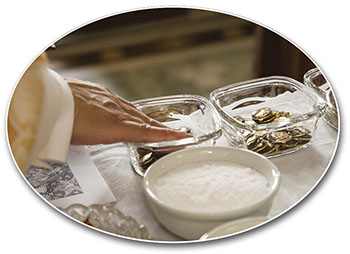 Objects that have been blessed by a priest begin to diffuse divine benefits
A priest blessing medals and salt
Notes
1 Cf. ST. THOMAS AQUINAS. Summa Theologiæ. II-II, q.1, a.4, ad 3.
2 Cf. JANOWSKI, Bernd. Bênção/Maldição. Antigo Testamento. In: BERLEJUNG, Angelika; FREVEL, Christian (Orgs.). Dicionário de termos teológicos fundamentais do Antigo e do Novo Testamento. São Paulo: Loyola, 2011, p.124-125.
3 Cf. SCHOLTISSEK, Klaus. Bênção/Maldição. Novo Testamento. In: BERLEJUNG; FREVEL, op. cit., p.125.
4 CCC 1670.
5 ST. PAUL VI. Indulgentiarum doctrina, norm 17.
6 ROYO MARÍN, OP, Antonio. Teologia da perfeição cristã. 4.ed. Anápolis: Magnificat, 2020, p.851.