 Heralds of the Gospel Magazine, Vol. 20, nº 227, September 2026
 Heralds of the Gospel Magazine, Vol. 20, nº 226, August 2026
 Heralds of the Gospel Magazine, Vol. 20, nº 225, July 2026
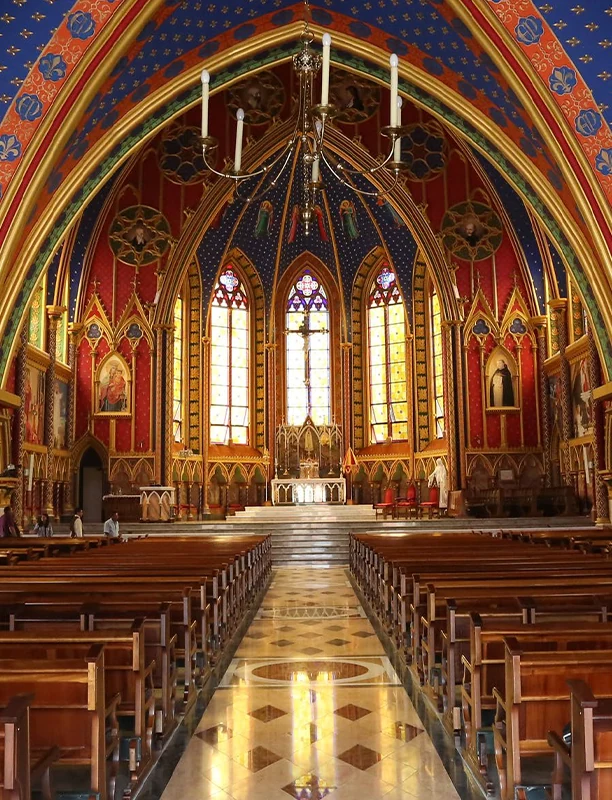 Who are the Heralds of the Gospel?
 Help of Christians
 Christmas Carols








Gospel of the Fifth Sunday of Easter
31 When Judas had gone out, Jesus said, “Now is the Son of man glorified, and in Him God is glorified; 32 if God is glorified in Him, God will also glorify Him in Himself, and glorify Him at once.33a Little children, yet a little while I am with you.
34 A new commandment I give to you, that you love one another; even as I have loved you, that you also love one another. 35 By this all men will know that you are My disciples, if you have love for one another” (Jn 13: 31-33a; 34-35).
I – The Harmony of Human Nature in Paradise
Life on earth is indeed a great trial. We come into this world to face a life tarnished by sin, replete with difficulties and only if we are faithful to grace will we merit the reward of eternal blessedness. This is the trial apportioned by the Creator to all intelligent beings; not even the Angels entered the beatific vision without undergoing it.1 Adam and Eve, our first parents, were admitted to Paradise, in grace, also to be tried, and were not faithful. In disobeying and eating the prohibited fruit, they were expelled from Eden and divested of many of the privileges conceded by God when they lived in the state of justice, such as infused knowledge which gave an understanding of nature’s secrets; impassibility, by which they were impervious to illness, and the magnificent gift of integrity.The gift of integrity
This most special gift harmonized the inclinations of the passions and the impulses of nature with divine law.2 The sensibility and the will were governed by a perfectly balanced intellect, and the latter submitted readily to the dictates of God. The order in man before sin was like a well-tuned motor with no loose parts, or like a fine piece of lacework with no missing stitches. All of the movements of soul and body were marked by complete and effortless equilibrium. With the gift of integrity we would never shed a tear, or experience pain, suffering, or dilemmas; everything would be in accord with the order established by the Creator. Only intimate knowledge of Our Lord and Our Lady confers an accurate notion of this privilege, since both possessed it from the first moment of conception, being untouched by even the shadow of sin. In Jesus, we find this gift in an infinite degree, for in Him all the human actions are reflections of the divine, in consequence of the indestructible union between both natures. This grace of union makes Him, even as Man, intrinsically and absolutely impeccable, and His Body and even His movements infinitely holy.3 With Our Lady, a purely human creature divinized by grace, this gift is manifested by the fact that she has no disordered movement. Where does man’s need for the gift of integrity come from? It comes from his being a microcosm—his nature encloses elements of the mineral, vegetable, animal and spiritual kingdoms, to which is added participation in divine life, by grace. These elements, with their contradictory laws, clash in man’s interior because of sin. For example, the spiritual element requires growing dedication to the impalpable and supernatural, yet the animal element eschews this tendency, diverting the attention to the physical and material. While God’s Law ordains that we should not covet the goods of others, our instincts induce us to appropriate whatever pleases us, whether it belongs to us or not. Examples abound, for behind the difficulties of this life there is relentless strife among the diverse laws which causes torment, perplexity and pain. We can say with St. Paul: “For I delight in the Law of God, in my inmost self, but I see in my members another law at war with the law of my mind and making me captive to the law of sin which dwells in my members” (Rom 7: 22-23). God’s precepts require a determined response from the Apostle, while his impulses lead him in a contrary direction. This is the dilemma that the human being faces on earth. To plan a life without suffering, then, is futile, for everyone suffers from setbacks. However, is there a feasible compensation for the absence of the gift of integrity, so that its effects somehow operate in our souls?Returning to the ways of integrity
The solution is found in a factor that has been likened, by one author, to the genre of the Sacraments4—as perhaps an “eighth Sacrament”—adding, analogically speaking, a new component to the definitive septenary which Catholic Doctrine teaches. It is suffering. The human soul is suited to suffering. Prof. Plinio Corrêa de Oliveira designates this as a ‘sufferative’ aptitude which consists in a “type of capacity and need to suffer.”5 Just as muscles need exercise to maintain tone, so do we—after having been expelled from Paradise and having forfeited the gift of integrity—need to undergo suffering to correct our disordered nature. And when our faculty for suffering “is not exhausted by effective suffering, it triggers a sensation of frustration that is greater than actual suffering. The life with the least suffering is a life of suffering. One of the deepest reasons for contemporary imbalances is the absence of suffering, because of the established paradigm that life without suffering is achievable.”6 Briefly put, what makes man happy in life—a state of trial—is suffering. This doctrine is only grudgingly acknowledged, for our nature cannot pass up happiness; it goes after it insatiably. But even the pagan philosophers grasped the role of pain in human life, simply by reason and logic. “I judge you unfortunate because you have never been unfortunate: you have gone through life without an antagonist; no one will know what you can do—not even you,”7 ventured Seneca. God Who created us with an avid desire for happiness, also granted our soul the ability to suffer. What is the reason for this divine conduct? The Liturgy for the Fifth Sunday of Easter instructs us on this point. "Last Supper", by Master of Sigena - Catalonia National Art Museum, Barcelona (Spain)
II – True Glory is only Born of Pain
The Gospel lays out a segment of the parting discourse of Our Lord at the Last Supper. Present at this most solemn moment, in which He instituted, for all time, the Sacrament of the Eucharist—the most precious of all the Sacraments, as regards substance—was an associate with malevolent intentions. After Judas received the piece of dipped bread, death entered him. For, although he was already in the state of mortal sin for having devised the betrayal of the Divine Master, he was then held prisoner by a devil that seethed with fury, who could no longer endure the humiliation inflicted upon hell by a Man who performed portentous miracles and was filled with power. The spirit of darkness had long perceived that his empire was tottering, that it was out of his control.831 When Judas had gone out, Jesus said, “Now is the Son of man glorified, and in Him God is glorified; 32 if God is glorified in Him, God will also glorify Him in Himself, and glorify Him at once.”
The Father desires utmost glory for the Son
This glory was accomplished at the moment in which Our Lord fully consented to the Passion, He Who is both the Second Person of the Most Blessed Trinity and most perfect Man with His soul in the beatific vision, gifted with infused knowledge and experimental understanding. His exaltation consisted in being arrested, undergoing the torture of condemnation, climbing Calvary, being raised aloft on the Cross, and from there, pouring out all His Blood and having His Heart pierced. The eternal Word inverted a law that He had instituted to become incarnate. For despite the fact that His soul was created in the beatific vision, He assumed a suffering body, when it could rightfully have been glorious.10 He rejected this prerogative because He willed to take on a body similar to ours, except for the stain of sin, to be able to suffer, to give us example and, principally, because the Father so desired it, intending that His eternal glory as man be the greatest possible. By accepting suffering well, and loving it, He triumphed. Fulfilment of the Father’s designs, then, did not require the magnificence of the glorious body, the splendours of worldly power or praise from men, but rather conformity with suffering. Moreover, Our Lord was aware that His end was not death, but rather Resurrection and Ascension into Heaven, where He would receive definitive glorification and eternal acknowledgement from the Father, the blessed and the Angels, for having fulfilled His redemptive mission. Reciprocally, the Father would also be glorified, because He and the Son are one. It was this substantial union that would enable Jesus, by the acceptance of suffering as it presented itself, to extol He Who had sent Him.Our glory should also be in suffering
Deeper reflection on the sufferings of Christ reveals that our glory is also achieved through suffering. It is not uncommon for grace to inspire us to follow a certain path, upon which we set out enthusiastically, only to come across difficulties on the way. Suffering should never make us lose heart. Rather, when the cross appears, we should imitate Our Lord Jesus Christ, that is, we should kneel and kiss the instrument of sorrow and shoulder it with determination, certain that in this way we have embarked on the path of glory. St. Francis de Sales wisely teaches: “How happy are the souls who […] drink courageously from the chalice of sufferings with Our Lord, who mortify themselves in carrying their cross, and who suffer and receive from His divine hand all manner of tribulation, with submission and love, according to His good will.”11 The same Doctor of the Church comments: “Patient forbearance of pain and distress is the worthiest offering we can make to Him Who saved us by suffering.”12 We must undergo strife to win a happy eternity. In accepting sorrow with entire resignation, love and piety, we draw peace into the soul, for we silence egoism and we express, not only by words, but also by actions, the desire for Heaven. “Happiness consists in suffering with proper deliberation, taking into consideration a determined end.”13 Therefore, when tribulation descends upon us, we should never murmur against God for having permitted it; we should follow the example of Jesus, Who exclaimed: “If Thou art willing, remove this cup from Me; nevertheless not My will, but Thine, be done” (Lk 22: 42). Let us be glad and conformed to the will of God, certain that everything that happens to us is for the good of our souls, for He cannot desire our downfall. Let us joyfully consider that our stay on earth is passing, for, if we were to remain here forever, these torments would continue in a fluctuating and indefinite succession. Therefore, for those who bravely confront trial in imitation of Our Lord, death will signify true rest. This is why the Church chants in the Liturgy of the Dead: “requiescant in pace — may they rest in peace.” This was also the teaching of St. Barnabas and St. Paul to the faithful of Antioch, which we contemplate in the first reading of this Liturgy: “Through many tribulations we must enter the Kingdom of God” (Acts 14: 22). On the other hand, the absence of suffering implies the loss of a valuable opportunity to acknowledge our incapacity and dependence on God, since we exist only because He sustains our being, moment by moment. It is only suffering that convinces us of this dependency, for it shows us our littleness and leads us to acknowledge our need of an infinite Good, which does not come from us.III – An ancient Practice with a new Form
Jesus offers us a way to ensure that this well-accepted suffering bears fruit; a new commandment to guide the conduct of all who consider themselves to be His disciples.33a “Little children, yet a little while I am with you.”
34 “A new commandment I give to you, that you love one another; even as I have loved you, that you also love one another.”
Love is shown in the effort to sanctify others
The extent of divine love is immeasurable, for God is so disposed to do everything necessary for our sake, that He offered His own life for us to the point of crucifixion which was the worst torment of those times. He immolated Himself for all humanity and He would do the same for only one person. This is why our love for others should also be taken to its ultimate consequences, with the view that each person receive what God wants for each: holiness. To desire that our neighbour cut with an egotistic, pragmatic and self-interested view of the world, and advance toward the Heavenly Jerusalem is the most perfect way we can show our love. To achieve this we should employ every means at our disposal—putting up with his weakness, correcting him compassionately, giving good example and sacrificing our personal tastes and preferences if this aids his practice of virtue. We know that these small actions are very little when compared with what is reserved for us when we cross over into eternity, obtained through the infinite merits of our Divine Model. It is a marvellous commandment which, when practiced, sets the soul in order, and eliminates attachments, whims and difficulties in human relationships. In this manner, all miseries disappear, and only a supernatural love remains, which is the tenderness of God for His creatures and of creatures among themselves. It is also appropriate for each of us to apply this teaching on an individual scale. Having considered what our love for others should be, let us now reflect on a tendency that comes from the ill-conceived practice of humility, by which, in view of our own insufficiencies we become self-destructive, contrary to the love of God. Since we have been created, we can have full certainty that we have some divine reflection that we should esteem which should be the object of our love for ourselves, alongside His love for us. When we perform a good act and He rewards us, He is not exalting our effort, but His own gifts,18 and, therefore, He glorifies Himself. Since they are His gifts that we acknowledge in ourselves, we must love them in order to practice the new commandment in its totality.The distinguishing mark of true Christians
35 “By this all men will know that you are My disciples, if you have love for one another.”
 "Apparition of Jesus and Mary to Saint Francis" - Fresco in the Chapel of Porciúncula, Assisi (Italy)
IV – Suffering and Love: Causes of the Final Reward
Before the scene unveiled by the Gospel of this Fifth Sunday of Easter, we should recall the end to which we are led by this supernatural notion of suffering and love of neighbour unto the imitation of Our Lord’s love for us. This end is clearly pointed out in the second reading, taken from Revelation: “Behold, the dwelling of God is with men. He will dwell with them, and they shall be His people, and God Himself will be with them; He will wipe away every tear from their eyes, and death shall be no more, neither shall there be mourning nor crying nor pain any more, for the former things have passed away” (Rv 21: 3-4). St. John prophetically indicates the place destined for all those who follow the Redeemer’s counsels; a place where pain is no more and joy is complete in the vision of God face to face. Next to eternal happiness, all sufferings here on earth are as nothing, as the words of St. Thérèse of the Child Jesus portray: “For a suffering borne with joy [...] during the whole of eternity I will love God better.”19 Yes, we will not even remember our difficulties in this world, for the state of trial will have passed like the wink of an eye. Only blessedness will remain. We are incapable of conceiving how life in eternity will be; it will be so replete with delight that St. Paul, after having ascended into the third heaven, returned unable to express in human terms what God had prepared for those who love Him (cf. 1 Cor 2: 9). St. John Bosco, having visited in a dream the antechamber of Paradise, returned describing wonders.20 The company of the Angels and saints, Our Lady and God awaits us; but to reach this Kingdom, let us accept with resignation all the suffering that Divine Providence permits for our good, and love our brothers with sincere affection. Let us remember that sorrow ends at the moment of our death, while in Heaven “love never ends” (1 Cor 13: 8).◊Notas
1 Cf. ST. THOMAS AQUINAS. Summa Theologiae, I, q.64, a.2. 2 Cf. Idem, q.95, a.1. 3 Cf. ROYO MARÍN, OP, Antonio. Jesucristo y la Vida cristiana. Madrid: BAC, 1961, p.72-73. 4 Cf. BEAUDENOM, Léopold. Méditations affectives et pratiques sur l’Évangile, vol. I. Paris: Lethielleux, 1912, p.227-228; FABER, apud CHAUTARD, OSCO, Jean-Baptiste. A Alma de todo Apostolado. São Paulo: FTD, 1962, p.112. 5 CORRÊA DE OLIVEIRA, Plinio. Conference. São Paulo, May 23, 1964. 6 Idem, ibidem. 7 SENECA. Tratados filosóficos, Cartas. Mexico: Porrúa, 1979, p.75. 8 Cf. ST. THOMAS AQUINAS, op. cit., III, q.81, a.2. 9 TANQUEREY, Adolphe. La Divinisation de la Souffrance. Tournai: Desclée, 1931, p.26. 10 Cf. ST. THOMAS AQUINAS, op. cit., III, q.14, a.1, ad 2. 11 ST. FRANCIS DE SALES. Sermon pour la Feste de Saint Jean Porte-Latine. In: Œuvres Complètes, vol. IV: Sermons. (Ed.2). Paris: Louis Vivès, 1862, p.540. 12 ST. FRANCIS DE SALES. Lettre CXII, à une Dame. In: Œuvres Complètes, vol. X: Lettres Spirituelles, op. cit., p.333. 13 CORRÊA DE OLIVEIRA, op. cit. 14 ST. JOHN CHRYSOSTOM. Homilia LXII, n.3. In: Homilías sobre el Evangelio de San Juan, vol. III: 61-88. Madrid: Ciudad Nueva, 2001, p.130. 15 Cf. ROYO MARÍN, OP, Antonio. Dios y su Obra. Madrid: BAC, 1963, p.451. 16 Idem, ibidem. 17 SAINT-EXUPÉRY, Antoine de. Vol de Nuit. Paris: Gallimard, 1931, p.104. 18 Cf. ST. AUGUSTINE. Epistola CXCIV, c.V, n.19. In: Obras, vol. XIb. (Ed.2). Madrid: BAC, 1972, p.71. 19 ST. THÉRÈSE OF LISIEUX. Letter 43b, to Sister Agnes of Jesus. In: General Correspondence. Washington: Institute of Carmelite Studies, 1982, v.1, p.400. 20 Cf. ST. JOHN BOSCO. Vestíbulo del Cielo. In: Biografía y Escritos. Madrid: BAC, 1955, p.654-663.