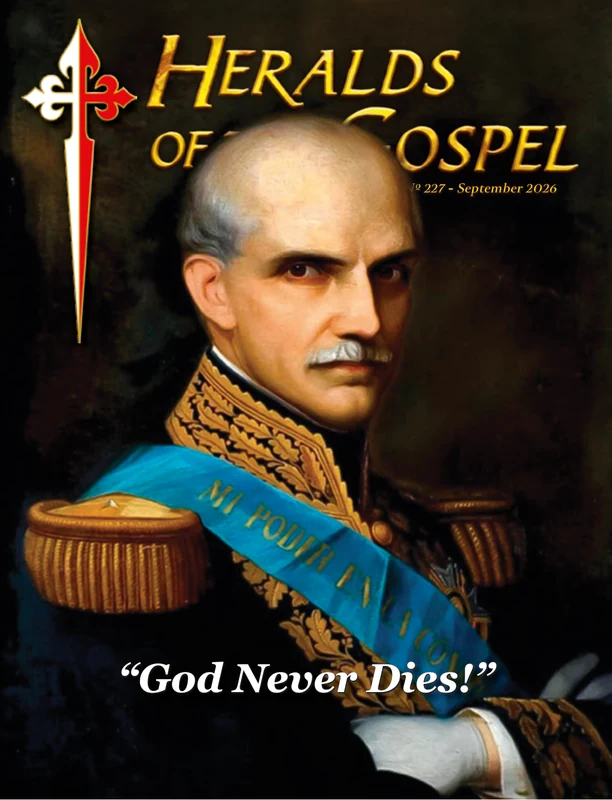
 Heralds of the Gospel Magazine, Vol. 20, nº 227, September 2026
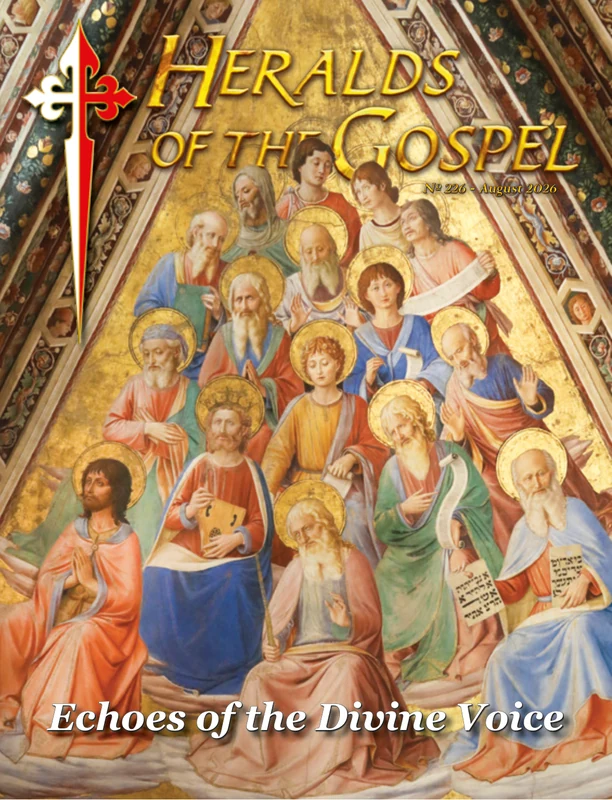 Heralds of the Gospel Magazine, Vol. 20, nº 226, August 2026
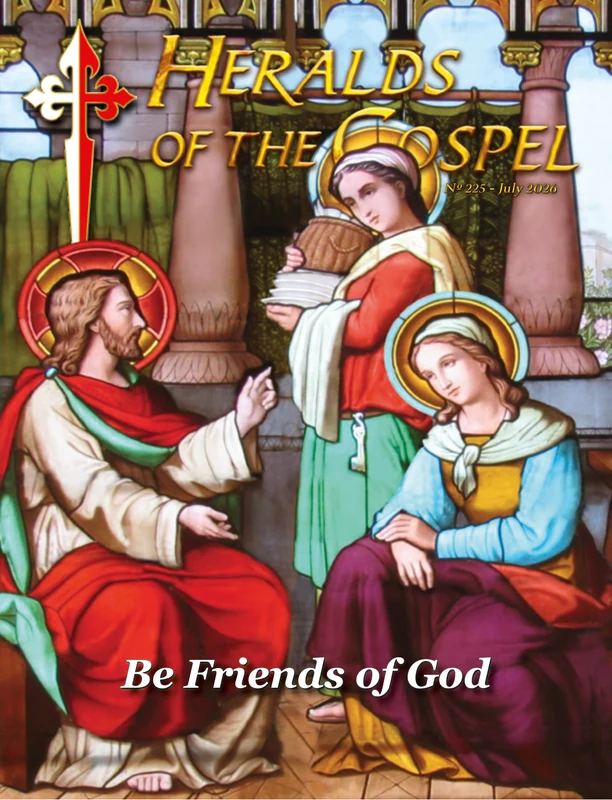 Heralds of the Gospel Magazine, Vol. 20, nº 225, July 2026
 Who are the Heralds of the Gospel?
 Help of Christians
 Christmas Carols







A new Peter for the Church
The Cathars, also known as the Albigensians, were swarming Europe with fury and cunning. Of unknown origin, they came to light as the most dangerous heresy the Church encountered in medieval times. Their doctrine was a revival of Manichaeism, affirming the existence of two gods – the good god, creator of the spirit, and the evil god, creator of matter – and upheld a strict puritanism which, paradoxically, could only lead to moral depravity. They used force and arms to gather crowds of indifferent or mediocre souls, thirsting for an easy life without the need to fight against vices. The main aim of this heresy was undoubtedly to hinder the Holy Church’s influence, dominion and capacity for expansion. Many Popes and Saints had already battled energetically to contain this power that was growing, sometimes openly, sometimes surreptitiously; St. Dominic of Guzman, with his spiritual sons, travelled vast regions fighting with the sword of the word. True spiritual jousts were held in public squares, which were attended by large crowds of good Catholics who were fond of fighting and thirsted for the truth in those confusing times. While these brave paladins of the Virgin were fighting in defence of the Faith, a new Peter was born in Verona, Italy, chosen from his mother’s womb by grace to repel the attacks of the hosts of evil, uphold the Church and be a rock of unshakeable firmness.The little polemicist
Born to Cathar parents, Peter displayed an outstanding purity, candour and innocence from an early age. Even before attaining the full use of reason, he mysteriously seemed to profess the one true Faith. It is said that when he was still a tender baby, he refused to drink the milk of any Cathar nurse, and if obliged to do so, he cried and resisted as much as possible. When he grew up, he shunned the company of children of this pernicious belief, keeping himself immune from heresy. Little by little, Peter was rising like a tower of integrity, like a beautiful lily born in the midst of the mud of false doctrines and irreligion. And God himself would water and cultivate this precious seed, to make it great in His eyes and those of the whole world. How? By making the boy a warrior in the fight against evil. And the first enemy Peter had to face was the malice of his own relatives. In the absence of Cathar teachers to instruct him in letters, his father enrolled him in a Catholic school in the city. Nothing could have been more providential! One day after school, the little boy was returning home when he came across one of his uncles, well advanced in age and a staunch heretic, who asked him how his studies were going. Without hesitation, Peter made his firm profession of faith: “I believe in God the Father almighty, Creator of Heaven and earth!” His uncle countered with vile arguments, but the boy was undeterred: “Whoever does not believe in this first truth of faith will have no part in eternal salvation.”1 Truly, it was neither flesh nor blood that had revealed this to him (cf. Mt 16:17)! At these words, the old man shuddered and feared that a new David would emerge from that little polemicist, ready to strike the giant’s forehead with a deadly blow. Sometimes evil’s premonitions are accurate… His uncle and many other relatives began to exert special efforts to seduce him with vain promises or threats. But Peter, sustained by grace and prayer, remained firm in his integrity.Amid the pomp of Bologna, an encounter…
His father paid little heed to the family’s admonitions to guard his son from a Catholic education. Thus, at the age of fifteen, he sent him to the famous University of Bologna to complete his studies. There, a new enemy presented itself to Peter: the frivolous and worldly environment of student life, made up of licentious youth, full of vanity and illusions. The young man was mocked and persecuted… But he knew how to fly with the wings of the spirit and find a safe refuge in God; after all, he was not just a skilled polemicist, but a virgin warrior who would not compromise with evil. In the difficult situation the young Peter was now facing, God would come to his assistance. Even more famous than the university was the figure of St. Dominic of Guzman, who lived in Bologna, “already an old man, surrounded by disciples, with the halo of a founder and a hammer of heretics.”2 He drew crowds, converted people and persecuted evil. Like so many others, Peter must surely have experienced surges of enthusiasm in his heart for this man of fire. At the age of sixteen, moved by grace, he went to the Dominican monastery in the city to enlist in the new militia. Having been accepted, he achieved his most ardent desire to receive the habit of the Order at the hands of St. Dominic himself. It was the year 1221, already at the end of the founder’s life…
St. Peter of Verona receives the Dominican habit - Church of St. Nicholas, Valencia (Spain)
Invincible, persecuted and victorious orator
Salvation or perdition was at stake in the Saint’s sermons; many upon hearing him were converted and did penance. In one of his open-air sermons, the demons, furious at so many victories, appeared in hideous forms in order to disturb him and disperse the crowd. Then, with angelic simplicity, Peter traced the sign of the cross in the air, and the figures vanished without a trace. He was not only a polemical speaker, but he also came into direct contact with souls in the confessional, where he would spend hours on end. To a young man who had kicked his mother, he recalled Our Lord’s advice: “if your foot causes you to sin, cut it off” (Mk 9:45). And the boy, deeply moved, took his words literally… This episode was enough to launch a campaign of slander against the Saint. However, when Peter learned of what had happened he intervened, made the sign of the cross over the mutilated leg and put the foot back in its proper place. Instead of diminishing, his fame grew on an even larger scale. With each onslaught from hell, he came out stronger. One day, immersed in tremendous temptations against faith, he turned confidently to Our Lady for help. As he prayed, he heard her motherly voice: “I pray for you, Peter, that your faith may not fail. Yet you must encourage your brothers.”3 These words allow us to glimpse the excellence of his virtues and his exceptional vocation, for they are similar to those of the Saviour when He warned St. Peter the Apostle of the temptations that would befall him (cf. Lk 22:32).A trial comes with the blessing
God crowned him with mystical gifts, granting him to speak with Heaven. However, this same singular blessing became, at a certain moment, an occasion of suffering for him. In one of his nocturnal visits, the holy virgins Agnes, Cecilia and Catherine came to speak to him. Ill-intentioned monks instigated by the devil, hearing female voices in his cell, rushed to the prior of the monastery to accuse him. The superior, gathering the community in a general chapter, reprimanded Peter for this grave breach of the rule. He did not dare defend himself and received the harsh sentence of being banished to the monastery of Marca d’Ancona, with his permission to hear confession suspended. The Dominican accepted the burden of such harsh calumny. One day, in penitent solitude, he lovingly complained to the Divine Crucified One about having unjustly been made the object such infamy. And Jesus answered him: “Was not I, Peter, innocent? Did I deserve the opprobrium and suffering with which I was burdened during my Passion? Learn from Me to suffer with joy.”4 Peter was fortified by this lesson and understood that God wanted him to be conformed to himself. He was eventually proven innocent and the Supreme Pontiff, Gregory IX, appointed him General Inquisitor. His war against the heretics would thus become even fiercer.Defender of the Church, with faith and arms
Peter was implacable, vigorously attacking vice and error, obtaining new and resounding conversions. Cathar leaders argued with him in public, but were always defeated. In order to corroborate his preaching of the truths of the Faith, God gave the Saint the gift of working miracles. The sick were cured and, conversely, hardened heretics became ill… To show that the true God was the Creator of the visible world, he once blessed the heavens and, lo and behold, a refreshing cloud formed over the people attending a public debate.
Scenes from the life of St. Peter of Verona: obtaining the miracle of a cloud forming in the sky during a public debate, his martyrdom and his funeral - Church of St. Nicholas, Valencia (Spain)
A cry of faith on the threshold of eternity
It was April 6, the Saturday in the octave of Easter, and the Saint was returning to Milan with one of his companions. In the dense woods near the village of Bersalina, two heretics were waiting for him in hiding, as if to fulfil the Psalm: “He sits in ambush in the villages; in hiding places he murders the innocent” (10:8). Seized with hatred, one of the mercenaries, called Carino, rushed at the religious, striking him twice on the head with an axe. Without giving in to panic, St. Peter did not retaliate or alter the firmness of his faith in any way. Raising his voice in the midst of the uncontrolled shouting, he prayed: “I believe in God the Father almighty, creator of Heaven and earth!” And when he could no longer articulate words, he turned his hand into a tongue and his finger into a feather, writing on the ground with his own blood: “I believe in God!” Thus the Veronese Saint sealed the faith he had professed since he was a boy. Finally pierced through the heart with a dagger, he surrendered his soul to God. Such was his strength in life, and so it was in death.
St. Peter of Verona (second from the right) in glory, detail of “the Crowning of Our Lady”, by Fra Angelico - San Marco Monastery, Florence (Italy)
Notes
1 SÁNCHEZ ALISEDA, Casimiro. San Pedro de Verona. In: ECHEVERRÍA, Lamberto de; LLORCA, SJ, Bernardino; REPETTO BETES, José Luis (Org.). Año Cristiano. Madrid: BAC, 2003, v.IV, p.114.
2 Idem, p.115.
3 LEHMANN, SVD, João Batista. Na luz perpétua. 2.ed. Juiz de Fora: Lar Católico, 1935, v.I, p.339-340.
4 VAILLANT, A. Vie des Saints des familles chrétiennes et des communautés religieuses. Paris: Victor Palmé, 1865, p.227.
5 BLESSED DIEGO JOSÉ DE CÁDIZ. Modelo de inquisidores en la fé, y en el celo, que a su ministério corresponde. Écija: Benito Daza, 1786, p.68-69.