 Heralds of the Gospel Magazine, Vol. 20, nº 227, September 2026
 Heralds of the Gospel Magazine, Vol. 20, nº 226, August 2026
 Heralds of the Gospel Magazine, Vol. 20, nº 225, July 2026
 Who are the Heralds of the Gospel?
 Help of Christians
 Christmas Carols








What did she see in Jesus’ gaze? Reprehension? Yes, but also an immense compassion. And soon her life of sin became unbearable.
 St. Mary Magdalene -
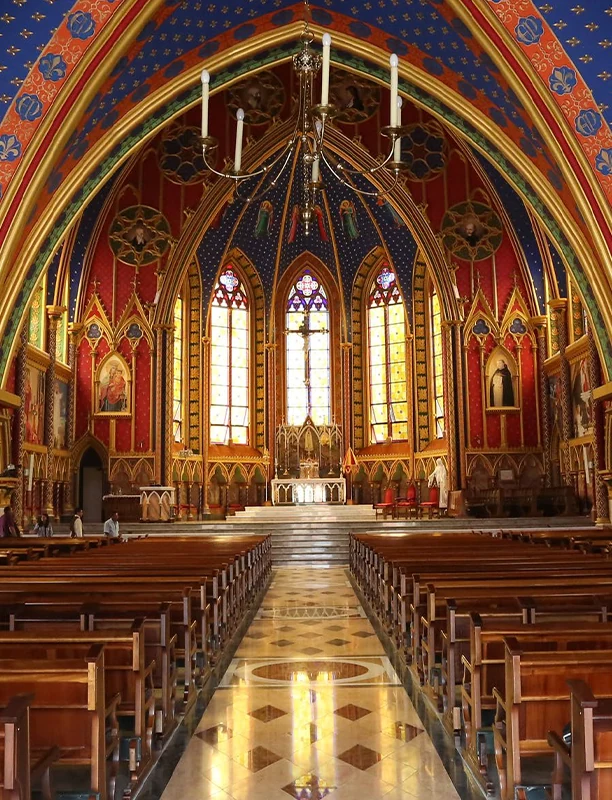
 Mount Carmel House, Caieiras (SP)
In her childhood, praise and pampering
According to the revelations received by this Blessed, Mary belonged to a wealthy family who owned many properties in Judea. One of them was next to the Temple in Jerusalem, the principal place of pilgrimage for the Jewish people and, as a result, a site by which a large number of people constantly passed. Little Mary was very beautiful, and her mother spoiled her and took delight in showing her off, setting her in a window, seated on cushions and dressed up in fine clothes, so that she could be seen and praised by the passers-by. This encouraged the worm of vanity to develop in the girl’s soul, leading her to indulge in pride and self-contemplation from an early age… Another factor influenced the course of her life in a decisive way: the death of her parents when she was still very young. After the inheritance was divided among her siblings – Lazarus, Martha and another sister, whose name is not mentioned in the Gospel – Mary received a castle in the village of Magdala, in Galilee. She went to live there, accompanied by her attendants and servants, when she was but eleven years old. Without a higher ideal to guide her decisions and little inclined to follow the advice of those who tried to direct her towards the good, Mary ended up sinking into the worst vices, always seeking to satisfy the follies of her self-love.The encounter with the Master
While Magdalene spent her time and fortune in futile amusements, her siblings Lazarus and Martha drew closer and closer to Jesus. As both owned a large castle in Bethany, near Jerusalem, they offered hospitality to the Master on His way to His baptism by John the Baptist. It was on this occasion that Martha first spoke to Jesus about Mary and expressed her concern. Our Lord encouraged her to persevere in her prayers for her sister, strengthening her in the hope that Mary would eventually mend her ways. After some time, Martha succeeded in persuading Mary to go to meet Jesus, who was then in Jezreel, in Galilee. However, since the Divine Redeemer’s stay there lasted only a few hours, the sisters were unable to see Him. Shortly afterwards, again urged by Martha, the young woman agreed to accompany her to a place where Jesus had stopped with His disciples to preach to the people and work miracles. At a certain moment, when Mary was in the guesthouse, she went to a window to observe the activity below and caught sight of the Master walking by with His disciples. “He looked at her gravely as He passed, with a glance that pierced her soul.”3 A contemporary author rightly comments: “What was in those eyes? Reprehension? Yes, reprehension; but also compassion, immense compassion. Her life became unbearable for her.” From that moment on, “each sin engraved that gaze more deeply in her memory.”4 Some time passed until, faced with her sister’s insistence, Mary eventually gave in again and went to the place where Our Lord was to preach. “She was inwardly confused and a prey to interior struggle.”5 It was grace that was calling her! “When Jesus appeared and began to speak, her eyes and her soul were riveted on Him alone.”6 Hearing Our Lord’s words and witnessing the healings He performed softened that hard heart, which from then on, without knowing exactly why, sought to draw near to the Master. Jesus in the house of Simon the Pharisee - Church of St. Quintinus, Tornai (Belgium)
“Her sins, which are many, are forgiven”
The opportune moment arose when a Pharisee invited Jesus to a banquet in his house (cf. Lk 7:36-50). As the seer recounts, Mary noticed that the Redeemer had not received, either before or during the meal, any gesture of honour or the respectful attention commonly shown to guests.7 This led her to take the initiative related by the Evangelist. She “brought an alabaster flask of ointment, and standing behind Him at His feet, weeping, she began to wet His feet with her tears, and wiped them with the hair of her head, and kissed His feet, and anointed them with the ointment.” (Lk 7:37-38). Mary wanted to express her repentance and beg forgiveness, but she could not manage to say a word; they were drowned out by tears. She could only kiss the feet of her Saviour as she wept, not sure whether from love or sorrow. With her head bowed, she heard Our Lord ask the Pharisee: “A certain creditor had two debtors; one owed five hundred denarii, and the other fifty. When they could not pay, he forgave them both. Now which of them will love him more?” (Lk 7:41-42). How those words must have echoed in Magdalene’s soul! And then she dared to raise her eyes… meeting with that gaze that had once reproached her, now transformed into an ocean of gentleness and goodness. Turning towards her, Jesus said to the Pharisee: “Do you see this woman? I entered your house, you gave Me no water for my feet, but she has wet my feet with her tears and wiped them with her hair. You gave Me no kiss, but from the time I came in she has not ceased to kiss my feet. […] Therefore I tell you, her sins, which are many, are forgiven, for she loved much” (Lk 7:44-45, 47). Oh, wonder! As Mary washed the Saviour’s feet, her soul was purified; as she anointed them with balsam, the pleasing odour of divine forgiveness inundated her entirely. And the Lord confirmed all that she felt in her soul, saying to her: “Your sins are forgiven. […] Your faith has saved you; go in peace” (Lk 7:48, 50). “Noli me tangere”, by Fra Angelico - Monastery of San Marco, Florence (Italy)
The first to announce the Resurrection
From then on, Magdalene “followed Jesus everywhere, sat at His feet, stood and waited for Him everywhere. She thought of Him alone, saw Him alone, knew only her Redeemer and her own sins.”8 She accompanied Him until the supreme hour of His Passion and Death: “standing by the Cross of Jesus were His Mother, and His Mother’s sister, Mary the wife of Clopas, and Mary Magdalene” (Jn 19:25). And after the “consummatum est” she remained beside the Master’s lifeless Body until assisting Our Lady, with all care and delicacy, in embalming and burying Him, and finally leaving the sepulchre only because of the dangers of the night. Nevertheless, burning with love for the Lord, so uncontainable was her desire to be near His Sacred Body that she resolved to anoint it once more.9 Accordingly, on the day after the Sabbath, before dawn (cf. Jn 20:1), Mary Magdalene went to the tomb, and was stunned by the discovery that the Body had been “stolen”… It was the consummation of the separation, which brought with it the quintessence of sorrow. Fr. Antonio Vieira, with his characteristic eloquence, makes the following comment: “The sorrow of seeing Him stolen, or not seeing Him because He was stolen, was the sorrow of absence: Et hic dolor maior erat. Take note: Christ was as dead, stolen, as He was deceased; but deceased was less absent than stolen; because death was a semi-absence, it took His Soul, and left Him the Body; theft was total absence; it took His Body after the Soul had been taken. And as theft was the greatest absence of the beloved, so it was the greatest sorrow of the lover.”10 Such was her urgency to find the Body that, even when questioned by Angels, she does not stop to wonder that they are heavenly spirits speaking to her; the only thing she wants to know is where the Beloved is: “Because they have taken away my Lord, and I do not know where they have laid Him” (Jn 20:13). Mary fears nothing and is ready to overcome any difficulty. And she shows this when, without recognizing the Master in the One who asks her “Woman, why are you weeping? Whom do you seek?”, she answers: “Sir, if you have carried Him away, tell me where you have laid Him, and I will take Him away” (Jn 20:15). But when He calls her by name – “Mary” (Jn 20:16), a series of impressions, graces and delights flooded her memory. What nostalgia would she not have felt of hearing that “Mary”? Such was her intimacy with Our Lord that her first impulse was to throw herself at His feet to embrace Him. Jesus does not need to show her His hands and side, as He will do later with the disciples, in order to prove to them that He was not a ghost (cf. Lk 24:37). “Mary does not even question that He had died and risen: it was He, the Master.”11 Seeing her robust faith and not wishing to deprive her of merit,”12 the Redeemer does not allow her to touch Him, but sends her as the first herald of the Resurrection: “go to my brethren and say to them, I am ascending to my Father and your Father, to my God and your God” (Jn 20:17).“Arise, my beloved, and come!”
 Scenes from the life of St. Mary Magdalene - Notre-Dame Cathedral in Coutances (France)