 Heralds of the Gospel Magazine, Vol. 20, nº 227, September 2026
 Heralds of the Gospel Magazine, Vol. 20, nº 226, August 2026
 Heralds of the Gospel Magazine, Vol. 20, nº 225, July 2026
 Who are the Heralds of the Gospel?
 Help of Christians
 Christmas Carols







When it seemed that the “wine” of virtue and grace had run out, and decadent Christendom was turning to paganism, a specially chosen figure arose, pointing to the One who can solve everything.
The dawn of a life under the auspices of the Mother of God
If Bernardine’s affection for the Blessed Virgin was great, it was outdone by that of Her who had loved him first. Yes, for even before the child’s mind had opened to the things of the world, before his eyes had been enchanted by creation, even before his inexperienced tongue had uttered its first words, Mary had chosen him for herself. A question soon arose in his young heart: how should he dedicate himself to Her? What state of life did She want him to embrace? It was then that the dreaded and unwelcome plague struck at the gates of Siena. Bernardine, barely seventeen years old, applied himself heroically to helping the sick. After four months, exhausted by his labours, he himself fell victim to the plague, and it seemed that the end was near. However, contrary to the expectations of many, his health was restored. What should he do with his life, which Mary had given back to him? – he kept asking himself. Religion attracted him greatly; was this the will of God? Full of youthful fervour – so often opposed to prudence and “common sense” – Bernardine tried out the life of a hermit. With his characteristic humour, he would later recount this unusual experience: “I want to tell you about the first miracle I performed. It happened before I became a friar […]. I took the resolution that I wanted to live like an Angel and not like a man. I thought of settling in a forest, and I began to ask myself: ‘What will you do in the forest? What will you eat?’ I answered, ‘I will do as the Holy Fathers; I will eat herbs when I am hungry and drink water when I am thirsty.’ […] And after invoking the blessed name of Jesus, I put a portion of bitter herbs in my mouth and began to chew. I chewed and chewed, but they did not want to go down. Not being able to swallow them, I thought: ‘Let’s drink some water.’ But the water went down and the herbs remained in my mouth. I drank several mouthfuls of water with a single portion of herbs and I couldn’t manage to swallow them.”1 Dissuaded from the solitary life, having understood that this was not the path for which Providence had destined him, his eyes turned to the Friars Minor. He became enthusiastic about their rule, and the divine call was confirmed in a dream. Having divested himself of the honours derived from his bloodline and his earthly goods, Bernardine took the habit of St. Francis. It was September 8, 1402, the feast of the Nativity of the Blessed Virgin Mary and the date on which he turned twenty-two. Thus it was always under the protective mantle of the Queen of Heaven that he took the biggest steps of his life, as he recounted: “I was born on the day of the Nativity of the Blessed Virgin, and on the same day […] I was reborn, entering the Order of the Seraphic Father Francis; on this day I professed my vows in the Order, on this day I celebrated the first Mass and pronounced the first sermon to the people on the Blessed Virgin, by whose love and grace I hope on this day also to depart this life.”2Untiring dedication and zeal for souls
On one occasion the young Franciscan went to attend a sermon by St. Vincent Ferrer, whose words shook the crowds, pointing out the stagnation and paganism into which Christendom was sinking. The day before, Bernardine had spoken personally with the Dominican, which filled him with gratitude and consolation. And St. Vincent, discerning the call of his interlocutor, foresaw during the sermon the future that awaited him: “O my children, there is at this meeting a religious of the Order of Friars Minor, who will soon be an illustrious man in all Italy; his word and his examples will produce great fruit among the Christian people. I exhort you, therefore, to give thanks to God; let us all pray to Him together to fulfil what He has revealed to me.”3 Some time would pass before the prophecy was fulfilled. For many years Bernardine remained under the veils of anonymity. In the silence of the convent, he climbed the steps of virtue and knowledge in order to later, from the pulpit, transmit not only doctrine but radiate holiness. And it was due to this that the crowds “concurrebant ad ecclesias instar formicarum.”4 His untiring zeal would edify and convert multitudes in Italy, then immersed in Renaissance neo-paganism. From 1419 to 1422, his voice echoed in Lombardy, especially in Bergamo, Como, Mantua, Cremona, Piacenza and Brescia. He stayed in each city for a few weeks and then set out on foot to find souls in the neighbouring town to whom he could do good.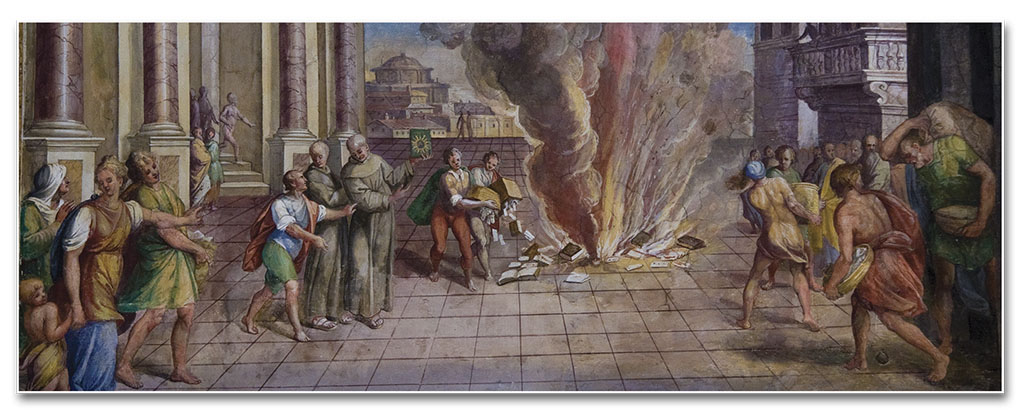 St. Bernardine of Siena burning dangerous books – Vatican Museum, Rome (Italy)
A lively and original method of moving hearts
In the pulpit, his genius and virtue united to attract sinners to friendship with God. The story is told, for example, that on arriving in the Umbrian city of Perugia he found a people indifferent to matters of faith, and given to continual and fierce internecine conflicts. Although many attended his sermons, Bernardine was not satisfied. One day, before the assembled crowd, he announced: “Dear inhabitants of Perugia, in the near future I intend to show you the devil.” Their curiosity was kindled, and the next day the audience had multiplied. And after a few days, the preacher declared: “Now I am going to fulfil my promise, and I will show you not just one devil, but many.” Everyone fixed their eyes on him attentively, wondering what depths would have to open up for the father of darkness to become visible. “Look at one another – continued Friar Bernardine – and what you will see is demons!” And in a tone of extreme gravity that tolerated no joking, the Saint warned the people that they were practising the works of Satan and therefore deserved to be called his children. Finally grace, conducted by Friar Bernardine, reached the hearts of those people and they experienced a complete conversion.A man of God is not to be taken lightly!
However, years later, discord and violence reigned again in the city and the Franciscan Saint returned there. “God has seen your dissensions, which He detests,” he said, having ascended the pulpit, “and has sent me to you, as His Angel, to speak to men of good will.” Four sermons followed, and Bernardine struggled to reconcile those souls. On the last day, he solemnly concluded: “Let all men of good will, desirous of peace, place themselves at my right hand.” The people, deeply moved, gathered en masse to the Saint’s right. All except one, who defiantly remained alone with his family on the left. Then the humble Franciscan showed that his zeal also transformed him, if need be, into an implacable judge. “There you are alone,” he said to the unhappy man, “obstinate in your error. I exhort you once more, in the name of God, to truly forgive others for what they may have done against you and your family. If you do not listen to me, you can be sure that you will not return home alive.” Now a man of God’s word is not to be taken lightly… The shameless man did not give up his bad conduct, and upon arriving home he died without receiving the Sacraments of the Church.At the name of Jesus, every knee will bend… even in the Renaissance
Many of St. Bernardine’s sermons have been preserved for posterity. Their simple and captivating style, full of metaphors and examples, allow us to recreate the atmosphere that surrounded him and, in some way, to feel the grace that hovered over him. Sermons that were the stage for a great battle, to which the Franciscan Saint would dedicate himself body and soul. In fact, as we turn the pages that make up St. Bernardine’s story, we must not lose sight of the dire situation of the world at that time, and how humanity was taking a course completely opposite to that which the Church had indicated over the centuries. Turning their backs on the Blood that had redeemed them and becoming so intoxicated with earthly things that they forgot Heaven, people were once again becoming drunk on the “old wine” of paganism. It was the arrival of the brilliant, but in so many ways reprehensible, Renaissance. God was expelled from His throne, and man took His place. The fruits of such a reversal of values were not long in coming: discord and war, immorality and madness became part of daily life. What was missing was someone who, like Our Lady at the wedding feast at Cana, could tell mankind: “Do whatever He tells you” (Jn 2:5), and lead them back to Jesus. This was the truly Marian role of St. Bernardine. For example, there was tremendous political strife among the inhabitants of Venice, as in many other cities of the Italian Peninsula. Houses were identified by a tile bearing the family name or coat of arms, which also indicated the party of the inhabitants. When Friar Bernardine passed through, his inflamed heart proclaimed the name of Christ to all, and the Venetians, moved, exchanged the marks of discord for a tile bearing the Most Holy Name of Jesus. And so, as he travelled through the cities, Friar Bernardine left behind him the name of Jesus engraved on homes and, above all, in hearts.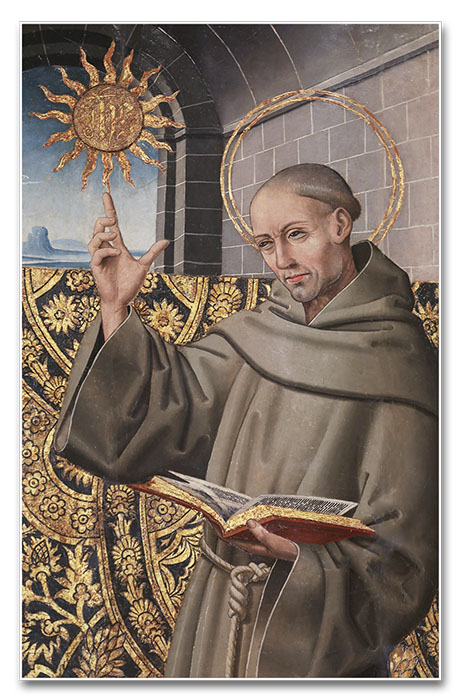 St. Bernardine, by Maestro de Osma -
 Lázaro Galdiano Museum, Madrid (Spain)