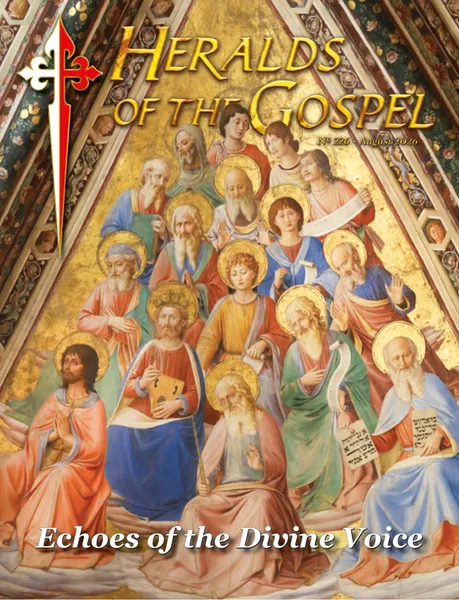
 Heralds of the Gospel Magazine, Vol. 20, nº 226, August 2026
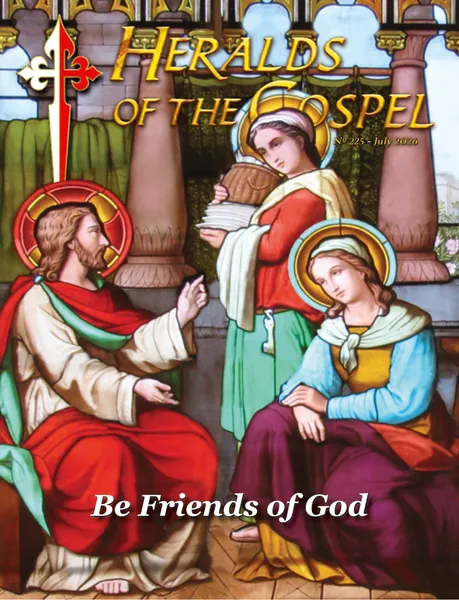 Heralds of the Gospel Magazine, Vol. 20, nº 225, July 2026
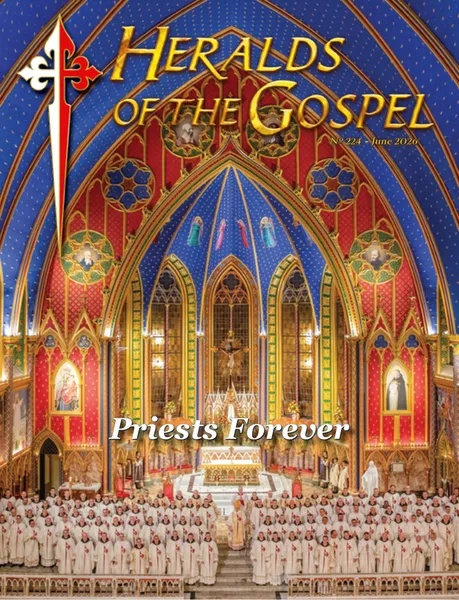 Heralds of the Gospel Magazine, Vol. 20, nº 224, June 2026
 Who are the Heralds of the Gospel?
 Help of Christians
 Christmas Carols








By declaring himself united in a symbolic marriage with Sister Poverty, St. Francis of Assisi left us a precious lesson.
Since the sharing of goods is inherent to marriage, we can imagine what “benefit” the holy mendicant must have derived from this mystical betrothal…
Sister Poverty, obviously poor by nature, and embodying virtues such as humility and meekness, is, nevertheless, rich in heavenly goods.
Theologically, through poverty we detach ourselves from earthly goods out of love for the heavenly pledge, as Christ prescribed: “If you would be perfect, go, sell what you possess and give to the poor, and you will have treasure in Heaven” (Mt 19:21).
Although this is a universal counsel, religious are to practise poverty with greater perfection through the profession of a vow.
Poverty is also a beatitude (cf. Mt 5:3), but not fulfilled in the same way by everyone.
It is often fitting for bishops, for example, to wear solemn vestments that manifest the fullness of the Sacrament of Holy Orders, so that they themselves may be reminded that they are Successors of the Apostles and may inspire the faithful to practise the virtue of honour, called dulia by St. Thomas Aquinas.
It is not their role to embrace a superficial poverty, but rather, by virtue of their office, to practise it in conjunction with the virtue of magnanimity, which also involves the possession of certain external goods.
Magnanimity, “which is also called greatness of soul or nobility of character, is a noble and generous disposition to undertake great things for God and for one’s neighbour”; it presupposes a “noble soul, […] a lofty ideal, generous ideas; a courageous soul that knows how to bring its life into harmony with its convictions.”1
Thus, among those who were at once magnanimous and detached we find St. Francis of Assisi, who “proclaimed to the friars the incomparable nobility, the hidden glory and the sublimity of imitating the humble and poor life of Christ.”2
The Franciscan tertiary, St. Louis IX, King of France, in building the dazzling Sainte-Chapelle; the mendicant St. Thomas Aquinas in erecting the exuberant monument of the Summa Theologiæ; the servant of the servants of God, the Supreme Pontiff, who from his See makes the authority of Christ shine forth as His Vicar.
The finest examples of harmony between poverty and grandeur are found precisely in the lives of the saints.
In them, magnanimous zeal for the Liturgy and for the instruction of the flock meant that they were not stingy in the use of earthly goods for the greater splendour of God’s service.
St. Clement Maria Hofbauer, renowned for his popular missions, remarked on the role of art in collaboration with the preacher, noting that “people listen more with their eyes than with their ears; they are captivated by what they see.”3
At the Redemptorist church in Warsaw, at the missionary’s instigation, an orchestra was not lacking; he was accompanied by dozens of violinists. He mentioned in a letter that he had acquired a valuable musical instrument in Vienna for use in the same church.
And to justify himself to certain irritated detractors, who held high office, he explained that:
It was not a matter of pleasing the ear, but of praising God. The more festive a religious service was, the more a person would experience God; through the harmony of music, heart and mind are lifted up to God and filled with devotion.4
In the presbytery he lit as many candles as possible, and the altar boys were dressed superbly. The vestments were the finest, and the place contained a Bible of great value.
Given the impressive results in terms of conversions and the administration of the Sacraments, it is perplexing to learn of the violent persecution unleashed against the holy Redemptorist, accused of “terrible” crimes…
A prototype of poverty, St. Francis, who even confessed to one of his spiritual sons – who was concerned about making savings for the future – that he would rather have the altar of the Blessed Virgin stripped if necessity required it, than break his vow of poverty for even a moment, was also very zealous in helping impoverished priests, especially with regard to the decent adornment of altars.5
St. Odilon, abbot of Cluny and great almoner, stated that “the gold of the Church is not meant to be accumulated, but to be distributed,” and one of his biographers recounts that he
gave up for the benefit of the poor beautiful vessels and jewels from his church, including the crown of Emperor Henry I, deeming it shameful to refuse these objects to Christ’s poor, since His Blood was shed for them.6
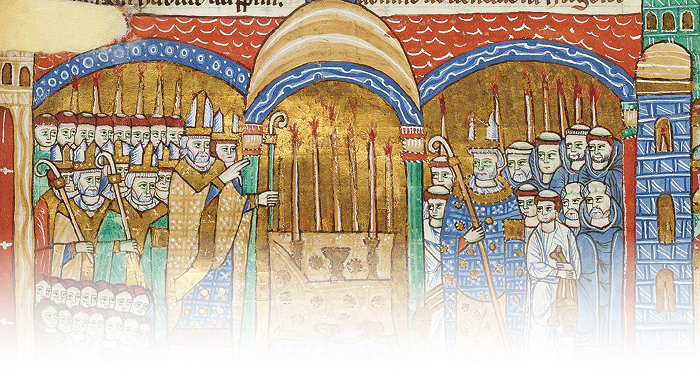
On the other hand, the same Saint – like the other Cluniac abbots – raised the splendour of the temples and the Liturgy to a surprising degree: valuable vestments, murals, gilded chandeliers, decorated books, candles in abundance, and every kind of ornamentation.
In short, Sister Poverty, when espoused by a just soul, does not generate meanness or pusillanimity, but rather the flourishing of the virtue of greatness, magnanimity.
Thus, the evangelical self-denial, lived in fullness by so many saints, is not an end in itself, but a means of emptying oneself for a greater manifestation of God’s glory: “He must increase, but I must decrease” (Jn 3:30).