 Heralds of the Gospel Magazine, Vol. 20, nº 226, August 2026
 Heralds of the Gospel Magazine, Vol. 20, nº 225, July 2026
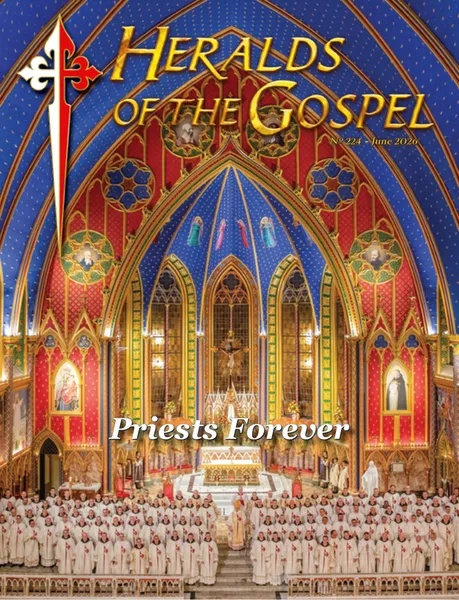 Heralds of the Gospel Magazine, Vol. 20, nº 224, June 2026
 Who are the Heralds of the Gospel?
 Help of Christians
 Christmas Carols









Silence… stillness… Let us pause for a moment and imagine ourselves in a solitary place where our senses can be better penetrated by the fullness of calm.
Be it on the peak of a towering mountain, on the edge of a misty cliff battered by the waves of the sea, in the luminosity of a desert, or in the delicacy of a pleasant woods.
Let us listen attentively to the whisper of the leaves moved by the wind, the murmur of a crystalline stream, and the symphonies of birds at dawn.
Let us imagine, with attentive ears, the rain falling and running down the stones. And, raising our minds with gratitude to the Creator of so many wonders, we will be predisposed to hear Him.
I now invite you to enter an ancient cloister, where the footsteps of a monk slowly echo in the arched passageway until they merge into the stone.
A short time later, amidst the chanting of the monks, we hear the distant silvery chiming of a bell announcing the celebration of the sacred mysteries in a secluded church located at the end of a snow-covered valley, where the praying people are already gathered.
Living moments like these – free from the hubbub of urban centres, the exhausting monotony of machines, the strident din of engines, and the endless noise pollution generated by our ailing society – has become a luxury that, regrettably, few have the chance to experience.
For the bodily ears, there is no such thing as absolute silence.
Even in a place completely isolated from external vibrations, this stupendous organ forged by God to make hearing possible would reveal the smallest internal movements of our body, including our heartbeats.

And so… what do we mean when we speak of silence?
One way to define it could be the pleasant perception, by the ear, of an ordered, moderate, and balanced environment, in which all sound comes from sources with rhythms and harmonies in consonance with human nature, without discordant stridency.
For this reason, the most exotic trill of a canary will not be felt as an aggression, but rather as a perfect complement; sometimes, even the imposing voices of the wind and the sea will unite to help us appreciate the silence.
The Gospel tells us that Jesus went to the mountains to pray alone (cf. Mt 14:23), for thus said “the Holy One of Israel, ‘In returning and rest you shall be saved; in quietness and in trust shall be your strength’” (Is 30:15).
The prophet Elijah also learned that it is not in the storm, nor in the fire and earthquake, that God reveals Himself to His servants, but rather in the whisper of a silent breeze (cf. 1 Kgs 19:11-13), because, as Ecclesiastes points out, “The words of the wise are heard in silence” (9:17 Vulg.).
In peace, understood as the tranquillity of order, man becomes capable of acquiring inner silence, which consists in the mastery of the passions.
St. Benedict,1 the father of monastic life in the West, also taught to value quietude as a forger of humility, stating that there are occasions when even kind words should be set aside for the sake of silence, until we learn, through struggle, the refined art of saying nothing that is not superior to it.
The friend who never betrays – according to the beautiful expression of Eastern wisdom – is not the nihilistic, egocentric, and sterile silence that some seek to achieve.
Because true silence is fruitful and more musical than any melody; countless wonders have sprung from its depths: preachers, apostles, architects, warriors, poets…
Perhaps its most eloquent version is the chant of the Holy Church, that is, Gregorian chant, “harmonious silence” par excellence, which, born from the silence of contemplation, engenders an even greater silence.
By analysing its simple and sublime melismas, emanating from souls that have attained inner silence, one will understand what is stated here.
Although it is difficult to escape the cacophony engulfing the vast majority of humanity, let us follow the counsel of Psalm 37 and trust in the Lord, keeping silent (cf. Ps 37:14-16).
From the peace we obtain in a well-lived interior life, harmonies will be born capable of silencing evil, casting it into the dark prison that the Just Judge destines for it.
Let us seek to distance ourselves from the noisy movement of diabolical and human voices that, like a turbid and violent river, threaten to sweep us away; and let us drink from the Absolute Silence, which is the Eternal Word.
An ocean of quietude, profound wisdom, countless treasures, joy, and infinite peace. “For God alone my soul waits in silence; from Him comes my salvation” (Ps 62:1).