 Heralds of the Gospel Magazine, Vol. 20, nº 227, September 2026
 Heralds of the Gospel Magazine, Vol. 20, nº 226, August 2026
 Heralds of the Gospel Magazine, Vol. 20, nº 225, July 2026
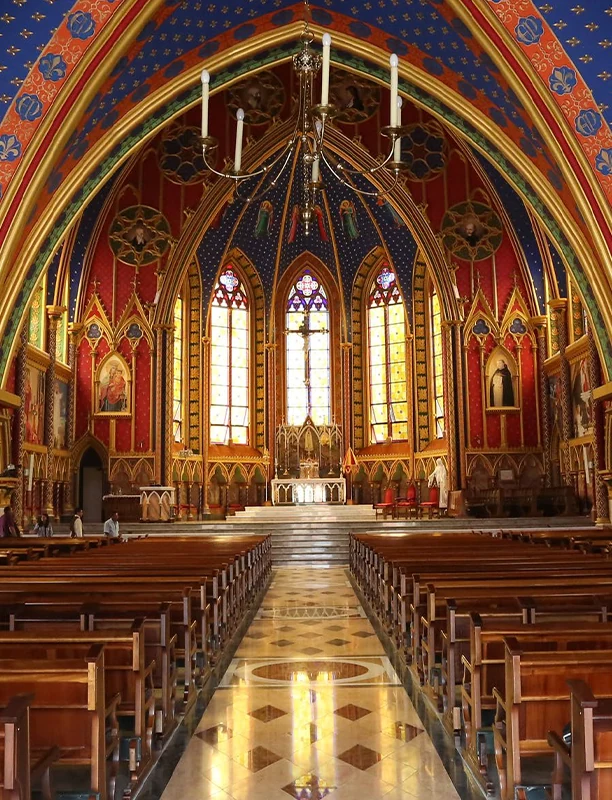 Who are the Heralds of the Gospel?
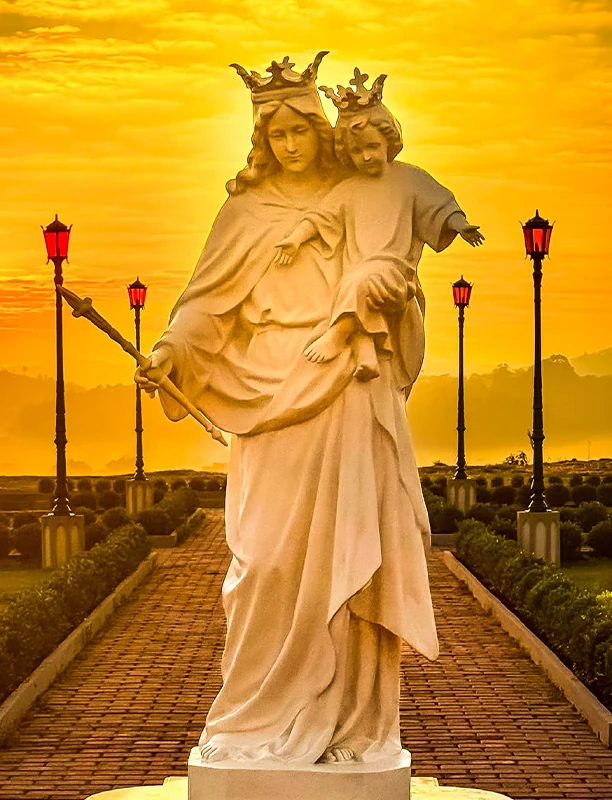 Help of Christians
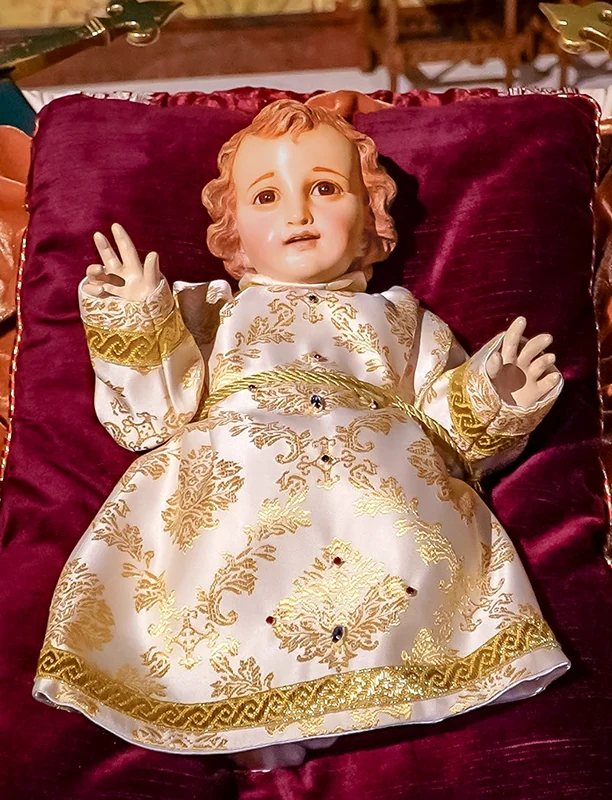 Christmas Carols









To perceive the excellence of every creature and appreciate the aspect by which it reflects God is a gift that prepares us, by way of affinity, for Heaven.
A lunch in the Monastery of St. Benedict
I remember the following scene I witnessed at the Monastery of St. Benedict in São Paulo. I was still new in the Catholic Movement and the feast of St. Benedict was being celebrated. At that time there was a tradition according to which, on the day of the Religious Order’s founder, the friars or monks would invite some friends to a festive lunch. I entered the hall very curious because I had never taken part in such a lunch. It was a two-storey high room, with a separate and raised table for the abbot, Dom Domingos de Silos Schelhorn, a venerable man. He had a beautiful gold cross on his chest, hanging from a chain, was dressed all in black, with a scapular and skullcap of the same colour, and on his finger he wore an amethyst ring. Next to him was a great historian – Afonso de Taunay,1 one of the guests at the celebration – and one or two other distinguished persons whose names I do not remember. Then there were two long tables, with friars, Benedictine monks and some lay people. As I was a newcomer, I was seated at the end of one of these tables. A beautiful light was streaming through the high windows; the tables were well set. The abbot prayed and blessed the bread that had already been placed on the tables and sat down with great distinction. Some Benedictine brothers entered in single file, carrying monumental plates, and began to serve. I found it very beautiful, very interesting, and I felt that it raised my soul to God. However, it was a temporal act, not the singing of the Office in church. At a certain moment I heard behind me, from above, a voice saying: “Continuation of the history of Cneius Pompey.” I looked back and saw a Benedictine friar reading an interminable biography of Cneius Pompey2 from the pulpit. He declaimed the text in melodious tones, from beginning to end. One could see that he was paying much more attention to the intonation than to the meaning of what he was reading, but that, at times, he had everyone engrossed with his narration. One stopped paying attention to the ambience to hear what he was saying: there was a chariot passing by, with fiery steeds and driven by a warrior; a little further on, an empress arrived; then a magistrate made a speech. Then one returned to daily life and continued eating.
One of the characteristics of Dr. Plinio’s spirit
I left there with my soul completely turned towards higher things, towards God, by means of the temporal and the material world. This was exactly the good use that Christian Civilization made of monasteries, but also of private homes – adapted, therefore, to family life. One of the characteristics of my spiritual formation was that the Blessed Virgin helped me very early on to perceive, with the ease proper to a child, the reflection of God in temporal things, and not only in spiritual ones. I delighted in spiritual realities, but I was not inclined, for example, to spend my whole life in a church. I would go to church on Sundays to pray, or when some need arose during the week; walking by a church, I would stop and go inside and, if I passed by one on the streetcar, and it caught my attention, I would analyse it. However, when I did enter, I would turn all my perceptive capacity towards the ecclesiastical and the supernatural, with great ease of soul. As for the material realities of temporal society, I also greatly enjoyed observing how proper and well-ordered they were, and I seemed to see in them a superiority and an attraction for my soul which, later on, with study and reflection, I understood to be a likeness of God.The attack of the Church’s enemies on temporal society
The Church is the centre of all order, of all beauty, of all dignity, not only in doctrine and morals, but also in the material aspects of churches, of worship, etc., which she preserved with incomparable splendour. Until a certain moment the Revolution had not attacked this, for fear of producing crystallizations. It had waged war on temporal society. And while the latter became more and more vulgar, bearing less resemblance to God, spiritual society seemed majestically frozen in time. Fashions changed; ambiences, manners, everything was decaying, but the Church seemed fixed in eternity, immovable in her dignity. I remember, at various times in my life, noticing the continual decadence of the customs of temporal society, of furnishings, of décor, in short, of everything, and observing the stability of the Church. My sensibility with regard to temporal things urged me to act against the Revolution, especially in the temporal field, which at that time was the one most under attack, and this led me to fight against immoral fashions, lack of good taste, vulgarity and so many other things, within the circles of whatever social class I might find myself.
Analogy between beauty and sanctity
Thus, I have seen magnificent things over the course of my life, both in Brazil and in Europe, especially. I have never been able to look at any of them without sensing a particular form of beauty very similar to virtue. In fact, true beauty resembles sanctity. And this in turn is the beauty of the soul. There is, therefore, an analogy between beauty and sanctity. The pulchritude of a material object is like a reflection of holiness, which is why beautiful things and not hideous ones are suited to Catholic worship. Our Lady obtained for me from God the gift by which, in all that is beautiful and sublime in the order of creation, I am able to perceive the excellence of each creature and distinguish what is dignified but common, or merely sufficient, and appreciate the aspect by which it reflects God. What idea of God does this give me? That which God wanted me to have. I look at something, perceive that it is beautiful and say: it is a likeness of Him, just as a work of art is of the artist who made it. There is an omnipotent Divine Artist who possesses all perfections and who created this from nothing, giving it this beauty so that I, by affinity, might know what He is like, and thus prepare myself for Heaven.An interesting, inexhaustible and sublime interlocutor
Let us analyse the sea. It is magnificent and very much like an interesting interlocutor, inexhaustible and sublime, who is capable of saying affable, charming things in some little corner of the beach where it curls around a snail. It has calm areas and, at the same time, others that roar; and it is all highly captivating! The sea would be an ideal interlocutor when it is about to tell us, for example, about a battle it fought: “I arose in the morning and the day was splendid”; one would see in it the beauty of the day. “I prepared for battle with great eagerness”; and one would note the pulchritude of youth. “I fought!”; and one would hear the strains of all the battle hymns in history. The sea is a great prose; it mimics an expansive human mind. However, the most dull-witted person is worth more than the entire sea. God has ranked things and established these chasms between them. If a stone could know a plant, it would sense an abyss, which is a small image of the abyss between the creature and the Creator. The difference from the plant to the animal, and from the animal to man are further images of this abyss; from the unbaptized man, and thus not belonging to the Church, to the baptized man who is in the state of grace, is yet another abyss. These abysses help us to measure how different God is from the entire created universe. And each being helps us to understand how God is. And then we, from our vantage point, exclaim: “My God, I have considered everything, measured everything. How your Mother must be and how You must be!” Oh, silence! Oh, grandeur! Like the abyss, that which is mysterious has its own beauty. At the same time, both supreme intimacy and infinite distance will delight us. Our Lord Jesus Christ has promised that He Himself will be our reward exceedingly great. These abysses, in their own way, are repeated in the relations between men. For although they are all essentially equal in nature, in their accidents they have profound inequalities.
We should be eager to contemplate superiorities
I now return to what happened in the Monastery of St. Benedict. That Benedictine was reading about Cneius Pompey in a tone of voice that reproduced, with Teutonic gravity – he himself was German – the impassibility of the centuries. It gave the impression of the grand march of the ages of history. If I were to read it, I would not do it like that. In that respect he is superior to me. And I should be eager to contemplate that superiority that makes me feel, know and learn something, and take delight in that superiority. It is another perfection that exists in the order created by God and which I did not know until then. I must love when I see others who are superior to me, just as I must love myself uprightly when I notice something in which I am more than another. Those, in turn, who are more than me should love my littleness, and those who are less, my grandeur. For in this interrelationship, creation mirrors not only God, but the difference that exists between it and its Creator. ◊Taken, with slight adaptations, from: Dr. Plinio. São Paulo. Year XXI. No. 247 (Oct., 2018); p.8-14