 Heralds of the Gospel Magazine, Vol. 20, nº 226, August 2026
 Heralds of the Gospel Magazine, Vol. 20, nº 225, July 2026
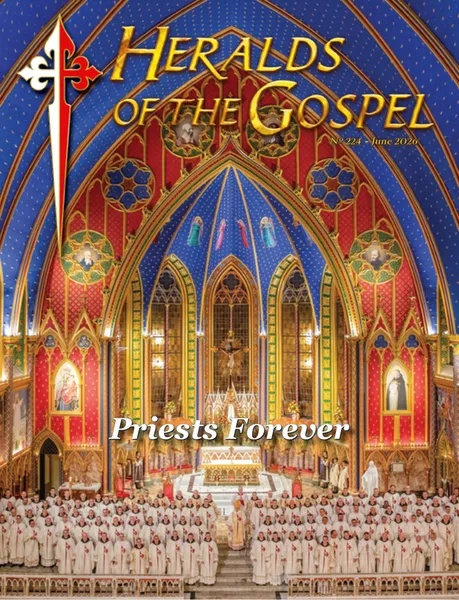 Heralds of the Gospel Magazine, Vol. 20, nº 224, June 2026
 Who are the Heralds of the Gospel?
 Help of Christians
 Christmas Carols





The Holy Scriptures present Jesus Christ as the High Priest of the New and Eternal Covenant, established by God through His Most Precious Blood shed on the Cross.
The Epistle to the Hebrews affirms this categorically; the Apocalypse represents Him in prophetic language, using symbolic figures; other New Testament writings manifest this when recounting the most prominent events in the life of Our Lord, especially when narrating His “Hour” or His “Passover,” that is, His passage from this world to the Father.
Perfect Priest and Immaculate Victim
The Letter to the Hebrews declares that Christ is “a merciful and faithful High Priest” (Heb 2:17), who atones for the sins of the world.
And comparing His priesthood with that of the Old Testament, it testifies that He “passed through the heavens” (Heb 4:14), where He remains because He possesses an eternal priesthood, therefore able to save definitively those who through Him approach God, for He is always alive to intercede for them (cf. Heb 7:24-25).
In short, Jesus is
holy, blameless, unstained, separated from sinners, exalted above the heavens. He has no need, like those high priests [of the Old Law], to offer sacrifices daily, […]; He did this once for all when He offered up Himself (Heb 7:26-27).
Therefore, Christians enjoy the favour of a High Priest “who is seated at the right hand of the throne of the Majesty in Heaven, a minister in the sanctuary and the true tent which is set up not by man but by the Lord” (Heb 8:1-2).
In it, He presents not the blood of goats or calves, but His own Blood, whose sanctifying power is incalculable (cf. Heb 9:13-14).
From this it follows that Our Lord brought His priesthood to perfection, offering a sacrifice of infinite value by giving Himself up to death, even death on a Cross (cf. Phil 2:8). He Himself was the Victim of His priesthood!
The priestly office thus reached an unsurpassed apex, for there cannot be a holier priest, nor a more pleasing victim, nor a more effective sacrifice.
Christ, in His ineffable kindness, willed that some of His chosen disciples should participate in this sublime and eternal new priesthood, as His ministers, from generation to generation, until the end of time. Now, what does this participation involve?
The liturgy of Calvary
The ancient priests performed ritual sacrifices, symbols of the Redeemer’s future sacrifice, and represented, above all, by the lamb sacrificed during the Jewish Passover.
Our Lord, in a different way, wished to offer Himself, raised on the wood of the Cross on the mountain called Golgotha, on the outskirts of the city of Jerusalem.
This was a bloody and real sacrifice, testified to this day by the vestiges in the Holy Shroud of Turin, which undeniably records the wounds of the nails, the lacerations from the scourging, and the marks of the crowning with thorns.
Furthermore, Jesus did not neglect the ritual aspect and wanted His sacrifice to constitute a sacred liturgy.
At the Last Supper, anticipating His martyrdom, the Eternal High Priest made the sacramental offering of Himself, transubstantiating the bread into His Flesh and the wine into His Blood.
He thus instituted the liturgical form of His sacrifice and His presence: the Holy Eucharist.
It is impossible to conceive of a greater gift! It is something so admirable that it becomes difficult to assimilate it.
He bequeathed His sacrifice to us with such propriety that the priest prays at every Mass: “Pray, brothers and sisters, that my sacrifice and yours…” Yes, the oblation of Jesus on the Cross is “ours.” What more can one desire or imagine?
At the same time, He left us His real and substantial presence, another gift of infinite value.
The promise of His permanence among men until the end of time is fulfilled in every tabernacle. Jesus is there is! His most sacred Heart is there, throbbing with love for every human being!
Origin of the Catholic priesthood
Along with the Blessed Eucharist, the priesthood of the New Covenant was instituted: “Do this in remembrance of Me” (Lk 22:19).
Our Lord wished to leave us His Body and Blood as a sacrifice, as food and as presence, and for this He made some of His disciples participants in His priesthood, charged by Him with celebrating the sacred liturgy of the Cross in a sacramental way.
Thus was born the Catholic priesthood, adorned with the power to renew, through the celebration of Holy Mass, the holocaust of Christ on the altars, offering the divine Bread and precious Blood as an oblation of sweet fragrance to the Father, and a sacrifice of communion for the faithful who receive Him as spiritual food and drink.
It can therefore be safely stated that there is no Eucharist without priesthood nor true priesthood without Eucharist, since there is no sacrifice without someone able to offer it, nor offerer without a victim to be immolated.
For this reason, St. John Paul II, in the Apostolic Letter Dominicæ Cenæ, reminds priests:
The ministerial and hierarchical priesthood […] [is] in the closest relationship with the Eucharist.
The Eucharist is the principal and central raison d’etre of the Sacrament of the Priesthood, which effectively came into being at the moment of the institution of the Eucharist, and together with it. […]
Through our ordination – the celebration of which is linked to the holy Mass from the very first liturgical evidence – we are united in a singular and exceptional way to the Eucharist.
In a certain way we derive from it and exist for it. We are also, and in a special way, responsible for it – each priest in his own community and each bishop.1
Therefore, each priest receives the immense gift of acting in the Person of Christ, taking His place and participating in His power, in order to renew His unique sacrifice for the benefit of the whole Church. The fruit of this renewal is Christ truly present in the Eucharist, adored by Christians in tabernacles throughout the world.
Called to full identification with Christ
The priesthood is an exalted vocation, freely granted, not in view of human merits or abilities, but of God’s merciful election.
Each priest is a fruit of the Father’s will, whom the faithful implore to send new workers into His vineyard (cf. Mt 20:1-16).
This must be taken seriously into consideration, both by the faithful – who must see this calling in the priest and respect it with veneration – and by the priests themselves, who must first and foremost be fully aware of their vocation, allowing themselves to be transformed inwardly by what it signifies, namely, God’s predilection and the very high responsibility for which they will have to give an account before Him and the Church.
For this reason, of the ordained priest is demanded an extraordinary holiness, commensurate with the gift he has received, as Pius XI teaches:
The Eucharistic Sacrifice in which the Immaculate Victim who taketh away the sins of the world is immolated, requires in a special way that the priest, by a holy and spotless life, should make himself as far as he can, less unworthy of God, to whom he daily offers that adorable Victim, the very Word of God incarnate for love of us.
“Realize what you are doing, and imitate what you handle,” says the Church through the bishop to the deacons as they are about to be consecrated priests.2
The same Pontiff concludes that, by virtue of being an instrument of our Redeemer, the priest is called to full identification with Christ; he even affirms that he must be “another Christ.”3
St. Pius X, in recommending to priests the practice of daily meditation to persevere in chaste love for the Lord and progress on the paths of holiness, also points out as a primary theme to be considered by priests: that of always keeping present in their minds, night and day, the singular grace of the priestly vocation, the call to be “another Christ.”4
Recently, Pope Leo XIV recalled this same principle, addressing the clergy of Madrid:
[Priests are] men configured to Christ, capable of exercising their ministry from a living relationship with Him, nourished by the Eucharist and manifested in a pastoral charity marked by the sincere gift of self.
It is not a matter of inventing new models or redefining the identity we have received, but of proposing again, with renewed intensity, the priesthood in its most authentic core – being alter Christus – allowing Him to shape our lives, unify our hearts, and give form to a ministry lived from intimacy with God, faithful dedication to the Church, and concrete service to the people entrusted to us.5
What is required of a priest?
Called to be “alter Christus,” the priest must imitate the example and virtues of the Lord Jesus, especially in his interior dispositions when celebrating Holy Mass, as St. Pius X teaches:
As His ministers in the august sacrifice which, with eternal wonder, is renewed for the life of the world, we must have the same disposition of mind with which He, on the altar of the Cross, offered Himself to God as an immaculate sacrifice.
For, in ancient times – when there was only a shadow and a figure of the true sacrifice – so much holiness was demanded of sacred ministers, how just will it be to demand it now that the victim is Christ?6
Herein lies the great responsibility of the clergy: through a serious, intense, and vigilant spiritual life, to strive to increase the sacramental grace received on the day of their ordination.
This grace invites and at the same time favours the granting of continuous supernatural aids so that the priest may imitate the charity that inflamed the Divine Heart of Christ, Priest and Victim, given up in the sacrosanct martyrdom of Calvary, out of His love of the Father and for humanity.
To obtain this grace, priests should fix their eyes on the example of the Blessed Virgin Mary, whose singular, supreme, and effective participation in the priesthood of Christ has been extolled by the Pontifical Magisterium.
As Pius XII teaches, it was She,
the second Eve, who, free from all sin, original or personal, and always more intimately united with her Son, offered Him on Golgotha to the Eternal Father for all the children of Adam, sin-stained by his unhappy fall, and her mother’s rights and her mother’s love were included in the holocaust.7
Ordained ministers ought therefore to unite their hearts to Mary Most Holy, so that, thanks to her infallible intercession, they may be one priest and one victim with Jesus, and finally be able to exclaim with St. Paul: “I have been crucified with Christ; it is no longer I who live, but Christ who lives in me” (Gal 2:20).
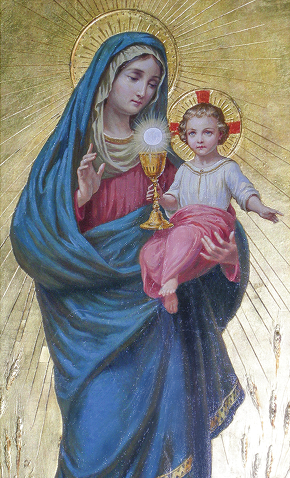
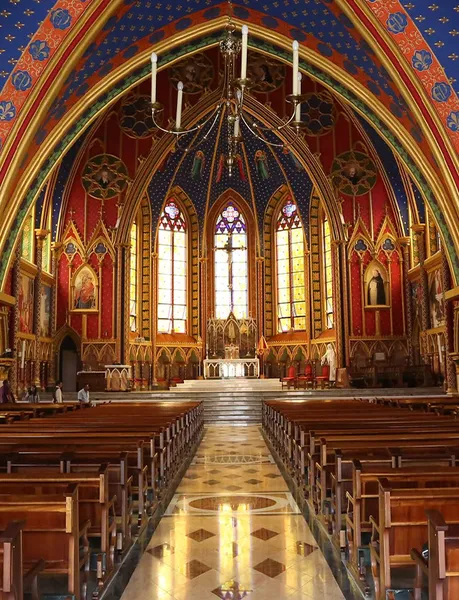
Sts. Claudius and Andrew of the Burgundians, Rome