 Heralds of the Gospel Magazine, Vol. 20, nº 226, August 2026
 Heralds of the Gospel Magazine, Vol. 20, nº 225, July 2026
 Heralds of the Gospel Magazine, Vol. 20, nº 224, June 2026
 Who are the Heralds of the Gospel?
 Help of Christians
 Christmas Carols









A famous French company specializing in fine carpets is working on a project with all due patriotic zeal.
At Chevalier, after cleaning antique Aubussons – a kind of fine rug –, ancient Persian tapestries and other historic items, the extracted dust – often centuries old – is collected in large sacks and distributed to the finest restaurants in Paris.
An unusual delivery to establishments known for their elegance… What is the reason for such a bizarre order?1
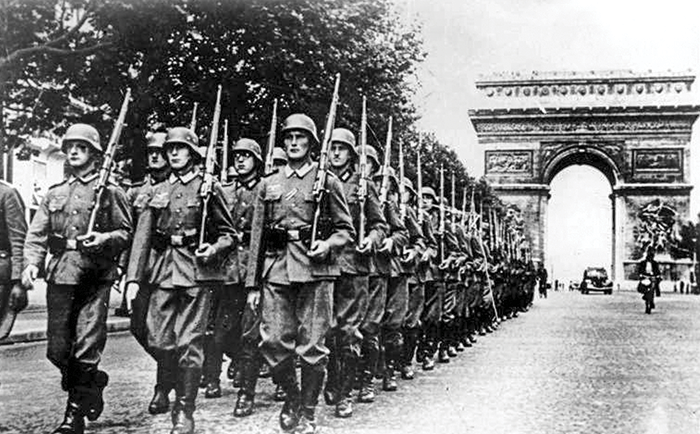
The year is 1940. Hitler’s military forces are carrying out the occupation of France, as well as several other European countries.
In the ongoing operation, many of the châteaux in the region are requisitioned for the use of the German military, who transform them into lodgings, artillery storage space, and surveillance centres.
However, amidst the confiscation of property, destruction of works of art, prohibition of national holidays and celebrations, devaluation of the local currency, and the imposition of labour in German factories by the S.T.O.,2 there was something else causing concern among the French population: their wine.
An ancient and highly prized art
Centuries of tradition have made French wines world-renowned gastronomic treasures, true refinements of Christian Civilization.
It is said, for example, that it was the austere monks of Cluny, in the 12th century, who taught the peasants how to plant and care for their vineyards.
And they discovered the benefit of pruning the vines in an unusual and picturesque way…
One day, in the year 345, St. Martin of Tours went out to inspect some plantations belonging to the monastery in the Loire Valley, leaving his donkey tied next to a row of vines.
Hours later, the Saint discovered, to his surprise, that the poor animal had helped itself to several branches as an appetizer… eating some of the vines down to the trunk.
The following year, however, the monks found that the vines most mistreated by the grazer were precisely those that became the most vigorous and produced the best grapes. They then began to prune the vineyards every year.
Well, donkeys were not the only ones who appreciated the delightful fruit of the vine.
In the Burgundy region, around the 10th century, winegrowers needed to guard their vineyards with weapons at hand because, in times of scarcity, packs of wolves would invade their properties to feed.
In this conflict, the factor that saved both vines and winegrowers was the fermentation of the grapes themselves, as this caused the wolves, intoxicated, to fall asleep in the city streets, making hunting a simple task.
In 1940, new wolves appeared in France. This time, however, they were wearing military uniforms…
Taking advantage of the invasion, the Nazis requisitioned the best harvests, which at the time represented not only good taste, but power and sovereignty. And the French wondered: how to protect them?
Covert tactics of war
“Don’t say a word to anyone about this!” ordered the winegrower Maurice Drouhin to his family, gathered in the cellar – a veritable labyrinth with 13th-century caves – in order to carry out an unusual task.
While he built a wall to hide bottles of the precious Burgundian wine Romanée-Conti.
his wife and children set about the cellar seeking spiders, which were then placed on the wall, so their webs would give the impression of antiquity.
Marie-Louise Lanson de Nonancourt had also decided to wall up her treasure. She entrusted it to the Virgin Mary, placing in the false wall a niche with an image of her who begged the Divine Master for the miracle at the wedding at Cana.
“Now everything is in her hands,” she told her children, “there is nothing more I can do to protect our future.” She could be sure she had left her possessions in very good hands.
A few decades earlier, during the First World War, the owner of a château in Bordeaux, upon learning that the Kaiser’s troops were about to arrive, threw his treasure into the depths of a lake.
The ruse seemed to have worked until a German soldier decided to take a stroll through the garden the following morning, and contemplating the still surface of the lake, saw it carpeted with floating labels…
In the Second World War, the inhabitants of Bordeaux had already conceived more effective ideas, such as the one adopted by André Foreau, of Vouvray, who buried his prized produce under the beans, tomatoes, and cabbages in his garden, without being discovered by the Germans.
United on a single “front”: defending French wine!
“There is strength in unity,” goes the saying, proven a thousand times throughout history. And in the “war for wine,” it was no different.
Once, a group of German soldiers went to a fine restaurant and, in addition to exquisite dishes, ordered a famous wine. When they saw the waiter arrive with the tray, they assumed it to be a vintage bottle taken from an exclusive section in the cellar.
It was covered in a dust that gave it the appearance of a fine aged wine…
Collected from carpets and museum pieces, the dust served as a disguise for regular wines, and sparing the precious ones, which the French persevered hidden from unwanted invaders.
Returning now to the fact narrated at the beginning of the article, one understands the objective of the unusual upholstery cleaning by-product distributed to famous restaurants…
On the other hand, while the Germanic people were very fond of the fermentation of barley – beer –, in general they had little knowledge of the vast world of wines.
For the wine trade, Weinführer3 were appointed, German oenologists qualified to make purchases and sales for the Third Reich.
They were generally chosen from among experienced merchants with contacts and friends in France, as was the case with Heinz Bömers, director of the importer Reidemeister & Ulrichs, appointed to work in the Bordeaux region.
Whether accomplices or not, a peculiar relationship was established between the Weinführer and winegrowers: without seemingly neglecting their duties, the Germans facilitated transactions for the French, and in particular were responsible for preventing their most valuable vintages from leaving national territory.
Among Bömers’ many wine merchant friends was one named Roger Descas.
He faced a dilemma: if he set high prices for wine, he would stimulate inflation and the fury of the German authorities; if, on the contrary, he set low prices, he would seriously compromise the situation of French winegrowers.
He therefore devised a curious stratagem with his Weinführer friend.
On the eve of the day they were to appear before the German Economic Service, they agreed on their prices. But the following morning, before the German authorities, both made a speech presenting completely altered prices.
It was then that a theatrical performance worthy of the Grand Opéra of Paris began: Bömers accused Descas of extorting him, Descas blamed Bömers of the same.
The discussion became heated, but finally “reason” triumphed and both reached a sensible settlement: the prices would be those they had secretly agreed upon the day before.
On another occasion, suspecting that Field Marshal Göring was about to requisition great vintages of Bordeaux, Bömers ordered some employees to place labels of the iconic Château Mouton-Rothschild on bottles of ordinary wines, an order that was promptly obeyed.
Wine becomes an ally in war
There were many occasions when, perhaps “grateful” for the loyal attachment of which it was the object, wine collaborated in the struggles and liberation of its makers.
It was common, for example, to see the winegrower Jean Monmousseaux transporting barrels from one side of the demarcation line4 to the other. As he lived nearby, the Germans were used to seeing him with his barrels.
However, these had a greater use than just containing wine: they hid people… For many Resistance leaders, the containers served as a first-rate transportation!
Jean used this stratagem for two years and never aroused any suspicion.
Champagne, the sublime “brother” of wine, also provided relevant military information to the Allies: the Reich had the custom of sending shipments of sparkling wine to its soldiers on the front.
So it was that the main champagne houses informed French officers about the destinations of these shipments, thus revealing the exact position of enemy troops.
On one such occasion, the Nazis requested that a huge quantity of bottles be specially corked and packaged for shipment to a “very hot country.”
This served as a clue for the Allies to discover that Field Marshal Rommel5 was about to launch a major offensive in Egypt.
A festival in confinement
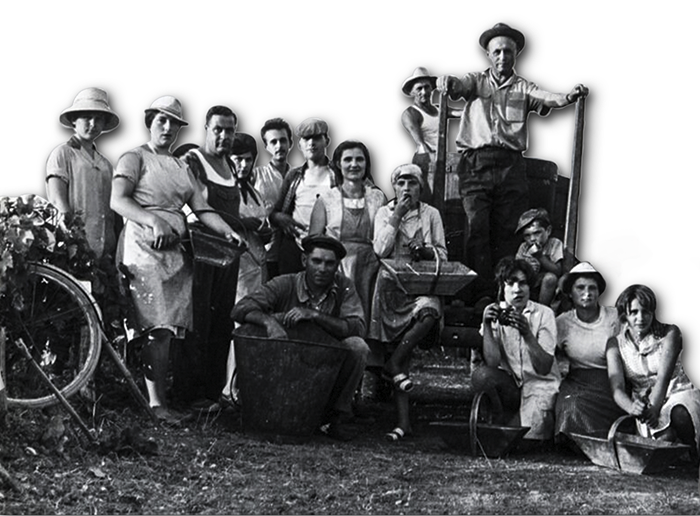
Despite it all, inevitably some French people were imprisoned during the war. Among them were winegrowers like Gaston Huet, from Vouvray.
To assuage their nostalgia for their vineyards and families, the prisoners passed the time exchanging knowledge about viticulture.
It was in one of these conversations that Gaston Huet had an idea: “Let’s have a wine banquet!” A wonderful proposal, but how to make it a reality?
Huet had learned that, in a nearby prisoner-of-war camp, fermented beverages were circulating among the guards, which was expressly forbidden.
A few days later, he blackmailed the German camp commander, asking for wine in exchange for his silence. The nervous and reluctant officer eventually agreed.
While awaiting the seven hundred bottles that would allow each prisoner to have a glass of wine, Huet and his companions took care in the preparation of a great feast.
A committee composed of representatives from each of the wine regions was assembled.
Artists volunteered to make posters and maps; a theatre group proposed staging skits about wine, complete with improvised sets and costumes; the priest who directed the camp’s choir began music rehearsals; carpenters built a wine press – later used to cover the entrance to a tunnel for a surprise escape.
The date of the festival was set for January 24, 1943, feast of St. Vincent, the patron saint of French winemakers. Preceded by several presentations and speeches, the moment eagerly awaited by all arrived: the tasting.
Each bottle would be divided among seven men, who could help themselves to their favourite wine.
Recalling all the work he had done organizing the event, Huet would comment years later:
It saved our sanity. I don’t know what we would have done without that festival.
It gave us something to hold on to. It gave us a reason to get up in the morning, to face each day.
Shrewdness worthy of imitation
It would be impossible to summarize in these lines all the feats related to the protection of French wine during the Second World War…
Nevertheless, we can draw a lesson from the exploits recounted here: in the many battles that arise throughout our lives, we must know how to be simple as doves and cunning as serpents (cf. Mt 10:16).
The intention here is not to defend the righteousness of the actions of the French winegrowers; but rather to uphold their shrewdness as worthy of imitation.
Shrewdness is a virtue attached to prudence, which allows for an easy and quick conjecture regarding the means to be undertaken in a given action.6
Indeed, they acted with remarkable circumspection in protecting a material patrimony.
And we, Catholics of the 21st century, when it comes to defending the Holy Church, divine patrimony and light of the nations, how do we proceed?
Do we utilize all our intelligence and shrewdness to confound the enemies of Christ and make innocence triumph? Or do we allow ourselves to be foolishly dragged into the snares of the adversary, permitting virtue to be crushed and corrupted?
Under the maternal protection of the Blessed Virgin Mary, let us not permit the children of darkness to be more cunning than the children of light (cf. Lk 16:8); rather, may wisdom truly dwell with prudence (cf. Prv 8:12).