 Heralds of the Gospel Magazine, Vol. 20, nº 226, August 2026
 Heralds of the Gospel Magazine, Vol. 20, nº 225, July 2026
 Heralds of the Gospel Magazine, Vol. 20, nº 224, June 2026
 Who are the Heralds of the Gospel?
 Help of Christians
 Christmas Carols









It was in the French capital, where history still radiated from every corner, that Dona Lucilia would finally fully recover her health.1
Paris was not wholly new to Dona Lucilia, for since her youth she had been acquainted with it by assiduously reading French authors, and particularly the Journal de l’Université des Annales.2 She had also learned much from relatives and close friends who frequently spent time in Paris.
The charms of the City of Light
Thus, as she beheld many of its structures for the first time, it was like a reunion with old friends, as she called to mind the ideal image she had formed of them from descriptions she had heard or read.
Over the years, her enchantment for this magnificent city’s historical traditions would steadily grow.
The tint of the stained-glass windows of Notre-Dame, the moonlight casting its glow on white stone monuments, the waters of the Seine flowing beneath beautiful stone bridges seeming to surge with memories – it was all marvellous.
She likewise admired the splendour of the refined society of the twilight years of the Belle Époque, during which it reached its highest peak.
Moreover, innocent as a lamb and as delicate as an ermine, she loved to savour the graceful sonority of the French language, which she spoke with perfection.
Dona Lucilia would remain for some time in this Paris, dear to her on so many accounts. One of the reasons for this – perhaps the primary motive – being her children’s formation.
One of the roads branching from the famous Place de l’Etoile, home of the Arc de Triomphe, is Avenue de Friedland, on which stands the Royal Hotel.
It was in this splendid establishment, whose proprietor was the noble Monsieur de Dedrines, that Dona Lucilia and the family took up accommodations in 1912.
In her advanced old age, at almost 92, Dona Lucilia still retained lively memories of several little episodes that marked her stay in that doux pays.3
The puppet theatre of Rond Point
She narrates:
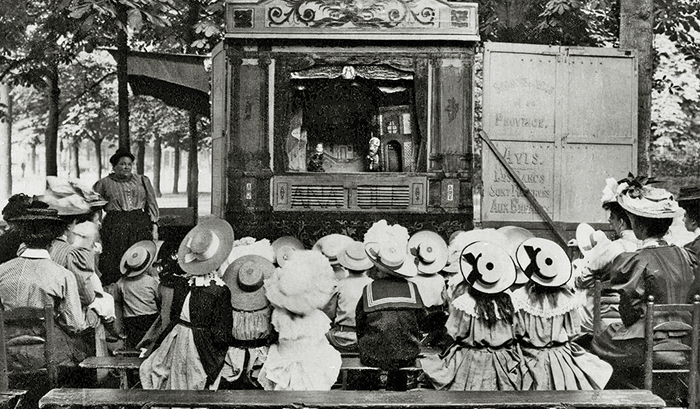
I was at the hotel, in Paris… You see, I couldn’t get about easily, since I was still suffering from the effects of the surgery I had undergone in Germany. So, I didn’t go out every day and would leave the children with the governess, who took them to Rond Point.4
One day, after their walk, the Fraülein5 told me that Plinio was causing a sensation among the puppet theatre audience. He was arguing with the puppets, lashing out against a “crocodile”… I became a little concerned. What could be happening?
The next day I woke up feeling a little better disposed, so I decided to accompany the children myself, without disclosing my motive even to the governess, since I didn’t want to make her uneasy.
We arrived and bought our tickets. It was an open-air theatre, with a cordoned-off seating area. All the children were smartly dressed and accompanied by family members or governesses.
Until the performance began, my two little ones were well-behaved, seated among the spectators. But you have no idea what happened when the play began!
Plinio became indignant with a “crocodile” that wanted to devour a “priest.” He stood up and began to dispute with it.
It was a play featuring a crocodile puppet having an argument with another puppet representing a priest. The former claimed that he had every right to devour the latter, offering unjust and anticlerical arguments, while the “priest” would counter-argue, trying to defend himself. Dona Lucilia continued:
The puppeteer seeing that Plinio’s involvement captured the viewers’ interest, used it to his advantage. He made the crocodile raise its voice and, turning to Plinio, begin to argue directly with him.
Becoming more incensed, Plinio climbed up on his chair, and from there brandished his finger and shook it like this (she wagged her finger to demonstrate). He told the “crocodile” that it was lying.
With an enchanting voice, she imitated him:
“Ce n’est pas vrai! Ce n’est pas vrai!”
The show, as Dona Lucilia described it, went on a while longer, with Plinio keeping up his part until the end.
The skit now included not only puppets but also a lively and intelligent little Brazilian boy who knew how to express himself very well in French.
Dona Lucilia went on to tell another charming vignette which occurred right after the puppet show.
The “theft” of the cake
She explained:
On the way back to the Royal Hotel I decided to take the children to a confectionery called Marquise de Sévigné. Rosée and Plinio were fascinated with the tastefully-arranged window displays, replete with sweets, chocolates, and colourful bonbons, in attractive packages.
Rosée picked a sweet and Plinio chose a coffee-flavoured cake. The salesclerk wrapped them and handed them to the children. Plinio took his and headed toward the door. I called him back and said:
“My son, are you only going to take yours? It is not becoming for a gentleman to leave something for a lady to carry. You must carry your sister’s as well.”
Without putting up resistance, he took the two packages and went down the street carrying one in each hand.
He cheerfully took the lead, and was walking ahead of Rosée and me, when a man with a top hat, goatee, a fine moustache – evidently a gentleman – overtook us.
He winked at me as he passed by as if requesting my leave to play a friendly prank.
As he walked past Plinio he plucked the two packages from his hands and said:
“Why thank you, thank you so much! You are most kind; I am much obliged for the gift you have given.” And he walked off.
Plinio ran after the man, grabbed him by the legs to stop him, and declared:
“What you’re doing is not right.”
“How so? You gave me these sweets.”
“No, you are committing two sins. First you are stealing, since I didn’t give you the sweets; and second, you are lying, saying that I gave them to you when I did no such thing. Give them back, please, because they are not yours.”
After a brief parley with Plinio, the man returned the packages. Turning to me, he doffed his hat and paid me his compliments:
“Madame, your son is enchanting. Every morning I take a break from work to stop by Rond Point to watch his debates at the puppet theatre. I congratulate you for this son of yours.”