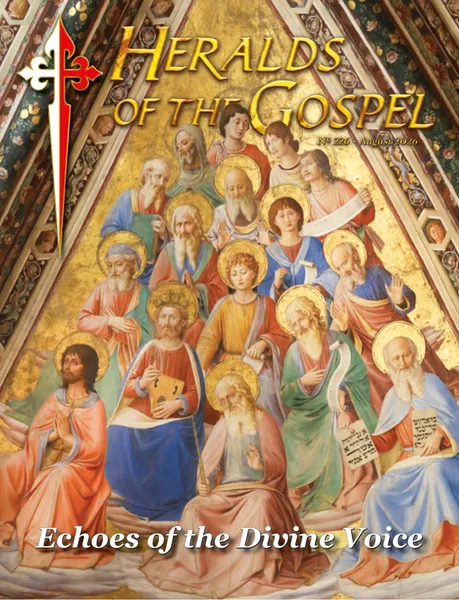
 Heralds of the Gospel Magazine, Vol. 20, nº 226, August 2026
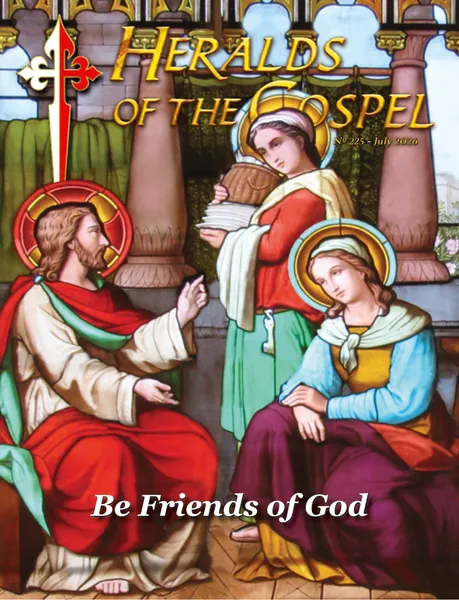 Heralds of the Gospel Magazine, Vol. 20, nº 225, July 2026
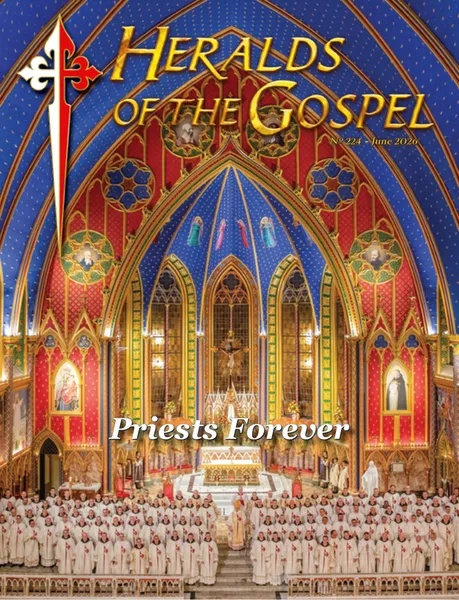 Heralds of the Gospel Magazine, Vol. 20, nº 224, June 2026
 Who are the Heralds of the Gospel?
 Help of Christians
 Christmas Carols






“May priests rejoice in the Blessed Virgin!”,1 exclaimed St. Ephrem, the Cantor of Mary.
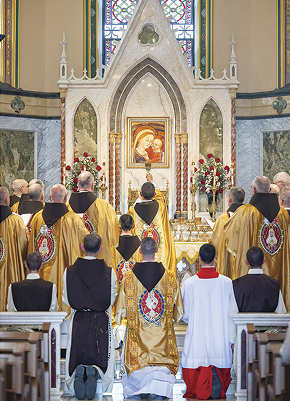
For the priest truly devoted to her, Our Lady is the inexhaustible source of all joys. And the preeminent occasion in which he can commune with his Mother is the Holy Mass, the high point of the day and of a priest’s life.
Commune, that is the appropriate term, because it is above all in the Eucharist that he will find her, and it is during the celebration that he will manifest his filial love to her, entrusting his intentions to her and opening to her the secrets of his heart.
Mary, at the foot of the altar
Can the celebrant be fully certain that the Blessed Virgin is spiritually at his side? Without the slightest doubt.
For, having remained at the Cross until the end of the agony of her Divine Son, She likewise accompanies the renewal of His sacrifice in every Eucharist.
And will do so until the end of time, as numerous authors demonstrate, among whom we highlight Pope John Paul II:
Mary is present in the memorial – the liturgical action – because She was present at the salvific event. […] She is in the memorial of the Passion-Resurrection, at every altar where it is celebrated, because, adhering with her whole being to the Father’s design, She was present at the salvific event of Christ’s death.2
Our Mother and Lady, called “Queen of the Clergy,”3 is the first assistant at all Masses, and the more the priest turns to her, the more will he benefit from her presence.
Firstly, because “we owe the Eucharist to the Blessed Virgin, and because, in instituting it, Our Lord thought first of her,”4 as a certain disciple of St. Louis-Marie Grignion de Montfort wrote.
And it is no coincidence that She is remembered and honoured in primis in Eucharistic Prayer I, the Roman Canon: “in communion with those whose memory we venerate, especially the glorious ever-Virgin Mary, Mother of our God and Lord, Jesus Christ.”
A priestly Heart
Furthermore, as St. John Eudes teaches, there is an admirable similarity between the altar of the celebration and the Heart of Mary:
It was on this altar that She offered to the Divine Majesty the same sacrifice that her Son Jesus offered Him on Calvary.
This adorable Saviour sacrificed Himself only once to His Father, on the altar of the Cross; but His Holy Mother immolated Him ten thousand times on the altar of her Heart, and this same Heart was as it were the priest who immolated Him, and was also immolated with Him.5
Another point of union between the Blessed Virgin and the priest is that, although She did not receive the ministerial priesthood, her dignity “as Mother of God is incomparably superior to that of the priest.”6
And, associated by her Divine Son with the work of Redemption, She “was a super-priest, by virtue of having intrinsically cooperated with Christ Himself in the redemptive sacrifice of humanity,”7 as the eminent Dominican theologian Fr. Antonio Royo Marín explains.
Refuge in our weakness
Considering his own smallness and unworthiness in the face of the adorable mystery of which he is minister and mediator, the priest raises his gaze to the Mother of Mercy and finds refuge in her, as a well-known Mariologist beautifully wrote:
When he considers that he holds in his hands this Christ, in whose name he speaks and acts; when he finds himself, a simple creature, before this God whose place he has assumed for a few moments; […] he will seek his model in superior heights.
As a creature overflowing with gratitude at seeing himself so close to the God of love, disconcerted by this intimate participation in a mystery that surpasses him, he will turn to the humble Mother of the Incarnate Word. In the obscurity of faith, he will look to the Star of the Sea.8
And the priest will be fully aware that, although it is through his words that transubstantiation takes place, it is from Mary that he receives the ineffable gift of Eucharistic Communion, just as it was through her that humanity received Jesus Christ.
Following the terms of the aforementioned Montfortian writer, he will apply to the Mother of God the words from the Book of Proverbs (cf. Pr 9:5), sung in the Eucharistic responsory Homo quidam attributed to the King of France Robert II, the Pious (972-1031):
“Venite, comedite panem meum, et bibite vinum quod miscui vobis – Come, eat of my bread and drink of the wine that I have prepared for you.”
Thus,
the Virgin invites us and has the right to invite us, for this bread is her bread: “panem meum,” which She prepared for us through the Incarnation.
This bread is Jesus, who, both on the altar and on the Cross, is her Son. And this wine that She prepared for us is the pure wine of Divinity, too strong for our weakness. Mary tempered it by humanity.9
How can we thank Mary?
How much gratitude the priest should devote to the Blessed Virgin Mary, from whom he receives everything! How can he repay her who considers priests her predilect sons, seeing in them the image of her Divine Son?
One could say that such retribution is not only difficult to conceive, but absolutely impossible, due to the incalculable distance between any human creature – including those elevated to the honour of the priesthood – and the sublime dignity of the Mother of God.
However, let us remember that, for a true mother, the sincere love of a child is invaluable, and She receives it in the joy of her soul, even though such a child may be burdened with guilt and misery.
Therefore, the filial affection of the priest has, of itself, the power to open the doors of the Immaculate Heart, and there deposit the offering of ardent gratitude.
And there is more: since the priest has the power to apply, according to his intentions, the merits of Our Lord in each Mass celebrated, he can offer them to the maternal hands of the Blessed Virgin.
This is what a fervent Mariologist calls “enriching Mary,” following the example of St. John the Evangelist, explaining that in this way we render to her a thanksgiving worthy of her greatness, for it is to honour her with homage of infinite value:
The beloved disciple made his Mother partake in all his goods, which means that he offered her the Eucharist and the sacrifice. Certainly, we can no longer benefit Mary with the sacramental presence of Jesus, since She already enjoys the glorious face of her Son in Heaven.
But we can deposit in her hands the fruits of the sacrificial offering that we celebrate at the altar, and thus enrich her with ever-increasing means of serving on earth the sacred interests of her God.10
Sons filled with love for our Immaculate Mother, priests consecrated to Mary for all eternity, we implore her:
Never leave our altar, O Lady. Accompany us from now until the last Mass of our lives, inspire our intentions, purify our hearts.
We desire not only celebrate in thy presence, but, enraptured with love, from the beginning to the end of the Eucharist we also wish to be embraced by Thee.