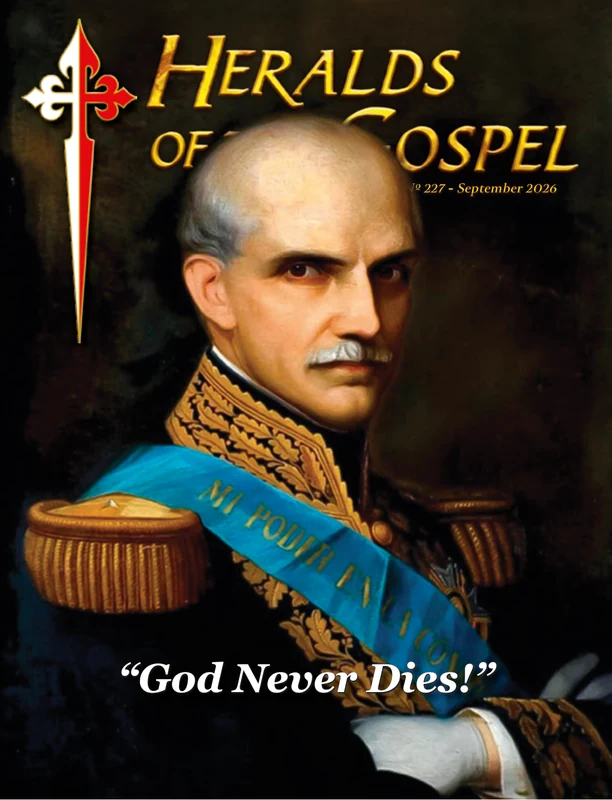
 Heralds of the Gospel Magazine, Vol. 20, nº 227, September 2026
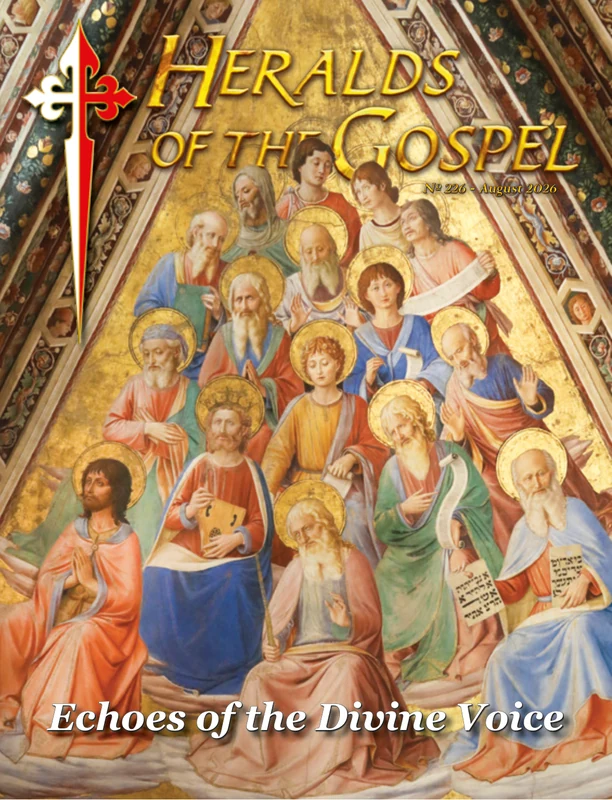 Heralds of the Gospel Magazine, Vol. 20, nº 226, August 2026
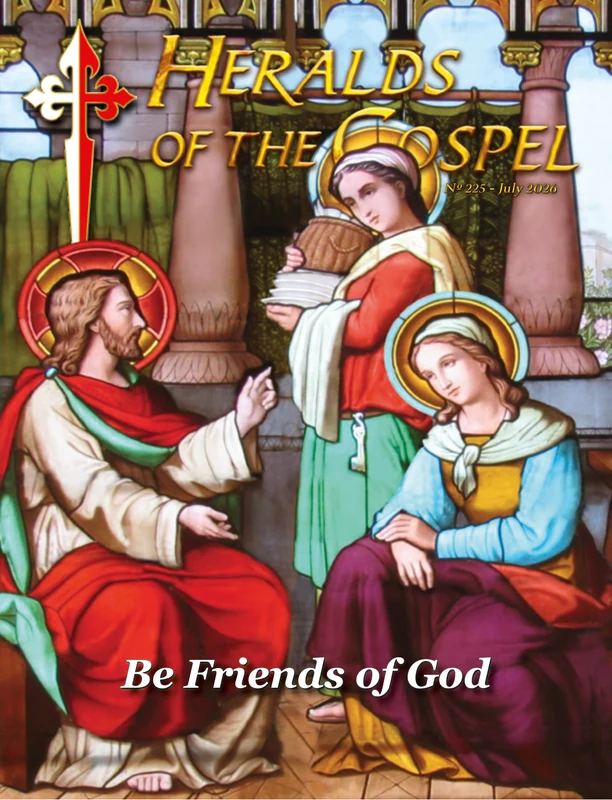 Heralds of the Gospel Magazine, Vol. 20, nº 225, July 2026
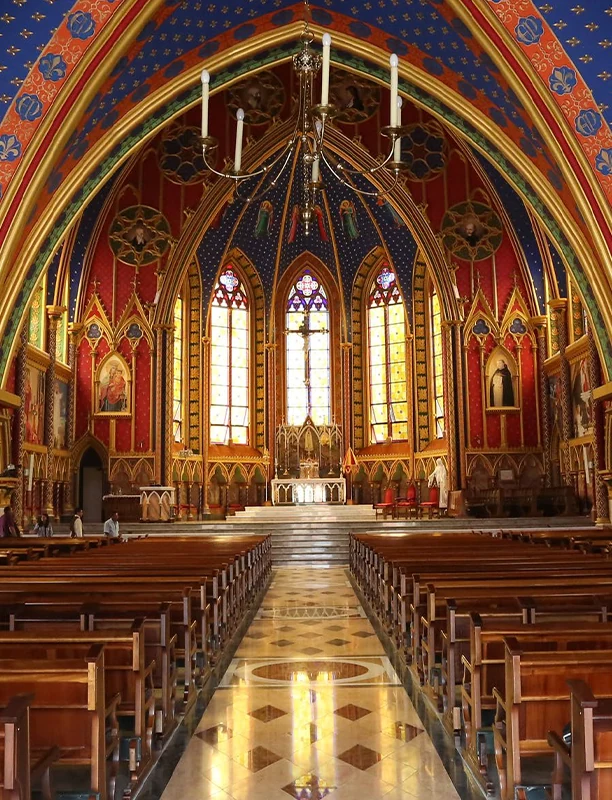 Who are the Heralds of the Gospel?
 Help of Christians
 Christmas Carols








Europe on the brink of schism…
The year 1073 was marked by the election of a new Pontiff, Hildebrand, whose name would be Gregory VII. An Archdeacon of the Church of Rome, he had been a counsellor to eight Popes and stood out among the clergy for his zeal and steadfastness of soul in the defence of good morals. But Hildebrand’s soul was above all that of a monk. Having spent a period of his life in Cluny – an abbey formed in the heart of Christendom, as it were – he embodied all the hallmarks of the Benedictine spirit, including discipline, love of chastity and absolute disinterest in earthly goods. The Church, for her part, was going through a turbulent period in which an unfortunate confusion between the temporal and the spiritual had taken hold everywhere. The issue was that of investitures: for the price of gold, the emperor granted ecclesiastical offices, such as the episcopate or the abbacy, to wealthy persons who often had not even received the Sacrament of Holy Orders nor had a vocation for it. Such disorders opened the door to a series of other abuses, and a contingent of self-interested bishops and clerics was formed, elected by the emperor, and opposed to the true clergy who were faithful to pontifical authority and its mission. Everything was in place for a schism between the Church and the Empire. In this historical context, the election of St. Gregory VII meant a declaration of war in favour of good order. Rallying forces among those who remained faithful, the Pope turned to Beatrice and Matilda, who, with the death of her father, Boniface of Canossa, and her brother, had inherited the lands of the vast and strategic region of Tuscany, north of Rome, which separated part of the Papal States from the Germanic Empire. St. Gregory VII wrote a letter to the two Italian noblewomen warning them about the situation of certain bishops and priests who wanted to spread simony in the region of Tuscany. He urged them to avoid any communion with them, addressing them both with the glorious title of “beloved daughters of St. Peter.”2“A providential mission”
With her mother’s support, from the age of 21 Matilda began her military career by leading the Tuscan armies against the Normans, together with Godfrey the Bearded, Beatrice’s second husband. She was truly capable of command, wielded weapons flawlessly, and her fearless character allowed her to confidently confront any arduous situation that opposed the interests of the Church and the Roman See. St. Gregory VII knew this and counted on her support. However, Duchess Beatrice and her daughter Matilda wished to embrace the religious life. When they presented their request to the Pope, he replied with a paternal missive, revealing in it the important contribution he expected from both of them in the situation the Church was facing: “If other princes wanted to take on that glorious role whose burden you alone bear, I myself would advise you, for your own good, to renounce the world and its cruel solicitations.” Continuing the letter, he explained to them that while many princes were driving God out of their palaces by the debauchery of their lives, both of them were instead attracting Him with the odour of their virtues. He concluded: “I beg you, as dearly beloved daughters, to persevere in your providential mission and bring it to a good conclusion.”3 A year later, Beatrice died. Countess Matilda found herself abandoned. The weight of responsibility for the whole of Tuscany pressed heavily on her shoulders. But that was not all… How could she continue the war against the enemies of the Church alone? Although she had entered into matrimony with a nobleman from the house of Lorraine, the marriage had been nothing more than a written contract, as her husband had died shortly afterwards and her virginity had remained intact. Determined to become a nun, Matilda once again turned to St. Gregory VII, who replied: “By imposing on you, in the name of charity, the sacrifice of your desire for solitude, I have contracted a stricter obligation to watch over the salvation of your soul.”4 The countess then assented. Relying on the favour and protection of this paternal Pontiff, she would face, with him, the conspiracy against the Vicar of Christ and his Church. While the bishops shamefully sold themselves to the imperial power, Matilda, the wealthiest princess in Italy, submitted to the Successor of Peter, thus countering with her virtues the horrors that were spreading throughout Christendom.An excommunicated emperor
Henry IV scandalized the whole of Europe by his behaviour. And the consequences of simony and the confiscation of the canonical investiture by the temporal power were spreading like an uncontrollable plague. In the face of this, St. Gregory VII was forced to take a just and uncompromising stance: excommunication, which robbed Henry of the right to maintain the crown. The princes of Germany met in a diet to judge the emperor’s case and decided that he would have a year to reconcile with the Pope, otherwise he would lose the throne for good and another election would be held. Desperate at seeing everything crumble around him, and driven by disordered passions, Henry gathered an army and headed for Rome to proclaim an antipope who would crown him once again. Now, Matilda had a fortress in Canossa, which was like an eagle’s nest: it stood on top of a mountain and was fortified by three imposing walls. Despite the harsh winter, the countess received the Supreme Pontiff there, where he would find protection from the emperor and his army.
Canossa: setting for an important event
One day two messengers arrived in Canossa, announcing: “The king wishes to be received by Your Holiness.” Matilda transmitted the notice to St. Gregory VII; however, suspicious of Henry’s intentions, she decided to go and meet him herself. The Pope blessed her, and the countess, girded with her sword as was her custom, mounted her horse accompanied by an officer and some soldiers. When she met the monarch, Matilda could see first-hand the inconstancy of that corrupted heart: his words seemed to denote repentance, but his physiognomy displayed self-interest and ambition for power. Despite this, in agreement with those who accompanied him, including St. Hugh, Abbot of Cluny and Henry’s godfather, she led them to the gates of Canossa. However, everyone was suspicious of the emperor’s sincerity… At first, the Holy Father refused to receive him until he had shown real signs of penance and a willingness to submit to the pontifical demands. Henry insisted, promising to repent, which led the Pope to authorize his entry into the castle domains. At a sign from Matilda, the officers opened the gates of the first wall and the emperor entered the second fortification, where he stayed with his entourage.
“Henry IV at Canossa”, by Eduard Schwoiser - The Maximilianeum, Munich (Germany)
Matilda’s heir
It had been six months since Matilda had received the Holy Father in Canossa; it was necessary for him to return to Rome. The time had come for a farewell between these two souls who had fought so hard for the Church. Matilda then knelt before the Supreme Pontiff and performed a beautiful act: she donated all her possessions to the Holy See. She was a virgin and would remain so until the end of her life; she therefore had no heirs and no relatives with whom to share her domains. These included the vast territories with castles, fortresses, churches and chapels, which covered part of Lombardy and all of Tuscany, received from her father, and the Duchy of Lower Lorraine, inherited from her mother.
Matilda of Tuscany bequeaths her goods to St. Gregory VII - Vatican Museums. Previous page, portrait of the countess
Virgin and warrior until her last breath
“Who can find a woman of worth? Far beyond jewels is her value” (Prv 31:10). Ratifying this phrase from Scripture, Countess Matilda was a lady who ruled more by the influence of her virtue than by political or diplomatic prowess; she fought more by the strength of her purity than by her martial dexterity; and she won more by her unconditional love for the Papacy than by her military ability! After the death of St. Gregory VII, she still fought alongside the Successors of Peter who continued the reforms initiated by the holy Pontiff. She was at the side of Victor III and with him uncompromisingly fought the antipope Clement III, fervently accompanied the endeavours of Urban II during the eleven years of his pontificate, and even responded to every request for help from Paschal II. At the slightest hint of a need for help from the Chair of Peter, her armies responded, almost always with the countess at the head, sword in hand, commanding the soldiers. At the age of 67 – a year before her death – Matilda, in the vanguard of her men, suppressed an insurrection in a town in her dominions which had arisen, instigated by the Caesarian revolts. Henry IV had died, and before him, the antipope Clement III. Alas, Henry V followed in his father’s footsteps, but in September 1122, during the pontificate of Callixtus II, the empire finally submitted to the Supreme Pontiff at the Diet of Worms, and the monarch declared himself a vassal of the Holy See. This event would have filled Matilda with joy! However, the countess had already surrendered her soul to God seven years earlier. In one of her more austere castles, Matilda spent the last year of her life. She asked for an altar to be placed at the door of her room so that she could attend the Holy Sacrifice from her bed. When she was rid of all material possessions, she devoted herself to spending the end of her days in seclusion, as she had always wished.
“Matilda of Canossa on horseback”, by Paolo Farinati - Castelvecchio Museum, Verona (Italy)
Notes
1 The historical information cited throughout this article is found in the book: GOBRY, Ivan. Mathilde de Toscane. Condé-sur-Noireau: Clovis, 2002.
2 Idem, p.28.
3 Idem, p.31-32.
4 Idem, p.32.
5 Idem, p.104.
6 Idem, p.226.