 Heralds of the Gospel Magazine, Vol. 20, nº 227, September 2026
 Heralds of the Gospel Magazine, Vol. 20, nº 226, August 2026
 Heralds of the Gospel Magazine, Vol. 20, nº 225, July 2026
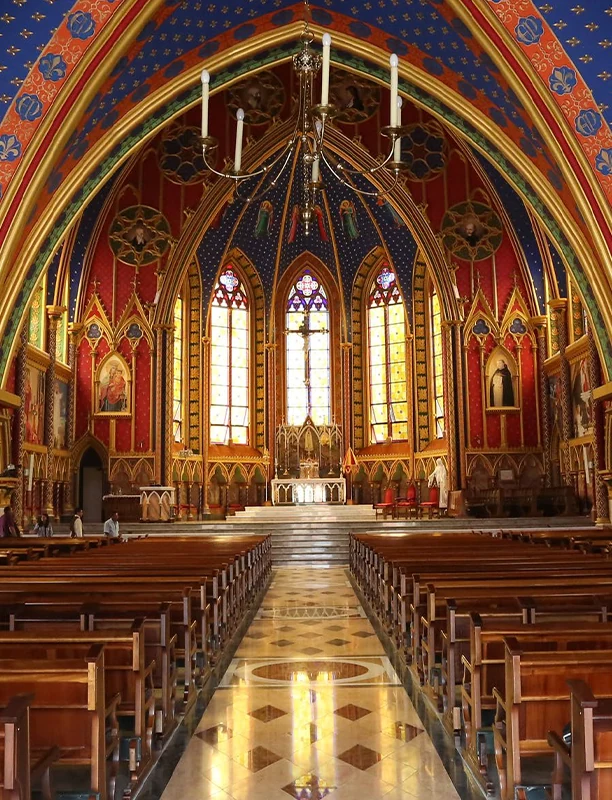 Who are the Heralds of the Gospel?
 Help of Christians
 Christmas Carols








Human existence: a night in the forest?
I was starting to get the impression that it was an arena in which wild animals destroy each other when someone pointed out to me the case of a forest at night. I am not particularly fond of the outdoors. However, in my few furtive contacts with the forest – which, it has to be said, took place during the day – I found it agreeable because it offered two very pleasant things: shade and fresh water. At night, however, the forest seemed strange, ugly and dark. If it had any beauty, it was only when the moonlight shone through the treetops. From inside, you could occasionally hear the squeak or rustle of a frightened animal, creating the impression that this was the realm of disorder, of things as they should not be, dark and sinister. In short, the wilderness at night did not interest me. Is life like a night in the forest which everyone has to go through, only to disappear?
Nightfall in a forest in Dülmen
The need for a Philosophy of History
Why this long discourse? To show a fact that is of the utmost importance to our viewpoint: it is not possible to study history without seeking to develop a philosophy of history. And it is not possible to undertake a Philosophy of History without trying to answer this question: what is its origin, its means and its end? Imagine a plane travelling with a group of people who had suffered a memory loss and who suddenly realize, surprised, that they are cruising through the air. They begin to ask themselves a series of questions as soon as they become aware that they are moving through space: “Where did we depart from? Where are we going? When and where will we arrive?” The more practical spirits among them would ask: “How is this moving? Do we need to do something to make this vehicle move?” Some might feel ill during the journey, posing a double problem for themselves, that of navigation – how to get to the end – and that of recovering from their illness: “Until I arrive, what can I do?” And notwithstanding of all of this, there are contingent needs to be met before reaching the end of the journey: the need to eat, drink, sleep, etc. Imagine there is a fifth factor: the enemy. That is, at a certain point it is perceived that there is an enemy inside the plane, who is plotting a horrible disaster for the aircraft. Therefore, he must be eliminated. The problems of the Philosophy of History are well represented in this image. History studied without taking into account the philosophy that explains it is completely unscientific. Now, this is the superficial history that we commonly learn at school, which is the theory of so-called historical evolution that we are taught.“In the beginning were the Egyptians!”
Teachers often explain, without any grounds, that it is impossible to trace back the origin of the Egyptian people, which is lost in the darkness of history. According to them, nobody knows what the first step was in humanity’s long journey on this earth. If one of them is asked: “Why do you begin your study of history with the Egyptians, when there are so many prehistories?” Instead of answering like St. John at the beginning of his Gospel, “In the beginning was the Word,” most teachers will say: “In the beginning were the Egyptians!” Then the Chaldeans appear – why not the Ethiopians? – and out comes history as we know it: the war between the Greeks and the Persians, with the feats of heroism being attributed to the former, which many teachers believe to be formidable, etc. You memorize it by rote, and the question arises: why did the Greeks fight with the Persians? Why did the Chaldeans fight with Egypt? Nobody explains it convincingly. Suddenly, in the continuity of the historical narrative, a small light shines through which, for our ordinary teachers, sheds no light at all; only the boldest mention the birth of Jesus Christ in Galilee. And that is it.The universe and history
However, for us Catholics, it is impossible to have a conception of the Philosophy of History that does not include God and the Catholic Religion. Only in Him will we find the right answers to the questions I have posed above. Firstly, because history is a living and valuable element of creation, the work of God our Lord. In fact, by making an act of faith in the fact that God is the Author of the universe, we include human history in the notion of the universe, and not just a static consideration of the world. We need to consider it in a dynamic way. History studied without taking into account the philosophy that explains it is unscientific; it is the superficial history commonly taught in schools
From left to right: ‘Pyramids of Giza and the Sphinx’, by Gustav W. Seitz; ‘The Fall of Babylon’, by John Martin; ‘The Battle of Marathon’, by Hermann Knackfuss
The flourishing or decay of peoples depends on the Church
Secondly, we must consider the Church as the centre of history and of the journey of peoples. We cannot deny this, since the key and central event in the entire life of humanity is the Incarnation of the Word, the Redemption and the foundation of the Holy Church. Let us also consider that the human order and the natural order have their perfect expression in the Decalogue. Now, only those who are in the Church know the Ten Commandments and interpret them correctly; only those who belong to the Church have the fullness of grace to practise them. Consequently, perfect human order is only attained in the Church, and by those who are very closely united to her. So she is truly the tree of life planted at the centre of history. All peoples who come close to her flourish; all those who distance themselves from her decay. Even if for other purely natural reasons, leaving aside the supernatural aspects of the subject – such as the capital importance of the Redemption, the Ten Commandments – we will reach the same inescapable conclusion.The link that connects all historical epochs
Let us look at the realm of ordinary life. Suppose a fight breaks out between a couple in a hotel room. As a result of the quarrel, the two separate and that night is a tragedy. The next day, after the couple have left the room, a good, pure, well-meaning priest goes to stay there; he says his breviary, says his evening prayers and sleeps in complete peace of mind. Do these two events have a historical link between them? No, because the agents are different: the couple is one, the priest is another. They do not even know each other; their actions are completely unrelated. Someone will tell me that these events are part of the “history of the room”. But that is only by analogy. In the history of mankind, for there to be continuity, there also had to be a continuity of humanity. However, people have never formed a single society: many peoples have not known each other, have never had contact with each other, and have often lived in the deepest ignorance of the existence of others. We find sufficient evidence of this if we consider, for example, the Aztecs and the Chinese – civilizations that developed for many centuries at a great distance from one another. Humanity, therefore, considered only in itself, does not form a whole, nor is it in fact a society. Rather, it is a heterogeneous conglomeration of men, and this alone does not make history. For there to be unity in the history of the world, there had to be an institution that travelled through it from beginning to end: it would be a kind of “carrier of history”. Has there been an institution that has accompanied the lives of men on earth from end to end? Like the binding of a book, the Catholic Church is the only factor that links all eras and unites universal history
Dr Plinio in 1992; in the background, the Evangeliary of the Basilica of Our Lady of the Rosary - Caieiras (Brazil)
Taken, with adaptations, from: Dr. Plinio. São Paulo. Year I. N.1 (Apr., 1998), p.16-19