 Heralds of the Gospel Magazine, Vol. 20, nº 226, August 2026
 Heralds of the Gospel Magazine, Vol. 20, nº 225, July 2026
 Heralds of the Gospel Magazine, Vol. 20, nº 224, June 2026
 Who are the Heralds of the Gospel?
 Help of Christians
 Christmas Carols







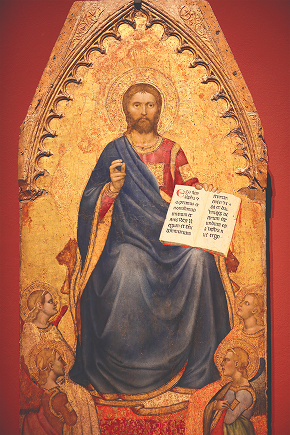
The Bible is still today the most widely read and circulated book in the world; however, its deepest meaning always remains unknown. Uninterrupted years of study would be insufficient to encompass all the wisdom contained in those sublime pages.
And why is that? Because the principal Author of the Holy Scripture is God Himself, infinite and eternal, whose designs are inscrutable and whose thoughts are as far above ours as Heaven is from earth (cf. Is 55:8-9)!
Thus, human superficiality often considers certain biblical facts to be commonplace, as well as certain ancient Jewish customs. In the light of faith, however, they possess great supernatural and symbolic value.
In fact, the Scriptures can be compared to a sacred chest from which we draw “what is new and what is old” (Mt 13:52), and in which we find narratives that are filled with meaning when analysed in the light of Christ’s Revelation, helping us to better understand the treasures received in the maternal bosom of the Holy Church.
The reader will be able to appreciate this reality in the following paragraphs. Various episodes from Sacred History will be recalled, many of them somewhat enigmatic, but which acquire special significance when correlations are established with the unique and supreme gift of faith.
Life and immortality enclosed in a fruit
Narrating the work of the six days, Genesis portrays the moment when, having planted a garden in Eden, the Lord introduced man into it and caused all sorts of trees of pleasing appearance and excellent fruit to sprout from the earth.
He placed “the tree of life also in the midst of the garden, and the tree of the knowledge of good and evil” (Gen 2:9).
In His infinite wisdom, the Creator allowed Adam to eat of all the fruits of the garden, except those that sprouted from the tree of the knowledge of good and evil; otherwise, he would certainly die (cf. Gen 2:16-17).
The Serpent, however, the most cunning of animals, approaching Eve suggested that she taste the fruit: “You will not die. For God knows that when you eat of it your eyes will be opened, and you will be like God, knowing good and evil” (Gen 3:4-5).
The result is already known: the woman yielded to temptation, and then the first man. Sinning by pride, our first parents disobeyed God and were expelled from Paradise.1
Now, immediately after this deplorable episode, Scripture narrates that
the Lord God said, “Behold, the man has become like one of us, knowing good and evil; and now, lest he put forth his hand and take also of the tree of life, and eat, and live for ever” (Gen 3:22).
He appointed “the cherubim, and a flaming sword which turned every way, to guard the way to the tree of life” (Gen 3:24).
An impenetrable mystery! Almighty God wished to hide the superhuman gift of immortality in a simple plant matter. Why would He have done so?
“The Lord had regard for his offering”
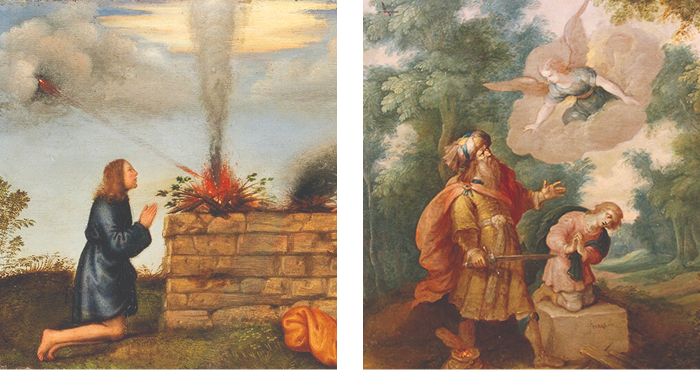
In the Book of Genesis, it is written that Adam and Eve initially had two sons: Cain and Abel, who became respectively a farmer and a shepherd.
When presenting sacrifices to the Lord, the first offered fruits of the earth, while the second offered the firstborn of his flock.
“The Lord had regard for Abel and his offering, but for Cain and his offering He had no regard” (Gen 4:4-5). This is because, while Cain presented God with the remnants of his harvest, his brother dedicated the best animals to Him, reserving nothing for himself.
Shortly afterward, Abel was murdered out fraternal envy and received into the eternal dwellings as the first of all the righteous; his soul was presented before God as a holocaust offering, crowning the pleasing sacrifice he had just offered.
Perfect in all His actions, the Creator then established a moving dialogue with Cain. He, who had not protected innocent Abel from death, marked his wicked brother, the fratricide, with a sign on his forehead, so that no one would attempt to take his life (cf. Gen 4:15).
A priest shrouded in the mists of mystery
A little later, in the early days of the epic of the patriarchs, another happening draws our attention. Melchizedek, king of Salem and priest of the Most High God, appears in the pages of Sacred History.
A mysterious figure, “without father or mother or genealogy,” whose life “has neither beginning of days nor end” (Heb 7:3), he was introduced by God into the life of Abraham when the latter was crossing the Valley of Shaveh, property of the king of Sodom, after rescuing Lot from the hands of the Canaanite kings.
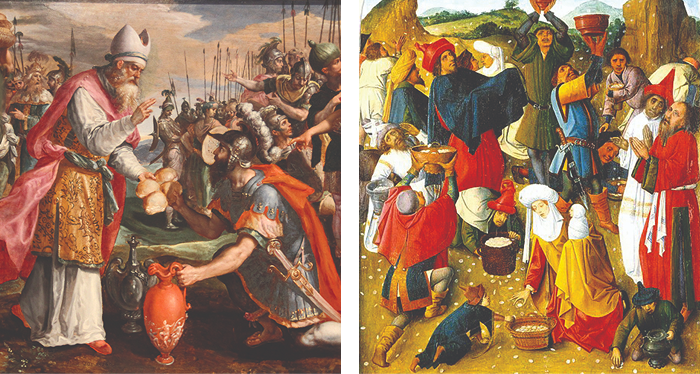
In an unusual manner, before blessing the holy patriarch, he ordered that “bread and wine” (Gen 14:18) be brought.
Now, at that time, it was customary to offer animals to God, sacrificed with the shedding of blood. Melchizedek was the first to present bread and wine; however, Scripture is silent about the reason for this choice.
A distressing challenge, faithfully fulfilled
Shortly afterward, despite his advanced age and his wife’s barrenness, Abraham had a son, the fruit of God’s promise that his descendants would be as numerous as the stars in the sky and the sands of the seashore (cf. Gen 21:5; 22:17).
The Lord then wanted to test him: “Take your son, your only son Isaac, whom you love, and go to the land of Moriah, and offer him there as a burnt offering upon one of the mountains of which I shall tell you” (Gen 22:2).
At first glance, the request seems overly audacious, even contrary to natural law, according to which a father never harms a child, but rather tends to give his own life to protect him.
Moreover, Isaac was the fulfillment of God’s promise: Abraham loved him not only as a son, but also as a gift from Heaven, a pledge of his covenant with God!
The Lord could have chosen any other type of trial to test the faith of his chosen one; however, for most wise reasons, He wished to subject him to this agonizing challenge, incomprehensible to human understanding.
Faithful to the divine will, at the height of his faith and trust in the Almighty, the holy ancient ascended to the mountaintop, built an altar, placed the wood, and bound his only-begotten son upon it.
Then he raised the knife, ready to consummate the holocaust, when the Angel of the Lord called to him from heaven: “Abraham, Abraham! […] Do not lay your hand on the lad or do anything to him; for now I know that you fear God, seeing you have not withheld your son, your only son, from me” (Gen 22:11-12).
And by his proceeding, the first patriarch won God’s blessing for himself and all his posterity.
A sign of salvation: The blood of the lamb
In the Book of Exodus, before inflicting of the tenth plague upon Egypt – the death of the firstborn – which would ultimately obtain Pharaoh’s permission for the people to leave his land, the Lord prescribed the celebration of Passover to Moses and Aaron, to be repeated every year as a perpetual institution.
A lamb was to be sacrificed per family, and if the family was too small to eat it, it should be shared with the neighbour, leaving nothing for the next day. Furthermore, the animal had to be without blemish, male, and one year old.
The doorposts of each house would be sprinkled with the blood of the sacrificed lamb, which would serve as a sign to ward off the destroying Angel (cf. Ex 12:3-13). And so it was done.
That night, the firstborns of the Egyptians were killed one by one, while the firstborns of the Hebrews remained unscathed, protected by the blood of the lamb (cf. Ex 12:29-30).
Bread from the heavens above
With the people were in the desert on their way to the promised land, many began to murmur against Moses and Aaron, saying,
Would that we had died by the hand of the Lord in the land of Egypt, when we sat by the fleshpots and ate bread to the full; for you have brought us out into this wilderness to kill this whole assembly with hunger (Ex 16:3).
To which the Lord replied:
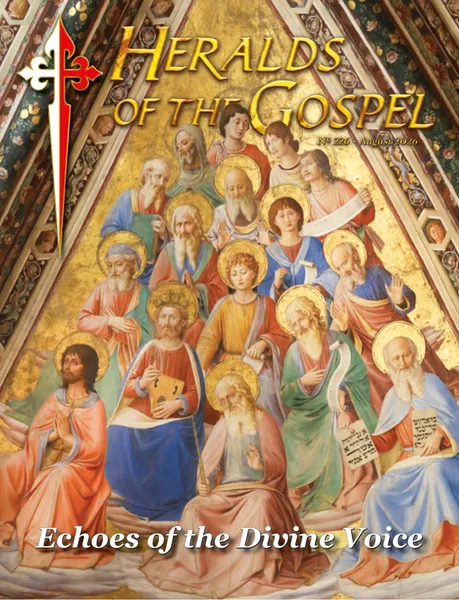
I will rain bread from Heaven for you; and the people shall go out and gather a day’s portion every day. […] I have heard the murmurings of the people of Israel; say to them, “At twilight you shall eat flesh, and in the morning you shall be filled with bread; then you shall know that I am the Lord your God” (Ex16:4, 12).
Indeed, the following morning the Jews found a layer of dew on the desert floor which, once evaporated, revealed “a fine, flake-like thing, fine as hoarfrost on the ground” (Ex 16:14).
Since they did not know what it was, Moses told them: “It is the bread which the Lord has given you to eat” (Ex 16:15).
The Israelites then named this food manna and ate it for forty years (cf. Ex 16:31, 35), until they could eat of the fruits of the land in the land of Canaan (cf. Jos 5:12).
The prefigures are fulfilled
“Ecce Panis Angelorum – Behold the Bread of Angels,” sings the Holy Church in ecstasy in one of the stanzas of the hymn Lauda Sion, composed by St. Thomas Aquinas for the Solemnity of the Most Holy Body and Blood of Christ.
In this inestimable gift of the Eucharist, each of the prefigures considered so far – and still others, which would exceed the scope of an article – is truly fulfilled:
It is in the form of symbolic figures, it is through the intentional obscurity of the prophetic texts, that the truth [about the Eucharist] is progressively revealed, just as the sun, before appearing radiant on the horizon, reveals itself through glimmers of light, at first barely perceptible, then more pronounced and, finally, fully apparent.2
Indeed, the first of the figures, the tree of life, is explained in relation to the Sacrament of the Altar through the words of the Saviour: “he who eats my Flesh and drinks my Blood has eternal life, and I will raise him up at the last day” (Jn 6:54).
The Eucharist is the true Tree of Life, which has taken root again in a paradise that is immensely more fertile, beautiful, and rich: the Holy Church.
As for the sacrifice of Abel, pleasing to God, it symbolizes divine acceptance of the Sacrifice of the Cross, renewed in the Holy Mass, whose acceptance by God the Liturgy implores in Eucharistic Prayer I, also called the Roman Canon: “as once You were pleased to accept the gifts of Your servant Abel the just.”
In the immolation of Isaac we find a clear allusion to the immolation that the Eternal Father made of His Divine Son on Calvary.
Now, the fact that it was an unbloody immolation, fully realized in intention but not consummated, more closely prefigures the mystery of the Eucharist, in which the sacrifice of the Cross is also renewed in an unbloody manner.
The sacrifice of Melchizedek, inspired by the Holy Spirit, contained in the offering of bread and wine, exact figures of the matter of the Eucharist, which truly obtains divine gifts for those who receive it with the proper dispositions.
The paschal lamb, on the other hand, was a figure of the Eucharistic substance, Christ Himself, the true victim who freed us, at the price of His blood, from the slavery of the devil.
Finally, the manna represents the Sacrament of the Altar as the Bread of Angels, which has all flavours and is suited to every taste (cf. Wis 16:20-21).
That is, it contains within itself the source of grace that adapts itself to each soul and satisfies all with the fullness of spiritual goods.
It is our daily food, sustaining us during our pilgrimage in this land of exile, just as manna sustained the Jews during their journey through the desert.
Let us never neglect such a precious gift
If the manna prefigured the Eucharist, the reality surrounding it also brings us a precious point of reflection: at a certain point, the Israelites were satiated with the manna and complained against God because of it (cf. Num 11).
Is it not, then, that in our days many Catholics receive the Bread of Life with bad dispositions, and others still reject this most precious supernatural sustenance given by the Heavenly Father, which is the very Body, Blood, Soul and Divinity of his Only-begotten Son?
Let us pray to the Virgin Mary, the first and most ardent devotee of the Eucharist, that She may obtain for us a sincere, fervent and increasing love for Jesus in the Eucharist, and deliver us from receiving Him with lukewarmness, negligence or carelessness.