 Heralds of the Gospel Magazine, Vol. 20, nº 226, August 2026
 Heralds of the Gospel Magazine, Vol. 20, nº 225, July 2026
 Heralds of the Gospel Magazine, Vol. 20, nº 224, June 2026
 Who are the Heralds of the Gospel?
 Help of Christians
 Christmas Carols








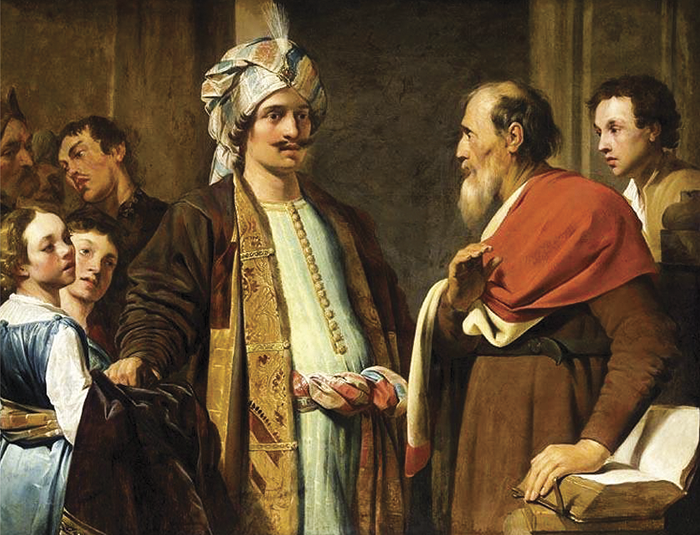
St. Elisha, who is he? The father and master of the prophets of Mount Carmel. The preacher who multiplied the loaves. The man whom bears obeyed, and who ruled over the kings of his time.
The seer for whom the future held no mystery. The most miraculous of the prophets. The general who defeated armies single-handedly. He who, while alive, raised a boy from the dead and, after his death, restored life to an adult. The Saint with whom the Most High spoke to the sound of the harp.
Is this Elisha? No.
These are the deeds of Elisha. His true story is not found in what he did, but in what he was. And he was far greater than the aforementioned feats. He became another Elijah.
A new father
Let us return to the year 860 BC.1 A young man, with his twelve yoke of oxen, is ploughing the land of Abel-Mehola in Israel: Elisha, a man of moderate means, settled in life.
He is perhaps twenty years old and has charted a course for himself in accordance with the law – a peaceful path, without major upheavals and, therefore, without great glory.
But suddenly everything changes! Elisha notices the man of God approaching: Elijah, the prophet who, only some two months earlier, had stood alone against the king and queen, as well as the eight hundred and fifty priests of Baal and Asherah.
He had defeated them in the name of the Lord, bringing fire down from Heaven to earth.
When he is close, without saying a word, he throws his cloak over Elisha. Elisha realizes that the prophet has just symbolically taken him under his charge and, immediately leaving his oxen, runs after Elijah (cf. 1 Kgs 19:20).
But the longing for an easy life might have betrayed Elisha. Not, however, a life that has been relinquished as a burnt offering.
He takes a yoke of oxen and sacrifices them. With the wood from the ploughs, he cooks the meat and serves it to his people (cf. 1 Kgs 19:21). Neither animal nor plough remains. He thus renounced his material possessions.
And while those people feasted, he took his leave of them forever for the sake of a mission greater than himself. In doing so, he renounced his affective and family ties.
These are the first two indispensable steps of self-sacrifice required to become a perfect disciple: then “he arose and went after Elijah, and ministered to him” (1 Kgs 19:21).
For about six years, Elisha closely accompanied his new spiritual father on his perilous adventures: it was during this time that Elijah confronted King Ahab (cf. 1 Kgs 21), denounced the idolatry of King Ahaziah (cf. 2 Kgs 1:1-4) and destroyed, with fire from Heaven, two groups of soldiers who had come to arrest him (cf. 2 Kgs 1:9-17).
Elisha was there, absorbing and admiring every gesture of his master.
Deaf to the world
But the time had come for Elijah to depart, and for the disciple’s ultimate test: would he be willing to follow his master, despite the clash between the latter’s judgements and those of society at large?
The test began with the most arduous part. Elijah forbade him from doing what he was made to do, that is, to follow the prophet: “Tarry here, I pray you; for the Lord has sent me as far as Bethel.” “But Elisha said, ‘As the Lord lives, and as you yourself live, I will not leave you’” (2 Kgs 2:2).
And so he prevailed, for he was able to hear in his father’s words, not what they said, but what Elijah truly desired. He understood the master’s fiery heart well.
Then came the second stage. “And the sons of the prophets who were in Bethel came out to Elisha, and said to him, ‘Do you know that today the Lord will take away your master from over you?’” (2 Kgs 2:3).
He now had to face his own milieu… Elisha had renounced the bonds of blood. He lived in complete opposition to the world.
At that moment, however, he had to ignore the dictums of his brothers of vocation, those who lived with him. He had to renounce his world. And he does so: “Yes, I know it; hold your peace” (2 Kgs 2:3), he replied.
And he continued to accompany Elijah. As master and disciple walked away talking together, the fifty sons of the prophets shook their heads, as if to say: “That radical Elisha… when will he learn to use his common sense?”
A double share of his spirit
Meanwhile, Elijah turned to Elisha: “Ask what I shall do for you, before I am taken from you?” (2 Kgs 2:9).
The reply was explosive and direct, bursting forth like a geyser from a soul wholly consumed by admiration: “I pray you, let me inherit,” cried Elisha, “a double share of your spirit” (2 Kgs 2:9).
It was the cry of final victory over pride! Elisha had torn down, one by one, all the towers of self-love as he meticulously renounced everything.
At last, emptied of himself, he became a chosen vessel prepared to receive the precious and ever-new wines of prophecy.
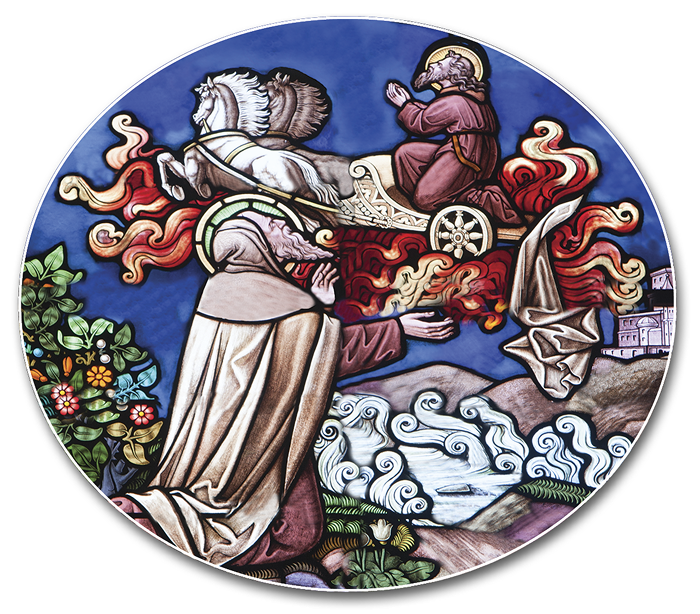
Thus, the moment the fiery horses swept Elijah away in a whirlwind, the mantle of the master, doubled over, descended upon Elisha, and with it, a double share of Elijah’s spirit.
And the disciple bade him farewell with cries invoking protection: “My father, my father! the chariots of Israel and its horsemen!” (2 Kgs 2:12).
Retracing his steps, Elisha reached the banks of the Jordan, parted the waters and crosses the river on dry ground.
The sons of the prophets, beholding this scene, could not help but observe: “The spirit of Elijah rests on Elisha” (2 Kgs 2:15). And they prostrated themselves before Elijah in Elisha.
From this point on, the profuse and astonishing miracles of the perfect disciple will begin.
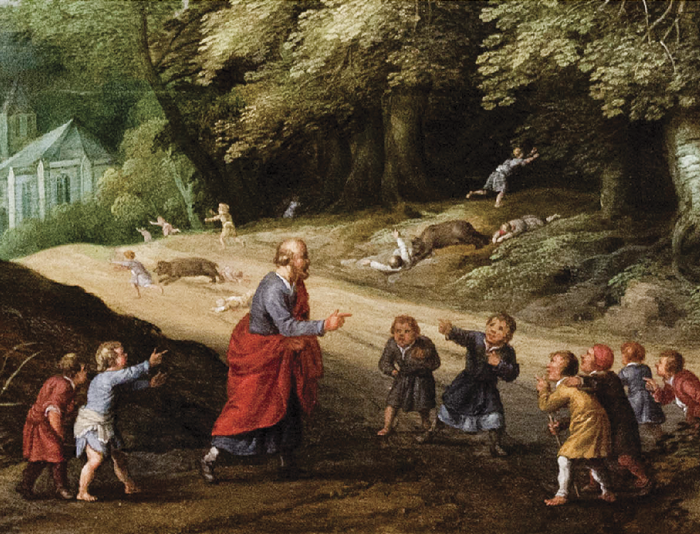
To start, he will purify the previously foul waters of a city (cf. 2 Kgs 2:19-22) and, shortly afterwards, command two bears to punish forty-two youths who were mocking the prophet (cf. 2 Kgs 2:23-25).
For a widow, he will multiply the precious oil; he will obtain from God a son for a barren woman, and when the child dies, will restore him to life and to his mother’s arms (cf. 2 Kgs 4:1–37).
Such an appreciation for motherhood will make him a “father” and “mother” to the sons of the prophets, whom he will heal of a collective case of food poisoning and, on another occasion, feed a hundred men with twenty loaves which, multiplied beyond measure, will still leave some to spare (cf. 2 Kgs 4:38-44).
We could list many other marvellous deeds of Elisha that fill several chapters of the Second Book of Kings. Let us, however, consider just two of the most significant aspects of the prophet’s life: his lordship and his slavery.
The armies of Elisha
In Elisha’s time, there was not a single secret plan against Israel, devised by the king of Aram in the region of Syria, that did not fail. The only explanation, the Aramean reasoned, was that someone in his entourage was on the Israelites’ side.
He summoned the men of the council and threatened: “Will you not show me who of us is for the king of Israel?”
And one of his servants said, “None, my lord, O king; but Elisha, the prophet who is in Israel, tells the king of Israel the words that you speak in your bedchamber” (2 Kgs 6:11-12).
An extreme measure was taken: an entire army mobilized to defeat the prophet of the Almighty.
When Elisha’s servant saw the troops arriving to arrest his master, he despaired. But the man of God reassured him: “Fear not, for those who are with us are more than those who are with them” (2 Kgs 6:16).
And, praying to God Omnipotent, he implored that the servant’s eyes might be opened. Then the servant beheld the reality: “the mountain was full of horses and chariots of fire round about Elisha” (2 Kgs 6:17).
The same fiery cavalry that had carried Elijah now formed Elisha’s honour guard. The holy one of Yahweh had at his command the countless legions of the Seraphim.
As this new horizon opened up before the servant, Elisha cast the vision of their pursuers into darkness. In the blink of an eye, the Aramean army became a farcical band of the blind leading the blind.
The son of Elijah went down to them and took command of those who had come to arrest him. He now had at his disposal not only the soldiers of Heaven, but also those of a foreign land.
And, just as he had just defeated them through the darkness and convinced them of this truth, he now restored their sight and persuaded them to return to their homeland: “And the Syrians came no more on raids into the land of Israel” (2 Kgs 6:23).
Where did such sovereignty come from? What raised him above emperors? Slavery.
A slave of love
Elijah had departed, but his perfect disciple did not cease to serve him.
“Elisha the son of Shaphat is here, who poured water on the hands of Elijah” (2 Kgs 3:11) – a typical role for a servant in those days – continued to show his servitude even in the master’s physical absence, with all the signs characteristic of that state.
He scorned honours and fame as though they were mud. When Naaman, the famous general of Aram, sought out the prophet to ask for a cure for leprosy, Elisha did not even go out to receive him. He did not need to be courted to cleanse the visitor’s decaying skin.
Just as he shunned prestige, so too did he shun treasures. Naaman, healed through Elisha’s intercession, offered him gold and garments: “so accept now a present from your servant,” he pleaded.
“As the Lord lives, whom I serve,” replied Elisha, “I will receive none” (2 Kgs 5:15-16).
Why did he not want the slightest trace of reward? Because he served.
In private, he was no less austere. This was attested by a couple from Shunem who used to welcome him into their home.
Husband and wife decided to build a room for their guest with everything he needed: “a bed, a table, a chair, and a lamp” (2 Kgs 4:10).
Such was the luxury of the man who managed Israel’s affairs, commanded enemy troops and was obeyed by Cherubim.
Where were the carpets? Where were the paintings? Where the beautiful gold artefacts? He had sacrificed all of that along with the oxen of Abel-Mehola.
Such was the servant of Elijah.
Death and recompense
The decades passed in a flurry of activity in Elisha’s life, until around 790 BC.
By this time, his final illness had overtaken him. Kneeling by the bed where he was preparing for his final journey stood the king of Israel, Joash, afflicted and distraught.
Elisha, who “in all his days […] did not tremble before any ruler” (Sir 48:12), then hears from the monarch’s lips the praise he did not expect, the supreme words of commendation, the very same he had addressed to Elijah upon seeing him amidst fiery whirlwinds:
“My father, my father!” King Joash exclaims in tears, “The chariots of Israel and its horsemen!” (2 Kgs 13:14).
Everything had been said. Elijah and Elisha, united in earthly life, inseparable despite death, would meet on the other side bearing the same title, the same halo, the same spirit.
“It is enough for the disciple to be like his teacher” (Mt 10:25). For Elisha, it was more than enough…
Eighty years after his birth and six decades after meeting Elijah, Elisha could peacefully close his eyes to the world.
For “nothing was too hard for him, and when he was dead his body prophesied. As in his life he did wonders, so in death his deeds were marvellous” (Sir 48:13-14).
Even a corpse, thrown upon “the bones of Elisha, […] revived, and stood on his feet” (2 Kgs 13:21).
Other Elishas
More than two and a half millennia after those events, in what ways does the story of St. Elisha speak to us?
In every way. He is for us an example, an ideal, an elder brother who has gone before us on the way, who has already trodden to perfection the roads we now travel.
Elisha was another Elijah. We must be so many other Elishas. For, just as “Elisha was faithful to Elijah, so must we be faithful to Our Lady.”2
Elijah, the first devotee of the Virgin, foreshadowed her in some way. In this way, Elisha too heralded the future slaves of love to Mary.
He taught that whoever surrenders himself to the Mother of God must give all and give himself entirely, renouncing his possessions and his world, if not in reality, then at least in his heart.
He proclaimed that only one who follows her despite the contrary opinions of others, who accompanies her even amid spiritual aridity and the apparent contradictions of the spiritual life, will be a servant of Mary.
But he also demonstrated for posterity that those who detach themselves from all things will have the heavenly host at their command and – O immense, inconceivable treasure – will receive the spirit of their Lady in double measure. Prophesied, in this regard, St. Louis Grignion de Montfort,
Perhaps sooner than we expect, God will raise up great men filled with the Holy Spirit and imbued with the spirit of Mary […]. These holy men will accomplish this by means of the devotion [of the slavery of love to the Blessed Virgin] of which I only trace the main outlines and which suffers from my incompetence.3
Let us imitate St. Elisha. And if we are to Mary what he was to Elijah, he will become a foreshadowing of us: “May we have her spirit as Elisha had that of Elijah, and all will be accomplished.”4