 Heralds of the Gospel Magazine, Vol. 20, nº 226, August 2026
 Heralds of the Gospel Magazine, Vol. 20, nº 225, July 2026
 Heralds of the Gospel Magazine, Vol. 20, nº 224, June 2026
 Who are the Heralds of the Gospel?
 Help of Christians
 Christmas Carols







Angelic nature, the work of God’s hand, is characterized by being purely spiritual, endowed with intelligence and will. When, through intellection, the Angels understand one same principle and love this ideal, they are united with one another.
Ideas are also a factor in uniting men, but, already in the Earthly Paradise, God wanted to place in the human creature the instinct for food, in order to promote unity around the table.
If, as Scripture says, He made “wine to gladden the heart of man” (Ps 104:15), a good meal gladdens the whole human being.
Food is indispensable for health; however, the bodily benefit is not, as materialists think, its main purpose, but rather social interaction.
Partaking in the same meal favours conversation and mutual understanding, and is also an excellent instrument for diplomacy.
Talleyrand, the great French diplomat, knew this rule: when he had to defend France’s interests before Germany or Austria, he would ask the king to send him a large quantity of wines, champagnes, and cheeses – especially the famous Brie and Camembert – because, he said, during a reception and conversation, cases were resolved more easily and always successfully.
To celebrate major events, such as important anniversaries, university graduations, or the inauguration of new buildings, festivities are usually organized, interspersed with theatrical performances, musical presentations, and fireworks displays.
Such events create an atmosphere of joy, but this joy takes on more substance at the table, because eating together holds an imponderable element of participation.
Therefore, when like-minded people sit down to dine together, the union of ideals is complete, and all the partakers are strengthened by the bonds forged with one another.
Food of true Wisdom, a sign of unsurpassed love
In fact, food was created by God to serve man as a means to know and love his Creator.
Why, then, did He place the tree of the knowledge of good and evil in the centre of the Earthly Paradise, whose fruit Adam and Eve could not taste? Because He wanted to give them the possibility of an even greater order by abstaining from something through the effort of obedience and submission.
However, there is still a fundamental point that leads us to better understand why God subjected human nature to the need to eat every day in order to subsist.
Adam must have longed for the knowledge of good and evil, trusting that the Creator would offer it to him in a special meal. God always acts in this way: He demands a small renunciation, to later grant an infinitely greater reward.
At a certain point, He would incarnate Himself and leave Himself as a food of true Wisdom. Indeed, even if man had not sinned, the Eucharist would have been instituted, for this was the divine plan from all eternity.
Now, original sin consisted of a misuse of the appetite; and decadent man, in his folly, made food into a delight for himself, refining it in the desire to enjoy it with an entirely selfish pleasure.
In Paradise, God had commanded: “of the tree of the knowledge of good and evil you shall not eat, for in the day that you eat of it you shall die” (Gn 2:17).
But, once sin was committed, Our Lord comes to earth and says to us, who were born with original sin, a creative and divine word:
Truly, truly, I say to you, unless you eat the Flesh of the Son of man and drink His Blood, you have no life in you; he who eats my Flesh and drinks my Blood has eternal life (Jn 6:53-54).
From a symbolic standpoint, the Eucharist is a reparation for original sin, but above all it is a sign of God’s unsurpassed love for mankind.
He wanted to give Himself to us fully, so that we might obtain more than our parents possessed in Paradise, with a view to eternal happiness.
The word for banquet in Latin is convivium, and it is in the Eucharist that we find the pinnacle of communion with God.
The benefits of this Sacrament will never be fully comprehended, classified, and explained on this earth, because they are indescribable and inscrutable even to the imagination of the most perfect of Angels.
And it is precisely to this grand banquet that we are invited.
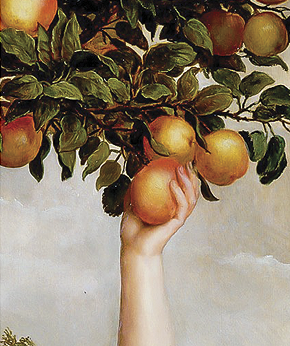
Art History Museum, Vienna
A dogma of Faith proven by miracles
The Real Presence of Christ in the consecrated bread and wine is a dogma of Faith revealed by Our Lord, who gave us His word in the Gospel: “For my Flesh is food indeed, and my Blood is drink indeed” (Jn 6:55).
Later, when challenged by Protestants in the 16th century, the Church clearly defined that the Body, Blood, Soul, and Divinity of Our Lord Jesus Christ are present in the Eucharist.1
Furthermore, throughout history, numerous miracles have occurred that prove the grandeur of this extraordinary Sacrament.
Among them, the miracle of Bolsena stands out, which led Pope Urban IV to institute the Solemnity of Corpus Christi.
Prior to this, the revelations of St. Juliana of Mont-Cornillon had already initiated discussions in this regard, and theologians were debating whether or not this feast should be established.
The Pope was in Orvieto when news reached him of a miracle that had occurred in a nearby city: a certain priest, tormented by temptations against faith concerning the Eucharist, was celebrating Mass when the host transformed into a piece of Flesh in his hands and began to bleed, soaking several corporals.
Another episode occurred with St. Louis IX, King of France. He was sitting at a table, writing, when a page approached breathlessly:
“Your Majesty! Your Majesty! Come quickly, there is still time!…”
“What happened?” he asked.
“Right now, during Mass, at the moment when the priest elevated the host, the Child Jesus appeared in his hands, and He is there!…”
St. Louis put his pen aside, stood up, and genuflected with profound recollection. Then he sat down again and said:
God works this miracle not for believers, but for those who doubt. My faith does not require that I see, and I do not want to lose my merit; I believe fully and firmly, and I have already adored Him from here!2
Other miraculous events that occurred with the saints also confirm the veracity of the Redeemer’s presence under the Eucharistic veils.
St. Catherine of Siena, for example, spent days being nourished solely with the Eucharist, and on many occasions, once she had ingested the Sacred Host, her body remained suspended in the air.3
It is said that St. Pius X sometimes took hours to celebrate Mass because, as soon as he pronounced the words “This is my Body which will be given up for you,” he would enter into ecstasy and levitate with the host aloft, to the astonishment of the congregation.
How Christ is in the Eucharist?
Let us now see in what manner Our Lord Jesus Christ is in the Eucharist. According to St. Thomas Aquinas,4 He is there with His glorious Body as He is now in Heaven, in His natural dimensions, whole in every particle and hidden beneath the accidents.
When we look at that small host, our minds are unable to comprehend how He is present there in natural size.
However, there is an image that brings us closer to reality, without, however, penetrating it entirely: when we talk to a person, or have a landscape before our eyes, it is not necessary for our interlocutor to try to diminish his stature, or for the panorama to be reduced to enter our retina.
Everything fits in real size in human vision. So too is Our Lord Jesus Christ in the host.
And, if the host is broken, He still remains whole in each of the parts, similar to what happens with a mirror: when it breaks, the image is reflected completely in all the fragments.
To understand that He is hidden beneath the accidents, let us imagine a well-closed reliquary case. When we look at it, we see a mere reliquary; but if we open it, we will find its precious contents.
Similarly, the Eucharistic Species are like a case, inside which Our Lord Jesus Christ is hidden.
It is because of His infinite goodness towards us, and to make it easier for us to receive Him, that He covers Himself under the appearances of bread.
If He were to appear in His full form, our first reaction would be one of amazement – which would cause us to lose the merits of believing without seeing – and the second of reverential fear, so that we would experience great apprehension about receiving Communion.
The Eucharist is a true sacrifice
Luther and the Protestants claimed that the Eucharist was a mere remembrance, and they spread this erroneous doctrine. For this reason, they were condemned by the Church, which declared that, much more than a memorial, the Mass is the renewal of the sacrifice of Calvary.5
It was Our Lord who instituted this ceremony on Holy Thursday, during the Last Supper, when He said: “This is my Body which is given for you. Do this in remembrance of Me” (Lk 22:19).
Therefore, the specific sacrifice that He suffered being scourged, crowned with thorns, and giving His life on the Cross is repeated on the altar. The essence is exactly the same, with one sole Victim.
The accidental circumstances are different, for on the Cross the sacrifice was bloody; while in the Eucharist it occurs without bloodshed.
On the Cross, the Body of Jesus was mortal; in the Eucharist, Christ no longer dies. On the Cross, He suffered only once; in the Eucharist, He offers Himself countless times.
On the Cross, the price of His Blood brought about Redemption; in the Eucharist, the application of this price He won on the Cross is obtained. However, the infinite value of the sacrifice of Calvary is identical to that of the sacrifice offered on the altar.6
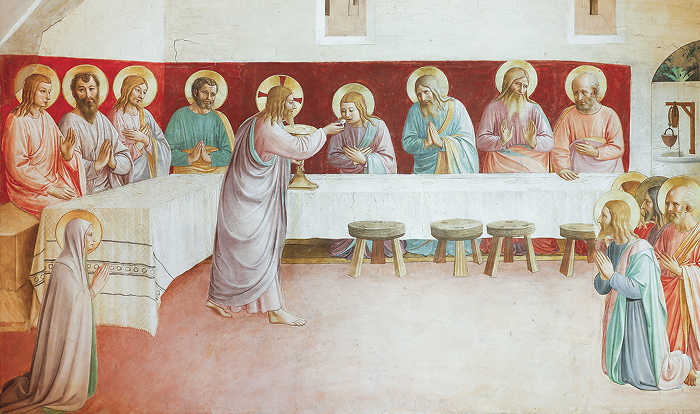
Union of the soul with God
Now, once we receive Him, how is He united with us?
There is, among men, a spiritual union, which is based on a bond of love, by which, despite great distance, those who love each other maintain an interconnection.
There is also an external union, which is established by physical contact, but this is very superficial, since two people can be side by side, and even jostling one another, without, however, even knowing each other.
And yet neither of these is the union we have with Our Lord at the time of Communion, for this union does not signify being together, nor even being joined fast, but it is a union so strong that we can call it “mutual interpenetration,” as He said in the Gospel: “As the living Father sent Me, and I live because of the Father, so he who eats Me will live because of Me” (Jn 6:57).
As long as the species remain uncorrupted within us, sanctifying grace not only increases, but the soul is filled with grace, and union with God intensifies, for He penetrates us in the manner of water soaking a dry sponge.
When we eat food, our body digests and avails itself of what is useful for health and physical development.
Therefore, we transform that food into energy for our body. But, according to several saints and doctors, in the Eucharist an opposite phenomenon occurs.
Given that the substance is infinitely superior to us – for it is Jesus Himself, true God and true Man – instead of transmuting Himself into us, it is He who assumes us and sanctifies us.
Who would not want to have all the gold in the world concentrated into their hands? But in this case, it is not about becoming rich, because earthly riches are nothing compared to the supreme value of this Sacrament.
Rather, the essence here is drawing closer to the Sacred Heart of Jesus, the Author and inexhaustible source of all grace, so that we may be millionaires in eternity!
Pledge of future life
If we carefully keep a cherry seed, it can be preserved for years and, once sown in the ground, it will germinate and grow into a leafy tree.
But if we take the same pit and chop it into slivers, even if after twenty-four hours we gather all the fragments and plant them, a cherry tree can no longer grow from them.
Those who strive to be faithful to God’s Law, within the practice of piety, seeking to avoid occasions of sin and saying “no!” to temptations; these maintain grace in their soul like a seed.
Those, on the contrary, who yield to envy, comparison, vanity, falsehood, and... finally end up falling into some mortal sin, are like those who cut up the cherry pit: they no longer have within themselves the germ of eternal glory!
The world of today places tremendous value on health and concern for well-being. However, even if a person reaches eighty or ninety years of age, death is a prospect from which no one escapes.
One day we will all die and our flesh will be consumed by worms, leaving behind only a skeleton and a fearsome skull!
Deep in our souls, however, there is something that yearns for resurrection. When we pray the Salve Regina, we recognize ourselves as “poor banished children of Eve,” and indeed, we are those who left their homeland and came to this “valley of tears”.
But we also know that our present existence is not true life, and that our destiny is not to remain buried for all eternity in the depths of the earth.
What is our homeland? We were born to go to Heaven, and that is precisely our longing!
But it is necessary to go through a period of trial during which we feel our contingency and the experience of our misery, and how without God we are worth nothing, we have nothing, and we are nothing.
Now, in order to maintain virtue and be resurrected in the future life, we need to nourish ourselves with the Eucharist, according to the promise of Our Lord: “he who eats my Flesh and drinks my Blood has eternal life, and I will raise him up at the last day” (Jn 6:54).
The Eucharist wins for us our resurrection and is a pledge by which God assures us of Heaven.
Thus it will happen on the last day: Our Lord will come and, at the sound of the trumpet, all the dead will rise.
Those who rejected Communion will recover their bodies in a suffering state, so as to burn in the torments of hell without being consumed; those who received the Body and Blood of Christ will rise with their bodies in a state of glory.
This is the joy we will have when we leave the darkness of this world and, emerging into the light of eternity, find the wonders of Heaven, in the contemplation of God face to face, worshiping Him as He sees Himself, singing His glories and enjoying His happiness!
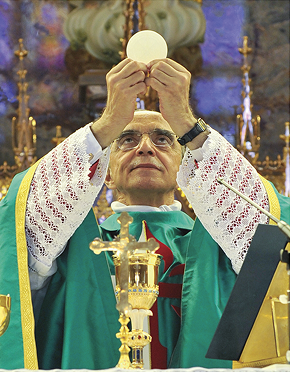
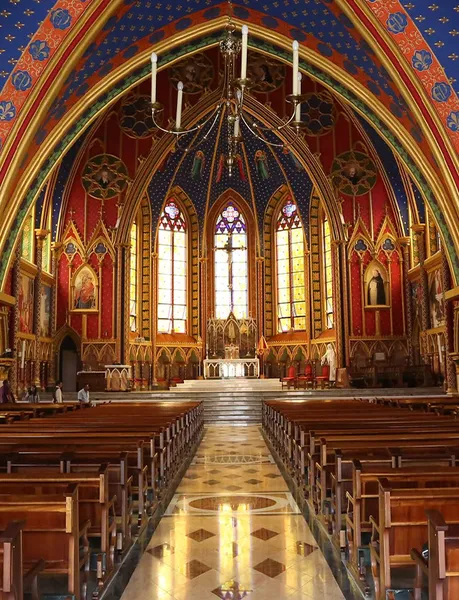
in August of 2009, in the Basilica of Our
Lady of the Rosary, Caieiras (Brazil)