 Heralds of the Gospel Magazine, Vol. 20, nº 226, August 2026
 Heralds of the Gospel Magazine, Vol. 20, nº 225, July 2026
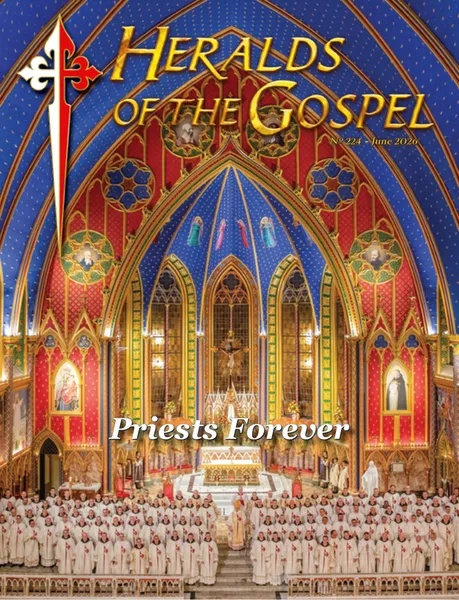 Heralds of the Gospel Magazine, Vol. 20, nº 224, June 2026
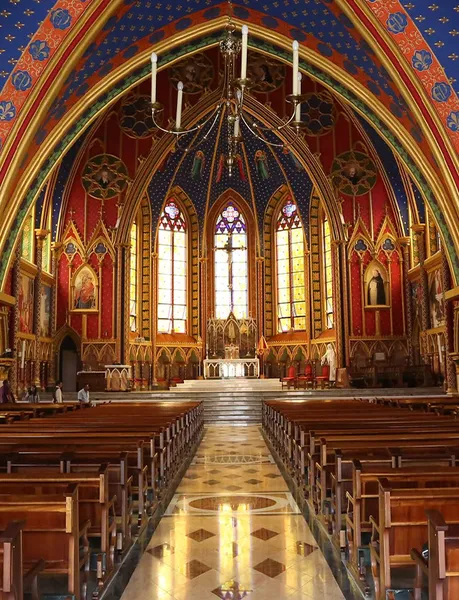 Who are the Heralds of the Gospel?
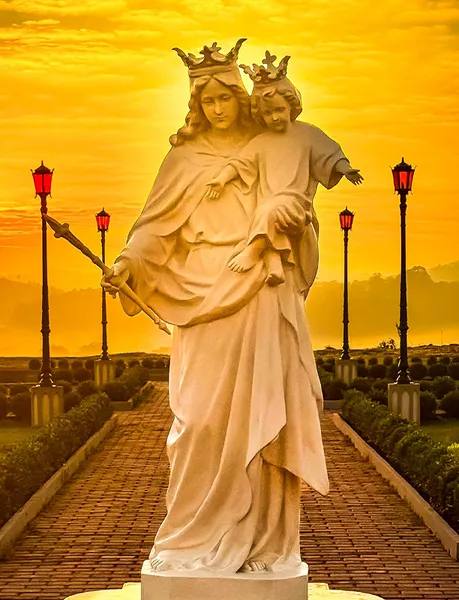 Help of Christians
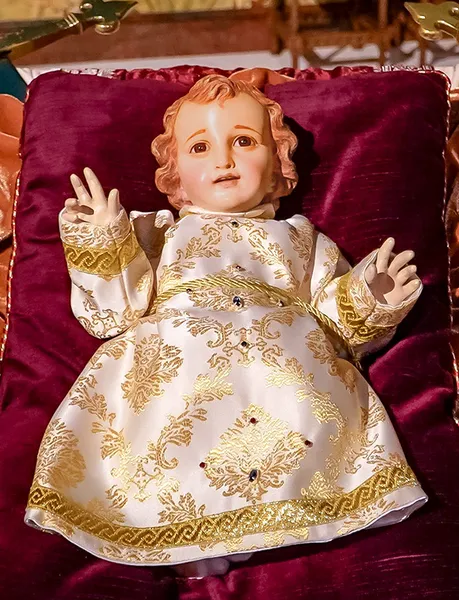 Christmas Carols






June 14 – 11th Sunday in Ordinary Time
For a sovereign state to exist, it needs a people, a defined territory, an organized government, and laws that regulate the common good.
However, a people can exist united by cultural or spiritual ties, even without their own territory, as is the case with Christians:
They dwell in their own countries, but simply as sojourners. As citizens, they share in all things with others, and yet endure all things as if foreigners. Every foreign land is to them as their native country, and every land of their birth as a land of strangers.1
In the Liturgy of this Sunday, the Lord promises Moses that His people will be “a kingdom of priests, a holy nation” (Ex 19:6).
Now, this covenant also applies to us, reconciled by the unfathomable love of Christ, who “while we were still sinners […] died for us” (Rom 5:8).
He attracted a numerous people (cf. Ps 99:3), as a Shepherd to his sheep (cf. Mt 9:36). And he wanted to multiply His ministers, for “the labourers are few” (Mt 9:37).
Yes! Their number is small when compared to the size of the harvest; even smaller when holiness is considered…
Priests, and in particular holy priests, are the most especially called to work in the harvest, but the laity also participate in the priesthood of Christ, they are a priestly people.
These are “in the front line of Church life; for them the Church is the animating principle of human society.”2
Indeed, by virtue of Baptism, “the laity, dedicated as they are to Christ and anointed by the Holy Spirit, are marvellously called and prepared so that even richer fruits of the Spirit maybe produced in them,” in every circumstance, provided it is “accomplished in the Spirit.”3
In this way,
what the soul is in the body, Christians are in the world. The soul is dispersed through all the members of the body, and Christians are scattered through all the cities of the world.
The soul dwells in the body, yet is not of the body; and Christians dwell in the world, yet are not of the world.4
Thus, the Virgin Mary never tired of, nor was She ever tiring to those whom She cared for as a Shepherdess. Upon learning that Elizabeth needed her, She hastened to the hill country to serve her (cf. Lk 1:39). She then went to Bethlehem, soon to give birth (cf. Lk 2:4-5).
When the Child was born, She fled with Him to Egypt (cf. Mt 2:14), returned to Nazareth (cf. Mt 2:21), and later searched for Him in the Temple when She thought She had lost Him (cf. Lk 2:45-46).
When the wine ran out, She interceded in favour of the bridegroom and, knowing that the hour had not yet come, commanded everyone to obey Jesus (cf. Jn 2:1-11).
When the shepherds of her Divine Son abandoned Him, She remained standing by the Cross (cf. Jn 19:25-27) and forgave them as a Mother. Finally, She joined them in the Upper Room, teaching them to pray, awaiting the Holy Spirit (cf. Acts 1:14).
The sheep grieve the lack of good shepherds, models of the priesthood, in which they themselves participate.
Mary was a sublime example of following Christ and a model of virtue for all the priestly people. Whoever imitates her generosity will never stray from the Lord’s flock!