 Heralds of the Gospel Magazine, Vol. 20, nº 227, September 2026
 Heralds of the Gospel Magazine, Vol. 20, nº 226, August 2026
 Heralds of the Gospel Magazine, Vol. 20, nº 225, July 2026
 Who are the Heralds of the Gospel?
 Help of Christians
 Christmas Carols








Gospel for the Feast of the Transfiguration of the Lord
28b Jesus took Peter, John and James and went up a mountain to pray. 29 While He was praying His face changed in appearance and His clothing became dazzling white.
30 And behold, two men were conversing with Him, Moses and Elijah, 31 who appeared in glory and spoke of His exodus that He was going to accomplish in Jerusalem. 32 Peter and his companions had been overcome by sleep, but becoming fully awake, they saw His glory and the two men standing with Him.
33 As they were about to part from Him, Peter said to Jesus, “Master, it is good that we are here; let us make three tents, one for You, one for Moses, and one for Elijah.”
But he did not know what he was saying. 34 While he was still speaking, a cloud came and cast a shadow over them, and they became frightened when they entered the cloud. 35 Then from the cloud came a voice that said, “This is My chosen Son; listen to Him.”
36 After the voice had spoken, Jesus was found alone. They fell silent and did not at that time tell anyone what they had seen (Lk 9:28b-36).
I – The Manifestation of the Lord’s Glory
In leafing through the pages of the holy Gospels, we see that there is no other Transfiguration of Jesus besides the one of Tabor. It is true that after He resurrected, He appeared to the Apostles in the Cenacle (cf. Mk 16:14-18; Lk 24:36-49; Jn 20:19-29), to St. Mary Magdalene (cf. Mk 16:9; Jn 20:1-18) and to the Holy Women (cf. Mt 8:9-10), but nothing indicates that He showed them the resplendence described in this grandiose scene that we now contemplate. In it, He revealed a diminished reflection of His glory, concealing the plenitude of His splendour. How can we interpret this sublime episode? What relationship does it have with us, two thousand years later? This passage offers many insights, with useful implications for the spiritual life. It seems, at first, to have no obvious connection with the Christian vocation, so aptly outlined by the Second Vatican Council: “If therefore in the Church everyone does not proceed by the same path; nevertheless, all are called to sanctity and have received an equal privilege of faith through the justice of God (cf. Rom 12:4-5).”1 Perfection is not something exclusive to the clergy or religious, but should also shine in the laity, so that the Catholic spirit pervades the temporal reality. To be a saint, it is not necessary to perform miracles, or have extraordinary gifts or be transfigured, as Jesus was. Even in the Old Testament, God convoked Israel to holiness: “The Lord said to Moses, ‘Say to all the congregation of the people of Israel, you shall be holy, for I the Lord your God am holy’” (Lv 19:1-2). Consequently, it is not easy to establish a strict relationship between the general vocation of the sons of God to holiness and the Transfiguration of Our Lord, a miraculous phenomenon. Let us examine the question more closely.Three chosen witnesses
28b Jesus took Peter, John and James and went up a mountain to pray.
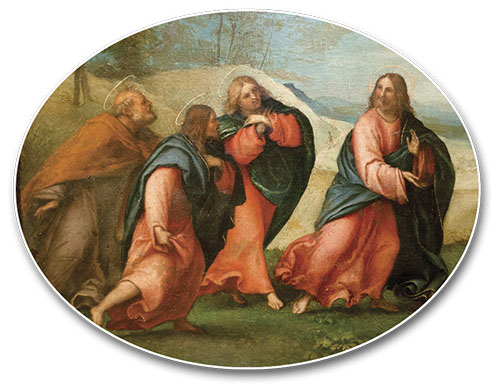 Our Lord with the three Apostles after the Transfiguration - Hermitage Museum, St. Petersburg (Russia)
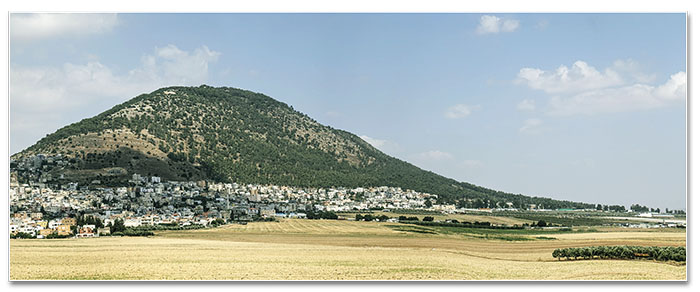 Mount Tabor (Israel)
Glory manifested in refulgent light
29 While He was praying His face changed in appearance and His clothing became dazzling white.
The apogee of the Old Law bows before the Gospel
30 And behold, two men were conversing with Him, Moses andElijah, 31 who appeared in glory and spoke of His exodus that He was going to accomplish in Jerusalem.
An enormous grace that escaped their understanding
32 Peter and his companions had been overcome by sleep, but becoming fully awake, they saw His glory and the two men standing with Him. 33 As they were about to part from Him, Peter said to Jesus, “Master, it is good that we are here; let us make three tents, one for You, one for Moses, and one for Elijah.” But he did not know what he was saying.
Adoptive sons, God loves us as an only child
34 While he was still speaking, a cloud came and cast a shadow over them, and they became frightened when they entered the cloud. 35 Then from the cloud came a voice that said, “This is My chosen Son; listen to Him.”
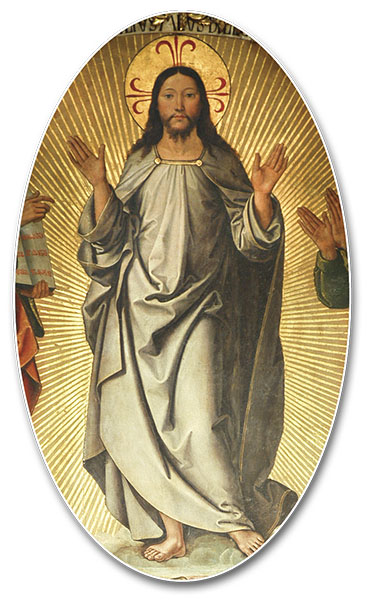 Jesus manifests His glory, detail of the “Transfiguration of the Lord” - Cathedral of Avila (Spain)
Consolations do not last forever
36 After the voice had spoken, Jesus was found alone. They fell silent and did not at that time tell anyone what they had seen.
II – A Reflection of the Absolute
The Transfiguration gives us an idea of the reflection of the Absolute that awaits those who go to Heaven. Let us keep our eyes trained on this final goal, our resurrection in a state of glory, if by God’s mercy we attain salvation. For a better understanding of what this state involves, let us first consider the state of the God-Man. He shows Himself to us in a mortal body, but we know that it ought to. be glorious,4 for several reasons: because of the hypostatic union – that is, the union of the divine with the human nature in the Person of the Word; because His soul never left the beatific vision from the moment of conception; and, finally, by the merits gained by His Death on the Cross. Obviously, we do not have hypostatic union with a Divine Person, but, respecting due proportions, we are called to see God face to face in Heaven, in addition to profiting from the merits of our Divine Redeemer, transferred to us by His infinite mercy. We have, then, like Jesus, the requisites that guarantee our acquiring a glorious body after the resurrection of the dead. The Transfiguration gives us an idea of our life in eternity and imparts hope, for, as the Apostle affirms, we will be similar to Christ in the future life and we will triumph with Him, “provided we suffer with Him in order that we may also be glorified with Him” (Rom 8:17). The three Apostles’ testimony of this miracle sheds light on the happiness of Heaven; Peter was prompted to suggest setting up three tents and staying on Tabor. He felt an inner joy that made him want to remain on the mount and to forget the battles and labours that still awaited him below, just like us when we are filled with supernatural consolation… we wish it would never end!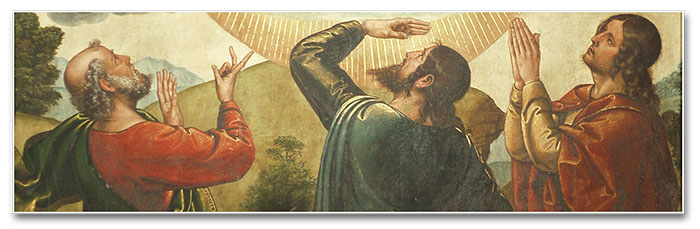 The Apostles behold the dazzling brightness of Jesus, detail of the “Transfiguration of the Lord” - Cathedral of Avila (Spain)
The heavenly inheritance
Now, as we know, Heaven is the inheritance of the sons of God. To gain a deeper understanding of this truth, we can form a contrast. If we reflect on hell, we recognize the total absence of love there. In that place, no one loves his neighbour; there is crazed hatred for the blessed souls in Heaven as well as for those sharing the same disgrace. It is a perpetual hatred, for everything and everyone. Life in Heaven, conversely, is an existence of eternal love. Love produces happiness, and this is Heaven’s essence, springing from the beatific vision, for the intelligence has the need to adhere to truth, and the will has the need to love the good within its reach. This aspiration of the powers of the soul is fully satisfied with the attainment of the vision of God Himself. An image illustrates this reality: when we are offered an appetizing fruit, such as a ripe and fragrant mango, our intelligence perceives its authenticity, which entices our will all the more. And if its taste corresponds with the expectations that we have formed of it, the will and intelligence are attended to, and we feel satisfied. The existence of evil could be held up to challenge the previous statement, for it seems that when man sins, for example, he loves evil. But, in practicing evil, man deceives himself, incorrectly believing that he will find good in sin, for he cannot love evil for its own sake or embrace error as such.5 False appearances suggested by the senses are what cloud the intelligence and weaken the will.6 In theft, to mention a particular sin, the thief wants to obtain a good for himself – the property of another – without the inconvenience and effort of working honestly for it. He knows that this is a violation of God’s Law, a serious transgression against the victim and against order, but he egoistically opts for his own advantage. To quell his troubled conscience, he will devise sophisms to justify the illicit act and cloak it with appearances that seem good, without which he would not be able to commit it. For the same reason, heresy disguises itself as truth in order to achieve free rein: if it flaunted its error without any masks, no one would accept it. In Heaven, where there is no fraud, Good and Truth are found in essence, and thus, it is impossible for man not to love. Thus, from the moment in which the soul sees God, in the beatific vision, the intelligence and the will immediately adhere to Him, absolutely and irrevocably.What will heavenly happiness be like?
We were all created for God, and our soul yearns for Him. This plenitude of satisfaction comes from the possession of Him in Heaven. Why plenitude? Because the intensity and the duration of joy depend on the quality of the object possessed. If it is small, with time it fades and we tire of it, as usually happens, sooner or later, with material goods and all worldly things. Human pleasure is fleeting. Who can listen uninterruptedly to the same music, however beautiful, or look at just one landscape fixedly for years without moving on? In this life, everything eventually becomes tiresome. But not God, because in Heaven He will be seen in His entirety, but not totally. And as He is the supreme Truth and Beauty, He will eternally present us with new aspects, and we will never experience boredom. “Then,” St. Robert Bellarmine comments, “wisdom will no longer consist in a quest for the divine in the mirror of created things, but in the revealed vision of God’s essence, Cause of all causes, and of the first and Supreme Truth.”7 The natural desire to find out and to know is satiated with this vision, for our understanding will be elevated by God’s light – lumen gloriæ – to the capacity of comprehending Him in the most perfect way possible for our state. And if in this life the notion of certain truths brings us joy, what will be the happiness stemming from the dilation of the human intelligence by a loan of the divine intelligence? Nevertheless, heavenly happiness would be incomplete if it were limited to heeding only the desires of the intelligence. The will also attains the fullness of its satisfaction therein. The heart needs to love and be loved, and nothing produces so much happiness as fulfilling this ideal, even if in a transient manner. When someone whom we regard highly, especially if they are superior to us in some way, says “I esteem you greatly!” the heart expands with the feeling of being loved. How great our joy will be when God says to us: “My child, I truly love you! I love so much that I created you, and My love instilled in your soul all the good that it has. Come, My child! I am here to be your eternal joy!” St. Alphonsus says that the souls “in Heaven are certain that they love and are loved by God. They see that the Lord embraces them with a great love, which will endure for all eternity.”8 This is the happiness in Heaven! It is a happiness that satisfies without satiating, for it does not produce boredom. Thus, just like the Truth, the Goodness of God is also infinite, always offering man something new and worthy of love. The Saints have created an expressive image to compare eternal delight to a thirst that, being satisfied, is never satiated: a thirst for thirst. “The heavenly goods satisfy. and always give joy to the heart [...]. And, even though they fully satisfy, they always seem new, as if it were the first time enjoying them; we always enjoy them and always desire them; we always desire them and always obtain them.”9III – Jesus was Transfigured for Each One of Us
These considerations on the glory of Heaven help us understand the meaning of Tabor. When Jesus transfigures Himself in the sight of the Apostles, He also does- - so before each one of us, for the Liturgy enables us to profit, today, from the graces that were poured out two thousand years ago during that event. We participate in the wonderment of Sts. Peter, John, and James. And from afar we understand, perhaps even better than the Apostles themselves, the message that the Divine Teacher wants to transmit for our benefit.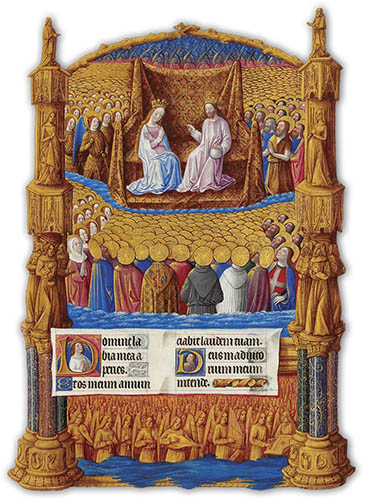 Paradise, “Les très riches heures du Duc de Berry” - The Condé Museum, Chantilly (France)
Notes
1 SECOND VATICAN COUNCIL. Lumen gentium, n.32.
2 ST. THOMAS OF VILLANOVA. Dominica secunda Quadragesimæ, n.1. In: Obras Completas. Madrid: BAC, 2011, v.II, p.735.
3 Cf. ST. THOMAS AQUINAS. Summa Theologiæ. I-II, q.111, a.2.
4 Cf. Idem, III, q.14, a.1.
5 Cf. Idem, I-II, q.77, a.2.
6 Cf. Idem, q.75, a.2, ad 1; q.77, a.1.
7 ST. ROBERT BELLARMINE. De ascensione mentis in Deum per scalas rerum creatarum, gradus XV (Ex consid. magnitud. iustitiae Dei). São Paulo: Paulinas, 1955, p.247.
8 ST. ALPHONSUS MARIA DE LIGUORI. Sermoni compendiati per tutte le domeniche dell’anno, Dom. II di Quaresima: Del Paradiso. In: Obras Ascéticas. Madrid: BAC, 1954, t.II, p.918-919.
9 Idem, p.919.