 Heralds of the Gospel Magazine, Vol. 20, nº 227, September 2026
 Heralds of the Gospel Magazine, Vol. 20, nº 226, August 2026
 Heralds of the Gospel Magazine, Vol. 20, nº 225, July 2026
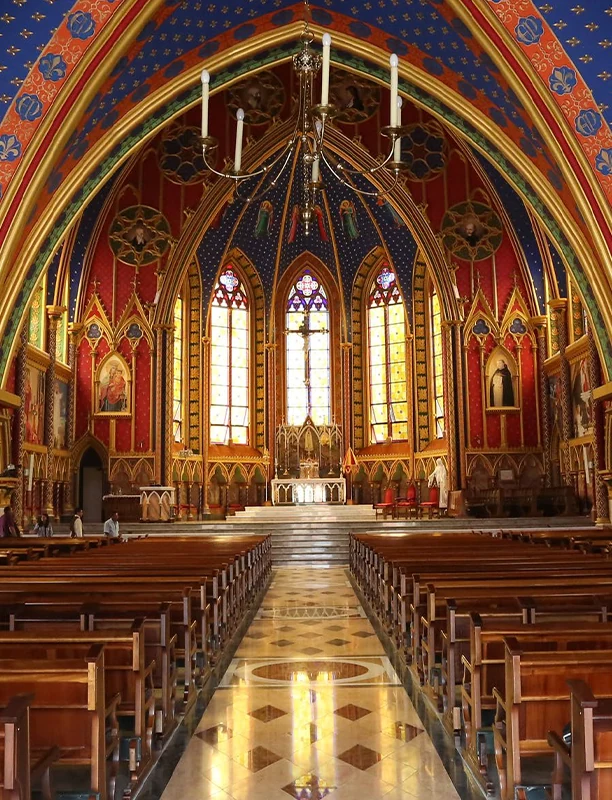 Who are the Heralds of the Gospel?
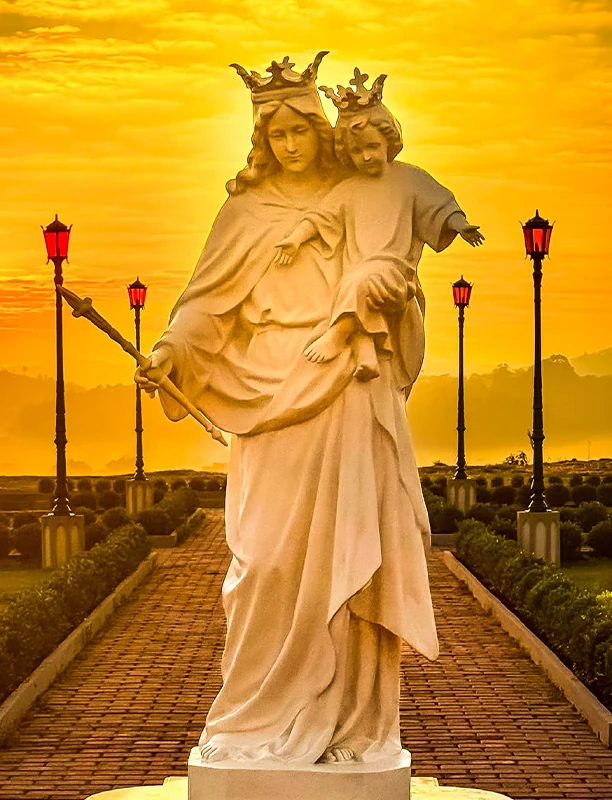 Help of Christians
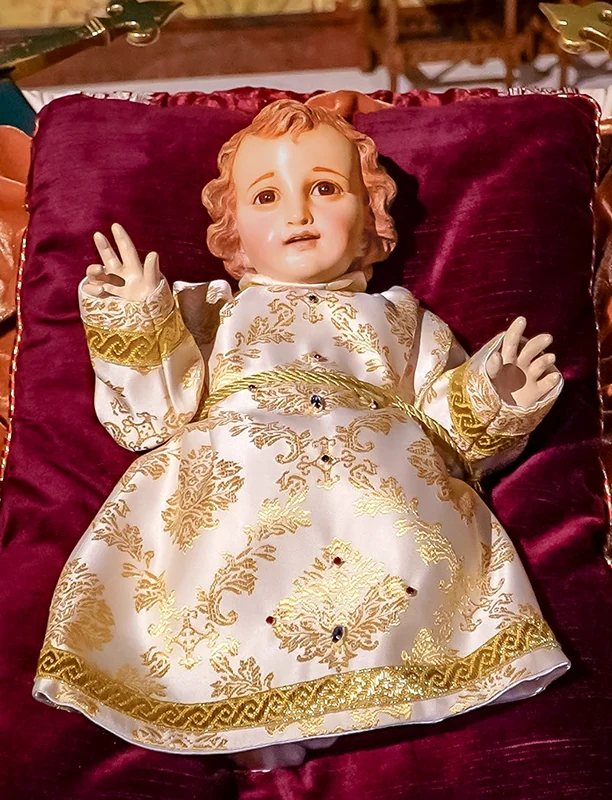 Christmas Carols







The oldest and most immense of armies
Heaven was the first battlefield on which “Michael and his Angels fought with the dragon” (Rv 12:7). Lucifer’s infamous declaration: “I will not serve!” was followed by St. Michael’s rallying cry: “Who is like unto God?” And its echo defined the course of history: war on evil, glory to the Most High! This archetypal struggle on the first day of creation would continue on earth, where the devil was expelled with his henchmen. God had only just begun to form his army, which, however, would only be complete when it included man as a decisive and primordial element. This is why Genesis tells us that the work of the six days ended with the creation of Adam: “Thus the heavens and the earth were finished, and all the host of them” (Gn 2:1). In fact, if an army is a joint organization of forces destined for war, it follows that all creatures were arranged, from the beginning, as if in readiness for battle. Accordingly, it was not fitting that the Creator should spare man the honour of fighting! By allowing the Serpent to enter Paradise, He wanted a hero to emerge from the gentle wonders of that land of delights.1 If this desire was not fulfilled due to the fall of our first parents, at least the path of combat was opened up to mankind, but with the addition of another enemy: the lust of nature itself, now tainted by original guilt. The earth became the greatest and oldest battlefield, on which soldiers follow one another, enemies take turns, but two flags flutter in constant and irreconcilable enmity: that of God, our Supreme Captain and Lord, and that of Lucifer, the mortal enemy of mankind. 2 Hanging in the balance between these two commanders is the human being, facing a reality that as harsh as it is beautiful, and does not allow for the option of being mere spectators because, much like real war, life does not take place in an amphitheatre. There are no grandstands, nor any alternative of retreat… There cannot be two masters: it is either God or the devil.The sect of the minimalists
Never in history have the infernal forces tried to make a peace treaty with God; on the contrary! They use violence and hatred to attack Him, especially His children and the Holy Church. However, in order to attract people to his side, the devil himself invites them to a third field of fantasy: an easy life, without effort, without struggle, without commitment to the cause of good, or an unequivocal commitment to the prince of darkness, through connivance with “small” faults that are not combatted or perhaps serious sins that are hidden and repeated … This is the life of the minimalists! The punishment, recounted in the Book of Daniel, that God inflicted on King Nebuchadnezzar, who, having been cast out from among men, grazed on herbs like a brute beast, is astonishing (cf. Dn 4:30). It was better to never have been born than to be reduced to a humiliating state, so inferior to that which his honorable position of monarch and his very human nature demanded. He, who had once been great and powerful, whose height reached the stars, whose dominion extended to the ends of the earth… (cf. Dn 4:19). What a gulf of difference!
“Way of Salvation”, by Andrea di Bonaiuto - Basilica of Santa Maria Novella, Florence (Italy)
On the cross of fidelity and heroism
If our existence is a war, in which we are inevitably involved, we must fight without ceasing, on pain of losing the life of our soul and eternal happiness. “No soldier on service gets entangled in civilian pursuits, since his aim is to satisfy the one who enlisted him” (2 Tm 2:4). Our Captain has already mapped out the path for us: “If any man would come after Me, let him deny himself and take up his cross and follow Me” (Mt 16:24). In order to be under the standard of the Divine Commander, we have to immolate ourselves with Him on the cross of fidelity to the Commandments. The conduct of the saints was no different. The Church defines them as members of the faithful who “practiced heroic virtue and lived in fidelity to God’s grace.”4 Now, giants in virtue are not formed suddenly, as Dr. Plinio Corrêa de Oliveira ponders: “Millimetric heroism, so small that it is confused with daily life, is a first step on the path to ascension,”5 because, just like climbing a mountain, holiness also begins at the base and not halfway to the top. The higher we climb, the more we will feel attracted. Difficulties will arise; there will be tremendous cliffs, fearsome gorges, threatening animals, all sorts of dangers; however, we must always advance if we want to reach the pinnacles of heroism! Thus, we must conceive of life in this present world from the standpoint of battle because, on an individual level, it can be seen as a factory of heroes in which the Saints of God are forged! Holiness “is nothing other than a great heroism that excites the whole soul and makes it capable of realizations so high and so great that, without the help of God, the most energetic man in the world would not be strong enough to carry them out.”6A Kingdom taken by force
St. Jerome7 explains to us that we must all do great violence to ourselves in order to reach the throne of Heaven, because, since we were engendered from the earth, we must conquer it by virtue, since we cannot obtain it by our nature. Now, if we are earthly, how can we reproduce in ourselves the features of the heavenly man (cf. 1 Cor 15:49)? Any creature can easily achieve the ends proportioned to its nature. Plants grow, birds migrate, fish swim, animals seek food, take refuge from danger, prepare for the offensive – in short, ensure their subsistence. In the same way, man develops and reaches the limits of knowledge; but his ultimate end, which consists in eternal beatitude, exceeds his natural capacity. Therefore, just as the arrow is launched at the target by the archer, the rational creature, capable of eternal life, can only reach it by the grace of God.8 Only He can introduce us to eternal life. However, with extreme love, He wants to give us the merit of our effort and, consequently, a greater reward of glory. It is true that He created us without our consent, but He does not want to save us without our collaboration.9 Thus, the spiritual struggle, although arduous and continuous, consists above all in a divine process in which God grants us grace and, in response to our necessary correspondence, responds with new gifts and benefits. Holiness therefore comprises two realities: grace, as the main factor and without which we cannot act supernaturally; and the fight against the enemies who oppose our salvation.Fight against sin and its allies

Detalhe de “A Trindade adorada por todos os Santos” - Metropolitan Museum of Art, Nova York
Precious tactics of war
So far we have a brief war plan, a map of enemies. But where can we find weapons, where can we seek help? A weakened soldier cannot sustain himself for long. Deprived of strength, sinful by nature, we will find no better weapon than continuous prayer and the preservation of the state of grace, to which frequenting the Sacraments contributes. Tactics vary according to the attack received and the blow to be delivered, but, as a rule, spiritual warfare involves the continuous flight from occasions of sin, a reaction in the opposite direction to sinful inclinations and a deep spirit of faith in heavenly realities, for we are only in this world in passing. Let us arm ourselves, therefore, from head to toe, for we have only one life to live, and in it we define our eternity, with no chance of return!* * *

Medieval knight - Neue Burg, Vienna
Notes
1 Cf. CORRÊA DE OLIVEIRA, Plinio. Conference. São Paulo, 21/9/1985.
2 Cf. ST. IGNATIUS OF LOYOLA. Spiritual exercises, n.136.
3 DANTE ALIGHIERI. The Divine Comedy. Hell, III, 62-63. São Paulo: Atena, 1955, p.20.
4 CCC 828.
5 CORRÊA DE OLIVEIRA, Plinio. Conference. São Paulo, 20/4/1985.
6 CORRÊA DE OLIVEIRA, Plinio. Carola: caricatura do verdadeiro católico [The sanctimonious: Caricature of a True Catholic]. In: Dr. Plinio. São Paulo. Year XXV. N.286 (Jan., 2022); p.11.
7 Cf. ST. JEROME, apud ST. THOMAS AQUINAS. Catena Aurea. In Matthæum, c.XI, v.12-15.
8 Cf. ST. THOMAS AQUINAS. Summa Theologiæ. I, q.23.
9 Cf. ST. AUGUSTINE. Sermón 169, n.13. In: Obras Completas. Madrid: BAC, 1983, v.XXIII, p.660-661.
10 Cf. ROYO MARÍN, OP, Antonio. Teología de la salvación. Madrid: BAC, 1997, p.67.
11 Cf. CCC 2516.
12 ST. CATHERINE OF SIENA. O diálogo. 8.ed. São Paulo: Paulus, 2004, p.327-328.