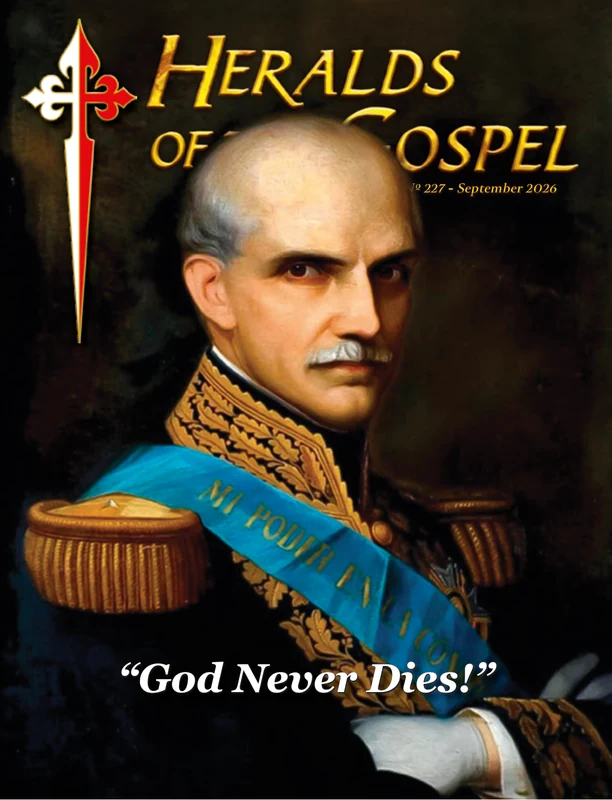
 Heralds of the Gospel Magazine, Vol. 20, nº 227, September 2026
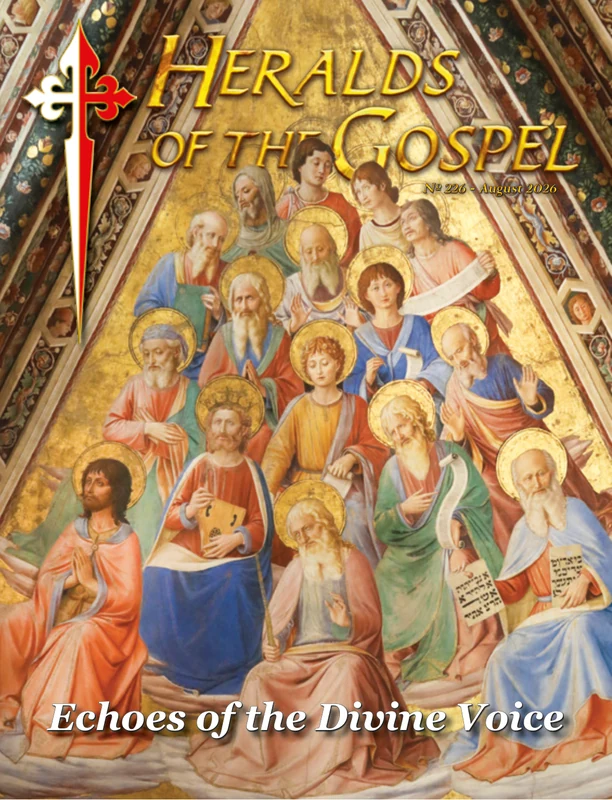 Heralds of the Gospel Magazine, Vol. 20, nº 226, August 2026
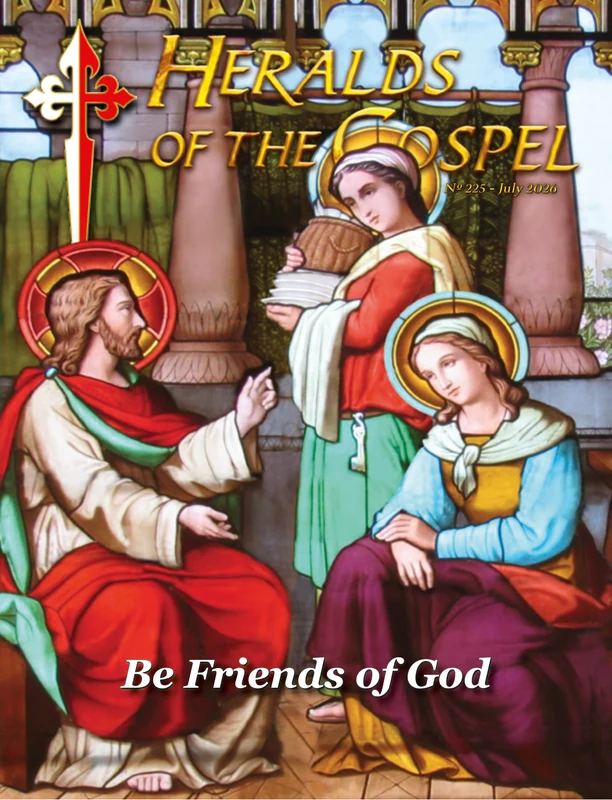 Heralds of the Gospel Magazine, Vol. 20, nº 225, July 2026
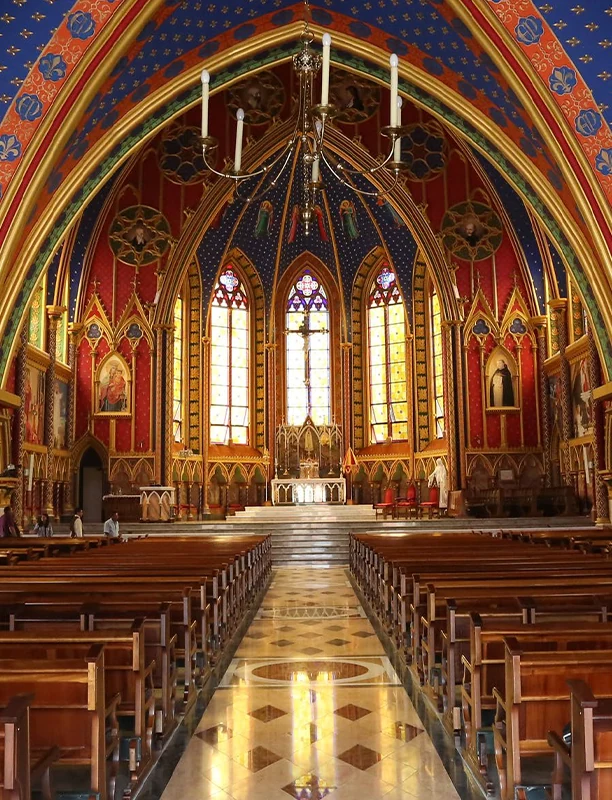 Who are the Heralds of the Gospel?
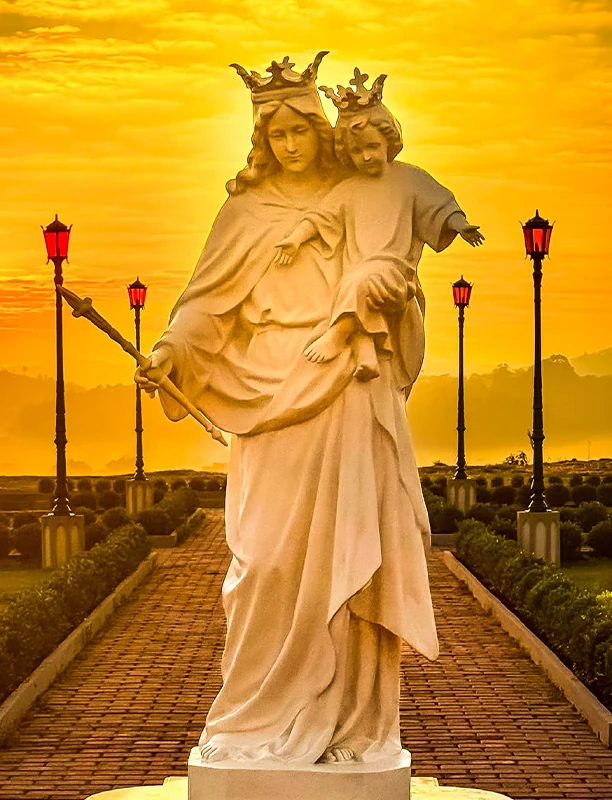 Help of Christians
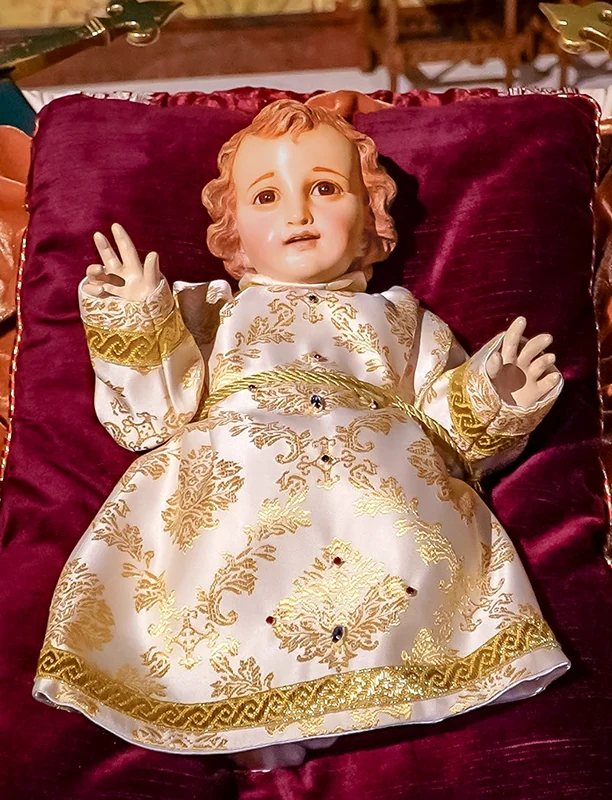 Christmas Carols







Gospel of the Feast of the Visitation of Our Lady
39 Mary set out and travelled to the hill country in haste to a town of Judah, 40 where She entered the house of Zechariah and greeted Elizabeth.
41 When Elizabeth heard Mary’s greeting, the infant leaped in her womb, and Elizabeth, filled with the Holy Spirit, 42 cried out in a loud voice and said, “Most blessed are You among women, and blessed is the fruit of your womb. 43 And how does this happen to me, that the Mother of my Lord should come to me? 44 For at the moment the sound of your greeting reached my ears, the infant in my womb leaped for joy. 45 Blessed are You who believed that what was spoken to You by the Lord would be fulfilled.”
46 And Mary said: “My soul proclaims the greatness of the Lord; 47 my spirit rejoices in God my Saviour, 48 for He has looked with favour on His lowly servant. From this day all generations will call me blessed: 49 the Almighty has done great things for me, and holy is His Name. 50 He has mercy on those who fear Him in every generation. 51 He has shown the strength of His arm, He has scattered the proud in their conceit. 52 He has cast down the mighty from their thrones, and has lifted up the lowly. 53 He has filled the hungry with good things, and the rich He has sent away empty. 54 He has come to the help of His servant Israel for He has remembered His promise of mercy, 55 the promise He made to our fathers, to Abraham and his children for ever.”
56 Mary remained with her about three months and then returned to her home (Lk 1:39-56).
I – The Symphony of Servanthood
In a world where the most radical egalitarianism is preached as a remedy to social discord, today’s Gospel runs the risk of being misunderstood. In fact, by means of St. Luke’s pen, the Holy Spirit performs in these verses the most beautiful symphony in praise of servanthood. With God himself as director, the “orchestra” includes “virtuosos” of the highest order, from the Infant Jesus, still hidden in the virginal womb of Mary, to St. John the Baptist, leaping with joy in his mother’s womb. In this beautiful composition, everyone sings the hymn of humility and seeks to treat the others as superior to themselves. Servanthood is a word proscribed in the dictionary of our egalitarian pseudo-culture, but it has great importance in the Catholic religion. Let us recall that Jesus made himself a servant in order to save us, going to the utmost extreme of humiliation (cf. Phil 2:7); Our Lady exulted in declaring herself the handmaid of God, as we shall contemplate in this article; and St. Paul exhorted Christians to be servants of one another out of love (cf. Gal 5:13). Thus, the Church proposes servanthood as an ideal to be attained by all, because it is the true solution to the world’s problems. Egalitarianism, as conceived by the bloodthirsty Jacobins, is an illusory remedy for the evil of envy. In a society levelled with iron and fire by the promoters of “liberty”, the proud are urged to sink into the anonymous mass of “equals” with the fallacious promise of never finding themselves overshadowed by a superior. But how to restrain the vehement desire of human pride to impose itself and dominate others? In reality, no egalitarian is satisfied with the uniformity that his supposed ideal propounds. This, in brief, explains the vicious circle brought about by the revolutionary utopia, leading man to terrible frustration, for social hierarchy will always exist, owing to the natural order of things. At the other extreme, Catholic submission – of which we have a shining example in the Gospel of this feast – readily admires the qualities of others, respects authorities,rejoices at the superiority of others, venerates those who stand out for their virtues, and adores God with all the strength of the soul. It is the best predisposition to true love, which consists in detachment from oneself in the contemplation of the goodness of others. At first sight, it would seem that submission is a negative attitude; nevertheless, it has an unusual power to elevate those who cultivate it, for “whoever humbles himself will be exalted” (Mt 23:12). If we consider that Our Lady, bearer of the Word of God and Queen of the Universe, decides to go in haste to help her cousin – inferior to Her in the order of grace – our spirit is amazed and filled with wonder. The Mother of God serves the mother of the Precursor. It is a gesture diametrically opposed to the spirit of the world. The noblest, without renouncing their own dignity, rush to the aid of those who are lesser, who react to such a profusion of goodness with heartfelt gratitude. This, on Elizabeth’s lips, becomes a sublime hymn of glorification to the Virgin and to her Divine Son. In the episode of the Visitation we see the pattern of human relationships that will mark the historical era prophesied at Fatima, the Reign of Mary. Looking at those who will have passed unscathed through the crucible of the coming purification, people will exclaim, “See how they are slaves to one another!” Yes, the desire to serve will be the keynote of future centuries, marked by the spirit of the Immaculate.II – The First Gleam of Mary’s Mediation
The Gospel of the infancy narrated by St. Luke conveys with enchanting scintillations sublime truths of our Faith, some of which have already been solemnly declared by the Supreme Magisterium of the Church, such as the Divine Maternity of Mary, and others, we may say, are waiting to be so. Specifically, the Visitation of Our Lady to St. Elizabeth highlights her role in the Church as the Universal Mediatrix of all graces, in union with Christ. This is a most noble mission, which over the centuries has become more explicit in the theological sphere, and in the latter times will come to manifest itself in its full splendour in the reality of events. The union of graces and designs between Mother and Son is such that God did not only entrust Her with bearing the adorable Body of Jesus, but also willed to associate Her with His redemptive work in an intimate, inseparable and sublime way. As the most solid theology attests, Our Lady was a Co-redemptrix with the Redeemer, as the New Eve next to the New Adam. And having purchased with Him the graces that heal and elevate fallen man, with Him She also shares them with motherly generosity. Jesus acts with grandeur in souls, but He does so through Mary, through her voice, her presence and her actions. And thus the distribution of the divine gifts reaches its zenith, producing miracles of sanctification, such as those that took place in the hearts of St. John the Baptist and St. Elizabeth during the Visitation. The more clearly the faithful see the scope of the supernatural mission that the Blessed Virgin must exercise in the world, the greater the flow of graces will become, inaugurating a true supernatural springtime in the whole world, today devastated by the sin of apostasy. Devout meditation on the mystery of the Visitation will give us some idea of what this new historical phase will be like, bathed in the purest waters of Marian grace, capable of raising humanity to a very close union with God and transforming the earth into a reflection of Heaven. Only the most humble and unassuming creature could be the golden bridge by which the Lord of hosts will convey His best gifts, to enrich mankind and transfigure it under the rays of purest splendour.“If any one would be first, he must be servant of all”
39 Mary set out and travelled to the hill country in haste to a town of Judah…
Mary’s voice is the bearer of efficacious graces
40 …where She entered the house of Zechariah and greeted Elizabeth. 41 When Elizabeth heard Mary’s greeting, the infant leaped in her womb, and Elizabeth, filled with the Holy Spirit…
The marvellous fruits of the Holy Spirit
42 … cried out in a loud voice and said, “Most blessed are You among women, and blessed is the fruit of your womb. 43 And how does this happen to me, that the Mother of my Lord should come to me? 44 For at the moment the sound of your greeting reached my ears, the infant in my womb leaped for joy. 45 Blessed are You who believed that what was spoken to You by the Lord would be fulfilled.”
 Pentecost, “The Grandes Heures of Anne of Brittany” - National Library of France, Paris
Mary’s exultant unpretentiousness
46 And Mary said: “My soul proclaims the greatness of the Lord; 47 my spirit rejoices in God my Saviour…”
48 “…for He has looked with favour on His lowly servant. From this day all generations will call me blessed: 49 the Almighty has done great things for me, and holy is His Name. 50 He has mercy on those who fear Him in every generation.”
A warrior hymn par excellence
51 “He has shown the strength of His arm, He has scattered the proud in their conceit. 52 He has cast down the mighty from their thrones, and has lifted up the lowly. 53 He has filled the hungry with good things, and the rich He has sent away empty.”
God’s fidelity
54 “He has come to the help of His servant Israel for He has remembered His promise of mercy, 55 the promise He made to our fathers, to Abraham and his children for ever.”
A long visit described in a few words
56 Mary remained with her about three months and then returned to her home.
III – Foretelling of the Marian Era
At Fatima Our Lady announced her triumph, as well as the desire of her Divine Son to establish devotion to her Immaculate Heart in the world. These two elements are of capital importance in illuminating the chaotic darkness of present-day society with a ray of light from Heaven. We have seen that St. Elizabeth praised the Blessed Virgin as the one who believed the words that were announced to Her. Thanks to this faith, God’s plan was fulfilled and the promises made to the patriarchs and prophets were wonderfully accomplished, surpassing all imagination: the uncreated and eternal God himself entered into time, descending to earth as true Man, in order to bring us salvation. But Mary’s bold and strong faith will go further, as She herself has announced. The Our Father prayer is without any doubt among the most valuable treasures left by Incarnate Wisdom. Of a sublime simplicity in its form, its content is of divine nobility. At each Mass, after the consecration, the Holy Church recites it, crying out to the First Person of the Holy Trinity: “Thy Kingdom come, Thy will be done on earth as it is in Heaven.” Besides imploring the coming of the Kingdom, this prayer also prophesies it in a sense, by the simple fact of it having been prayed by Jesus Christ and by the Church in union with Him, for His intercession before the Father is infallible. It remains to be seen when this will happen. In the golden ages of medieval Christianity, the Kingdom of God was established in the world to some degree, but just as this magnificent tree was about to bear its best fruit, the poisonous serpent of the Revolution coiled around it, bringing about a calamitous sterility. The events that followed chronicle the progressive demise of this magnificent civilization, once animated by the maxims of the Holy Gospel. It is a sadly truncated history that has precipitated humanity into a horrific barbarism. From then until now, although countless glorious Saints have appeared as beautiful stars in the firmament of the Church, society as a whole has progressively closed itself to the action of divine grace. Nevertheless, the prophecies of the Cova da Iria give us a fairly clear idea of the time of the most perfect fulfilment of God’s Kingdom among men. In effect, Our Lady foretold to the little shepherds the outbreak of the Second World War, the spread of Marxist errors throughout the world, the annihilation of various nations and, finally, the triumph of her Immaculate Heart. Our Lady of Graces - Mairiporã (Brazil)