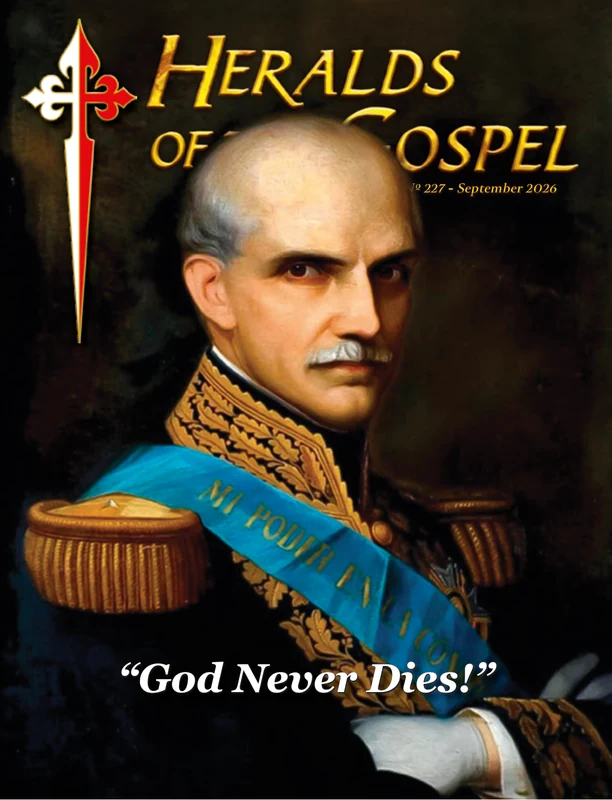
 Heralds of the Gospel Magazine, Vol. 20, nº 227, September 2026
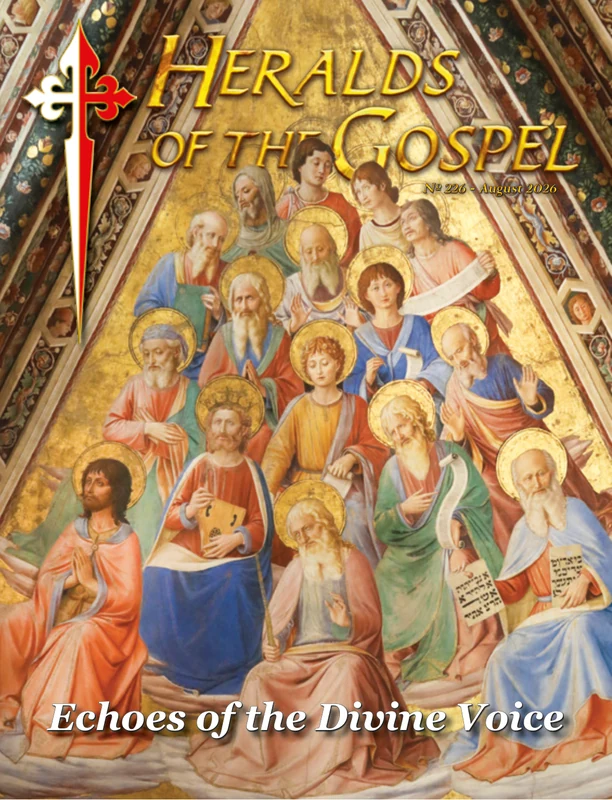 Heralds of the Gospel Magazine, Vol. 20, nº 226, August 2026
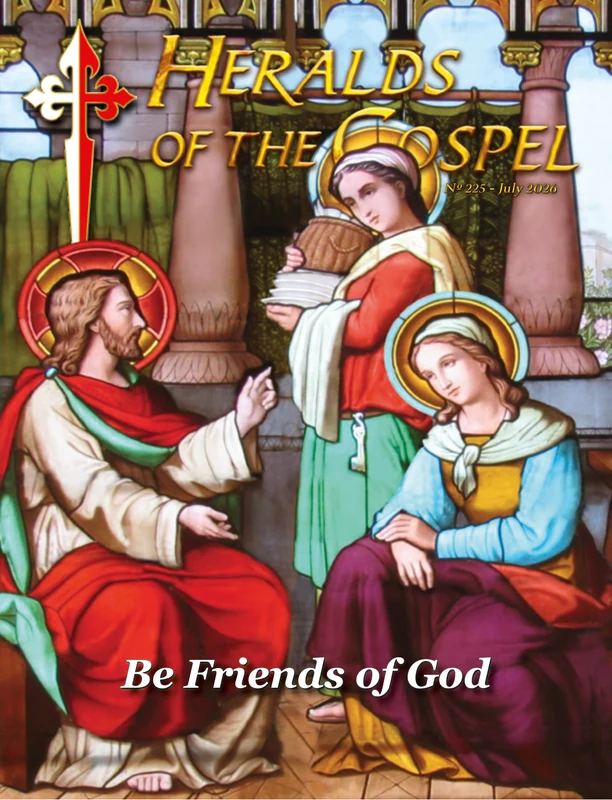 Heralds of the Gospel Magazine, Vol. 20, nº 225, July 2026
 Who are the Heralds of the Gospel?
 Help of Christians
 Christmas Carols






A man of exceptional psychological traits
The poetic image we can conjure up of a still pre-medieval Monte Cassino on the rocky slopes of the Latin Valley, with its monks absorbed in prayer, is only enhanced with the insertion of Thomas Aquinas, admiring the paths by which one can ascend from creation to the Creator. During the years passed in Monte Cassino, Thomas’ psychological characteristics began to take form: analytical, affable, balanced
Abbey of Monte Cassino (Italy)
“He never spoke but about God or with God”
As for his manner of being, however, he was clearly careful to remain discreet; like someone who is afraid to squander a precious treasure by making it known to many, St. Thomas always preferred to speak little and to express his thoughts in a measured way. At the same time, he made the Most High his confidant, with whom he came to nurture ever deeper and, perhaps, mysterious bonds. Thus, it may “be truly said of Thomas what is commonly reported of St. Dominic, Father and Lawgiver, that in his conversation he never spoke but about God or with God.”3 It is also said that during his period of study, Thomas kept his talents so inconspicuous that his classmates nicknamed him the “dumb ox”. However, this nickname did not persist for long, for Aquinas’ explanations of the subjects taught astonished his companions by their clarity and genius. This fact came to the attention of St. Albert the Great, who decided to put him to the test: one of the professors was to ask him a very complicated question in front of the whole class. He felt aggrieved in his humility, but he had to accept out of obedience. The answer was so precise that the master went so far as to say: “Thomas, you fill the role of one who teaches, not one who learns!” To which the Saint replied, in all simplicity: “Professor, I see no other way to answer this question.”“Doctor Angelicus” in both study and work
On the other hand, before he made himself heard by the Christian world, St. Thomas’ solicitude for his confreres in simple daily monastic life was a source of delight, both for his zeal in doing all things well and for attending to the innumerable consultations of which he was the target: “There are those who estimate his incredible and unsurpassable capacity for work at sixteen hours a day.”4 Meanwhile, these consultations could come from the most diverse spheres: from the King of France, St. Louis IX, from eminent ecclesiastics, or from simple fellow Dominicans. In addition to leading a life filled with duties, to which he paid a secondary level of attention – since the first level was usually occupied with the loftiest cogitations – Aquinas was very strict with himself. As Tocco tells us, St. Thomas “took only one meal a day”;5 perhaps he found the energy to carry on his highly active intellectual life in his exemplary temperance.Loyal and realist philosophy
As a result of this integrity of body and soul, “Thomistic philosophy is loyal and realistic, in which there is no sudden and comfortable evasion of mysteries that are declared to be evident, but rather rational progress from the known to the unknown,”6 respecting the limits of reason, as far as it may reach, aided by divine grace; without, however, transgressing the barriers of the divine with human speculation. Thus, “no author better respects the necessary distinction between [theology and philosophy] – although he makes the former, within a well-ordered hierarchy of values, the summit of the latter.”7 St. Thomas is therefore honest in his thought!Humility: the foundation of the virtues
It is worth noting that, in the trajectory of his discreet and luminous life, much of this honesty will shine by means of another virtue that is its basis and support: humility. Humility which, in daily life, translates into the docility with which he treats his brothers in the community, as the following fact proves. One day a modest friar, who did not know him, asks for his company and obliges him to undertake a tiring errand. When others inform him as to who he has as his companion, the embarrassed friar apologizes. And when those who witnessed the scene are amazed at such docility, St. Thomas tells them that the perfection of religious life presupposes, above all else, obedience. Humility which, in the application of the human powers of intelligence and will, finds no better example of conduct than in the innocence of those who have the Kingdom of Heaven as their inheritance (cf. Mt 19:14), in proposing the following prayer before their studies: “You [God], who make the tongues of little children eloquent, shape my words and place on my lips the grace of your blessing.” Humility, moreover, which in the face of praise and honours, is clothed in disinterest and unpretentiousness. As Ameal remarks, “no one is so simple, so natural as this amazing unveiler of the transcendent”8 who, in the face of such sought-after invitations as to dine at the table of kings and nobles, or to be a counsellor to Popes, or even to be the heir to possessions that confer a high social status, rejects everything. We need only allude to the following episodes: at the instigation of his family, St. Thomas was invited by Pope Innocent IV to accept the benefaction of the wealthy Abbey of Monte Cassino; a fact that was later, it seems, repeated by Clement IV. And then there were the many calls to the episcopate, which would give him the most coveted dioceses… Were these repeated invitations motivated by the high prestige he had achieved, the noble blood that distinguished him, his great oratorical skills, or rather his holiness? In the face of them all, the evasive – and assertive – attitude of the “dumb ox” was the only answer they received.9Piety: the axis of his spirituality
It was therefore in the religious state, through which man subjects himself to man for love of God, just as God subjected himself to man for love of man, that St. Thomas wished to live and carry out his mission to the end. It was the mission of St. Thomas to universalize Eucharistic devotion, the axis of his spirituality
St. Thomas Aquinas, by António André - Museum of Aveiro (Portugal)
Prudence: the norm of conduct
It is edifying to see how countless of St. Thomas’ explanations found an echo in his modus operandi. There was no inconsistency between what he preached and what he lived, but just the opposite. For example, in accordance with the principle that “human virtue is a habit perfecting man in view of his doing good deeds,”10 the Angelic Doctor’s actions were always guided by a certain virtue which, in his eyes, is “most necessary for human life”:11 prudence. Being the virtue that perfects the practical intellect to operate in a right way, but which also perfects the appetitive power as a moral virtue, prudence is classified by St. Thomas12 in a singular way in the two modalities of human acts, both those that have their origin in reason, and in the volition. Therefore, in the intellect prudence is responsible for advising, judging and deciding well, but because it is applied to action, it depends equally on the will.13 Now, how can we fail to see in St. Thomas a man of refined prudence? As a child, he was prudent in his questions, in order to hear from those with more experience why things exist; as a young man, he was prudent in his circumspection, having the facility to discover quickly a great number of solutions to problems; as a mature man, he was prudent in taking into account the opinion of the most knowledgeable – the greatest example of which can be found in his Summa Theologica, where he always appeals to the authority of the Fathers of the Church. If this were not enough, as a religious, he was prudent in not accepting ties with the world and the flesh; and, even more admirable, prudent in knowing he was fallible, accepting as the only indissoluble friendship that established with Wisdom – the friend of prudence, possessor of a profound knowledge (cf. Prv 8:12) – from which he drew the necessary means for the fulfilment of his great calling. At the end of his life, Thomas could no longer teach, for God had revealed to him “the secret of a superior knowledge”
Vision of St. Thomas Aquinas - Monastery of St. Dominic, Lima (Peru
“The Lord has revealed to me the secret of a superior knowledge…”
Approaching death, graced by supernatural favours and already alienated from this world, St. Thomas eloquently summed up the state of mind with which he was departing for eternity: “I asked [God] to take me from this world, His unworthy servant, in the humble condition in which I found myself, and that no power would transform my life by conferring some dignity upon me. I could still, no doubt, make further progress in knowledge and be, by doctrine, useful to others. But through the revelation made to me, the Lord has imposed silence on me, since I can no longer teach, as you know, after it has pleased Him to reveal to me the secret of a superior knowledge.”14 Taking advantage, then, of a principle attributed to him, that “Life comes before learning: for life leads to the knowledge of truth,”15 let us contemplate in some of the following articles a prelude of this superior knowledge, expounded in his doctrine. ◊Notes
1 Reference is made to the fact that St. Thomas was canonized on July 18, 1323, only fifty-one years after his death, but was not recognized as a Doctor of the Church until 1567.
2 The following calligraphic composition of the Saint was taken as a parameter for observation: cod. Autogr. F. 101va 1-27, referring to q.6, a.1 e q.3, ad 1-4 of Super De Trinitate.
3 PIUS XI. Studiorum ducem.
4 AMEAL, João. São Tomás de Aquino. Iniciação ao estudo da sua figura e da sua obra. 3.ed. Porto: Tavares Martins, 1947, p.131.
5 WILLIAM DE TOCCO, apud AMEAL, op. cit., p.136, nota 2.
6 AMEAL, op. cit., p.147.
7 Idem, ibidem.
8 Idem, p.117.
9 It should be noted that St. Thomas, already recognized by many of his contemporaries as a luminary, ended up carrying out the triple task of teacher, writer and adviser to the Popes. Nevertheless, the Saint never accepted any kind of ecclesiastical dignity or honour.
10 ST. THOMAS AQUINAS. Summa Theologiae. I-II, q.58, a.3.
11 Idem, q.57, a.5.
12 Cf. Idem, ibidem.
13 Cf. Idem, I-II, q.58, a.4; II-II, q.47, a.1-4.
14 WILLIAM DE TOCCO, op. cit., p.146.
15 PIUS XI. Studiorum ducem.