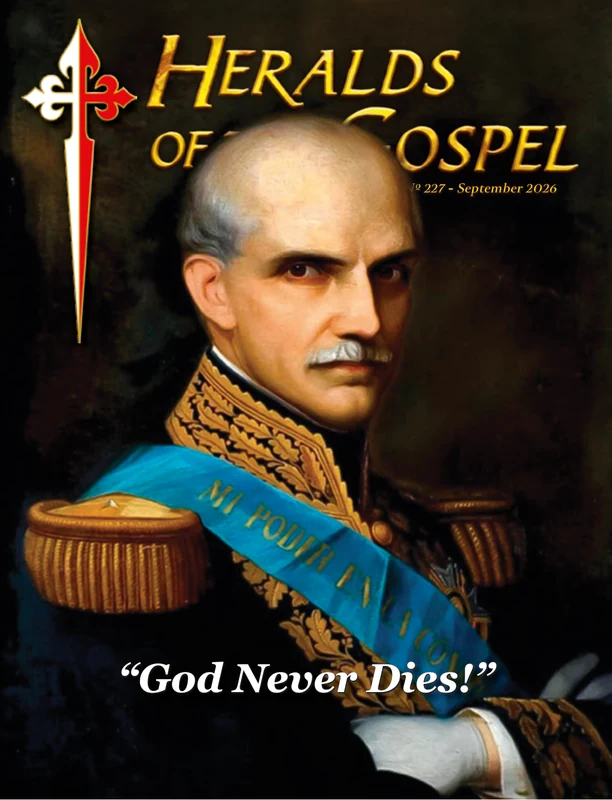
 Heralds of the Gospel Magazine, Vol. 20, nº 227, September 2026
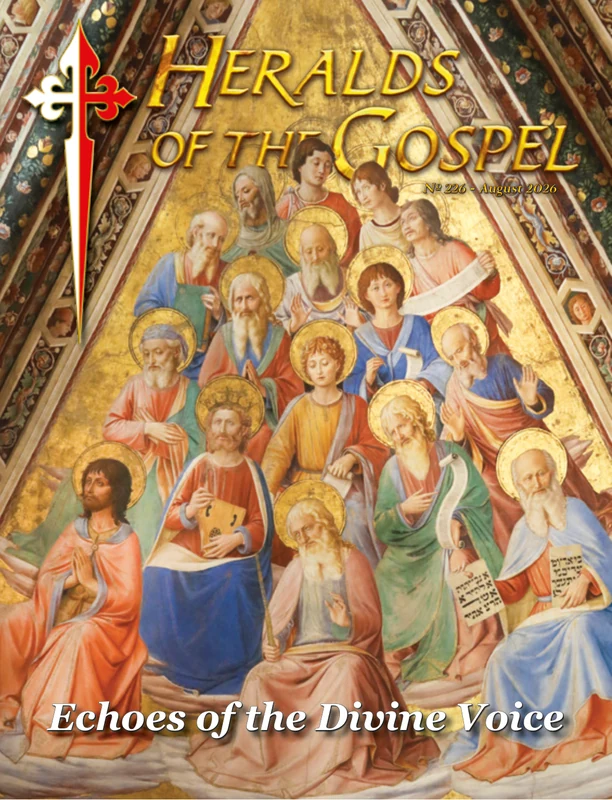 Heralds of the Gospel Magazine, Vol. 20, nº 226, August 2026
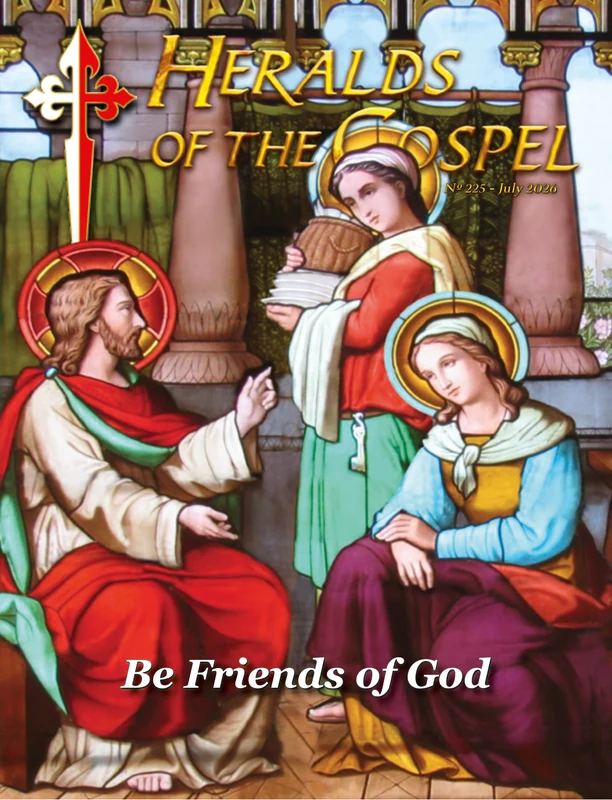 Heralds of the Gospel Magazine, Vol. 20, nº 225, July 2026
 Who are the Heralds of the Gospel?
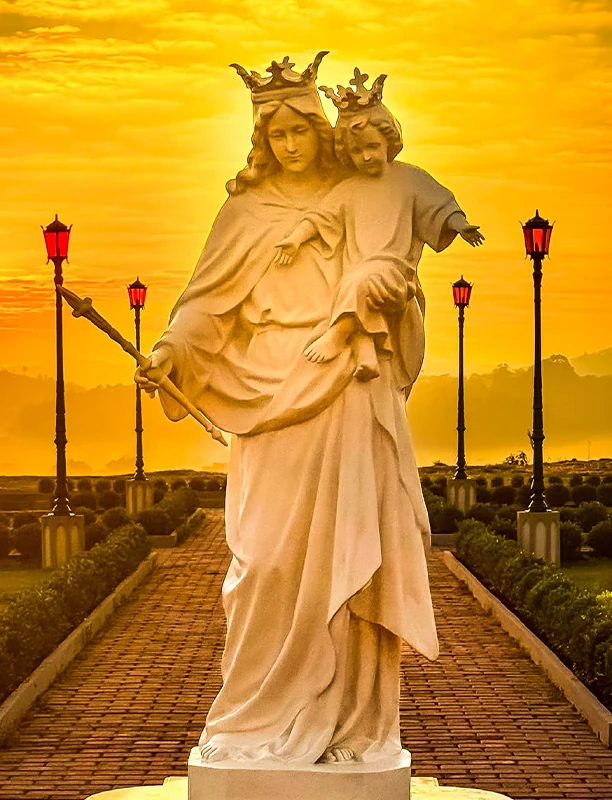 Help of Christians
 Christmas Carols








The revolutionary hydra advances under the banner of progress
The craving for the enjoyment of life and pleasures, characteristic of the bourgeois spirit that permeated society, especially with the brilliant rise of countless parvenus and every other sort of opportunist, had seriously wounded the “surface” of souls, allowing the Revolution to move swiftly towards their core. Dazzled by technical development, intoxicated by the innovations of the machine and industrial production that gave “man possibilities that he once desired and could not achieve, because they were more or less considered a miracle,”3 the masses were deluded by the utopia forged under the banner of progress. As Dr. Plinio observes, there are still theorists who maintain that “utopias are necessary and man cannot live without them, even if he knows they are utopias; hence, for example, the conception of Heaven, they say. Utopia, however, is engendered by a morbid tendency: because it does not accept religious truth, it then engenders the idea that Heaven is the paradise of a set of tendencies it seeks to realize in this life. And the world that the Industrial Revolution aimed for is a utopia that it sought to bring about.”4 However, modernity did not wish to recognize that an immense theatre was being set up for the Revolution’s new offensive in its third great thrust: “Pride, the enemy of all superiority, had now to attack the last inequality, that of wealth.”5 It was communism that was being fashioned as the demagogic defender of the working classes – themselves an artificial product of industrial development, which had torn veritable multitudes from the preservation of their generally rural origins and thrown them into factory neighbourhoods in the big cities. For this step, the spirit of egalitarianism and revolt, of liberalism and atheism, would be fostered in the working class, transposing into the social and economic sphere the maxims of false justice and freedom proclaimed in the previous Revolutions. In this way, the revolutionary hydra advanced, rearing its sinister heads into all areas of society and swallowing up what was left of Christian Civilization. Dr. Plinio, prolific in formulating metaphors, compares the revolutionary action to a fire spreading in a forest. It is not “a thousand autonomous and parallel fires of a thousand trees close to one another,” he says, but a single fact, totally encompassing the “thousand partial fires, however different they may be from one another in their accidents.”6 This is what happened at the outbreak of the pre-communist episodes that emerged from the post-French Revolution world, which was in the process of moral disintegration.Preparatory breeding ground
These accidental episodes constituted nothing other than the phenomenon of the “burning forest”, establishing the preparatory breeding ground for the communist explosion. This is how Dr. Plinio describes them: “From of the French Revolution was born the communist movement of Babeuf. Later, from the increasingly dynamic spirit of the Revolution burst forth the nineteenth-century schools of utopian communism and the so-called scientific communism of Marx.”7 As mentioned in the previous article, François Noël Babeuf, a French atheist journalist, figured in the French Revolution as a Jacobin and defended ideas of radical egalitarianism. In 1795 he founded the Conspiracy of the Equals, aimed at upholding revolutionary ideals and ensuring the collectivization of land and property. The terms anarchism or communism, not yet in vogue, were later used to define the nature of his movement, considered the first “communist party” in history and a precursor to the proletarian uprisings that would break out less than a century later. His ideas inspired so-called utopian socialism, whose most prominent thinkers were Saint-Simon, Charles Fourier and Robert Owen. Friedrich Engels rejected this concept because it did not point to the political and rebellious struggle of the proletariat. However, he recognized its importance, as it presented communist alternatives to industrial society, while criticizing the situation of the workers and fuelling the aforementioned utopian desire. Accordingly, the aim of the Revolution was to “set fire to the whole forest”: “The utopia towards which the Revolution is leading us is a world where countries, united in a universal republic, are nothing but geographic designations, a world with neither social nor economic inequalities, ruled by science and technology, by propaganda and psychology, in order to attain, without the supernatural, man’s definitive happiness.”8Communism shows its face
It was Karl Marx’s so-called scientific communism, with the collaboration of Engels himself, however, that proposed concrete practices for class struggle, establishing the bourgeoisie – once the revolutionary vanguard! – as the new class oppressing the workers. Alas… This is how the Revolution rewards and phagocytizes its own mentors. Such was the tone of the Communist Manifesto of 1848, representative of the programme and aims of the Communist League: it made the proletariat aware of the need to rise up against private ownership of the means of production and urged this class to fight for a new social organization. The first socialist takeover of the labour force in modern times was the Paris Commune in 1871, following the French defeat in the Franco-Prussian War. This proletarian and atheist government, which lasted only seventy-two days and was strongly repressed by Adolphe Thiers, president of the Gallic republic, outlined the paradigm for future revolutionary experiments, such as the Russian Revolution of 1917 and the Chinese Revolution of 1949. “A world where countries, united in a universal republic, are nothing but geographic designations, a world with neither social nor economic inequalities, ruled by science and technology, by propaganda and psychology,” such is the Revolution’s objective
Vladimir Lenin during a speech in 1920
Two sides: of a coin and a medal
This whole process reveals a two-track march: on the one hand, industrial progress, which generated a working class exploited by a savage capitalism, unscrupulous with regard to human dignity and opposed to Catholic teaching; on the other, the defenders of the oppressed proletariat, with class struggle. They were two sides of the same coin: the advance of the Revolution. The Church was not passive and indifferent to these radical transformations in society. Zealous for the faithful, her concern, full of Christian charity, made itself felt in the countless documents that make up what we know as the Church’s Social Doctrine. In fact, it is not misplaced to point out that the great legislative advances in terms of true social justice have often come from Catholic political initiatives. The Popes of the time also issued teachings on two fronts: one in defence of the workers; the other condemning the errors of communist doctrines that presented themselves as a way out of what they called “social injustice”, a refrain used by revolutionaries to attract sympathy even from Catholic circles. Examples include the encyclicals Rerum novarum and Quod apostolici muneris by Leo XIII, the encyclical Nostis et nobiscum by Blessed Pius IX, the motu proprio Fin dalla prima nostra by St. Pius X and the encyclical Ad beatissimi apostolorum by Benedict XV. They were two sides of the same medal: the desire for the salvation of souls, through the protection of good or the repression of evil. “Such pontifical acts were aimed in part at preventing the drifting of Catholics into communist ranks, but also at stopping communists from infiltrating Catholic circles under the pretext of joint collaboration for the solution of certain socioeconomic problems.”10Opposition to Catholic doctrine
In 1917, shortly before the outbreak of the Communist Revolution that overthrew Tsarism in Russia, Our Lady warned in Fatima that this nation would spread “her errors throughout the world, causing wars and persecutions of the Church.”11 In fact, Russian Bolshevism was a milestone and gave further strength to the movement, which conquered a large part of the world’s nations, precisely through wars and persecutions of Catholics. “Communism is intrinsically wrong. In the regions where it successfully penetrates, so much more devastating is the hatred displayed there by the godless’”
Leftist militants take aim at the monument of the Sacred Heart of Jesus during the Spanish Civil War - Cerro de los Ángeles, Madrid
Tragic consequences
Nefarious were the consequences of the huge transformation that the civilized world underwent as a result of communism, which the then Cardinal Ratzinger described as the “shame of our time”: “Millions of our own contemporaries legitimately yearn to recover those basic freedoms of which they were deprived by totalitarian and atheistic regimes which came to power by violent and revolutionary means, precisely in the name of the liberation of the people. This shame of our time cannot be ignored: while claiming to bring them freedom, these regimes keep whole nations in conditions of servitude which are unworthy of mankind.”18 Just as denounced by Dr. Plinio, communism opened the way for a new phase of the Revolution
Dr. Plinio in a conference in Rio de Janeiro, in 1961
Notes
1 RCR, P.I, c.7, 3, B.
2 Idem, c.11, 3.
3 CORRÊA DE OLIVEIRA, Plinio. Talk. São Paulo, 5/1/1986.
4 CORRÊA DE OLIVEIRA, Plinio. Talk. São Paulo, 22/8/1986.
5 RCR, P.I, c.3, 5, D.
6 Idem, c.3, 2.
7 Idem, 5, D.
8 Idem, c.11, 3.
9 Idem, P.II, c.11, 1, B.
10 CORRÊA DE OLIVEIRA, Plinio. Comunismo e anticomunismo na orla da última década deste milênio [Communism and Anti-communism on the Threshold of the Millennium’s Last Decade]. In: Catolicismo. São Paulo. Year XL. N.471 (Mar., 1990); p.12.
11 SISTER LUCIA. Fatima in Lucia’s Own Words, Prologue. Fatima: Postulation Centre, 1976, p. 162.
12 PIUS XI. Divini Redemptoris, n.3; 58.
13 SACRED CONGREGATION OF THE HOLY OFFICE. Decree Against Communism: AAS 41 (1949), 334.
14 BLESSED PIUS IX. Nostis et nobiscum.
15 LEO XIII. Quod apostolici muneris.
16 ST. PIUS X. Singulari quadam.
17 PIUS XI. Quadragesimo anno.
18 SACRED CONGREGATION FOR THE DOCTRINE OF THE FAITH. Instruction on Certain Aspects of the “Theology of Liberation”, c.XI, n.10.
19 RCR, P.I, c.3, 5, D.