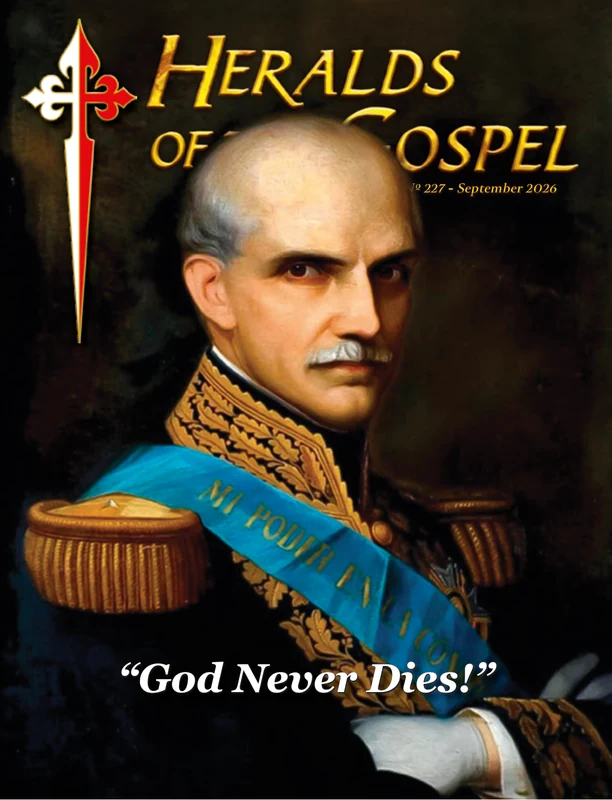
 Heralds of the Gospel Magazine, Vol. 20, nº 227, September 2026
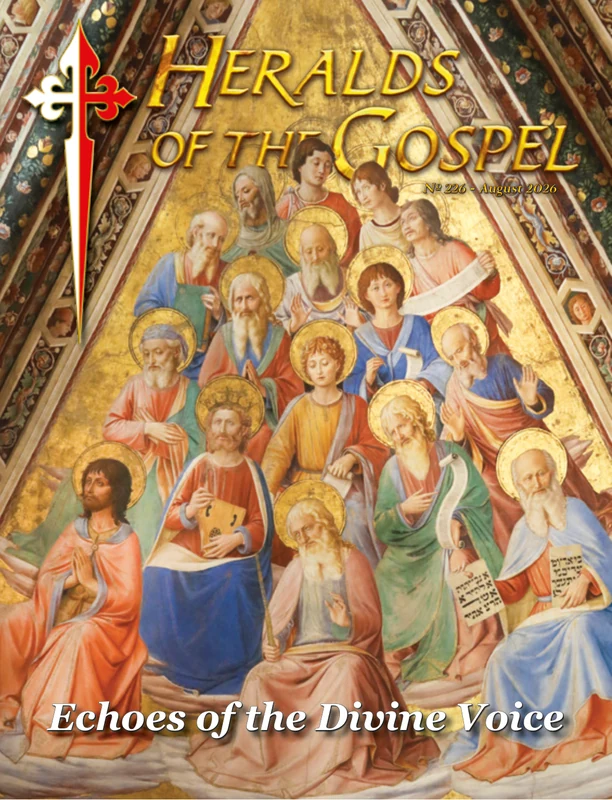 Heralds of the Gospel Magazine, Vol. 20, nº 226, August 2026
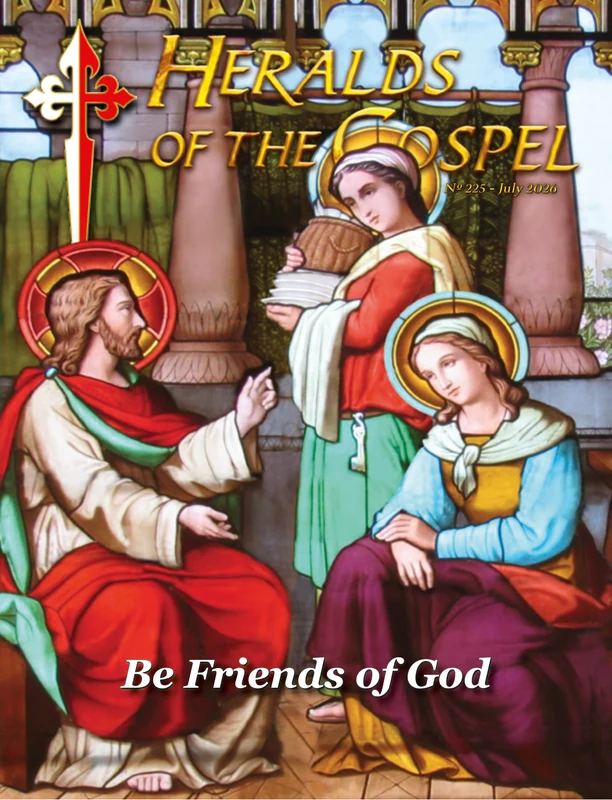 Heralds of the Gospel Magazine, Vol. 20, nº 225, July 2026
 Who are the Heralds of the Gospel?
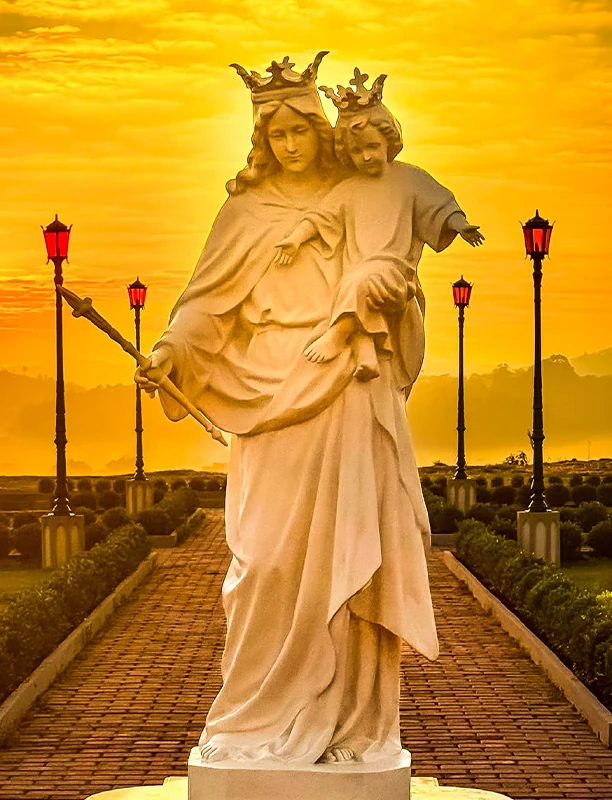 Help of Christians
 Christmas Carols








Gospel of the Eighteenth Sunday in Ordinary Time
13 One of the multitude said to Him, “Teacher, bid my brother divide the inheritance with me.” 14 But He said to him, “Man, who made Me a judge or divider over you?” 15 And He said to them, “Take heed, and beware of all covetousness; for a man’s life does not consist in the abundance of his possessions.” 16 And He told them a parable, saying, “The land of a rich man brought forth plentifully; 17 and he thought to himself, ‘What shall I do, for I have nowhere to store my crops?’ 18 And he said, ‘I will do this: I will pull down my barns, and build larger ones; and there I will store all my grain and my goods. 19 And I will say to my soul: Soul, you have ample goods laid up for many years; take your ease, eat, drink, be merry.’ 20 But God said to him, ‘Fool! This night your soul is required of you; and the things you have prepared, whose will they be?’ 21 So is he who lays up treasure for himself, and is not rich toward God” (Lk 12: 13-21).
I – A Vocation Exchanged for a Lock…
The story is told of a monk who ended up abandoning his vocation in exchange for a mere trifle. He had worked for years as a skilled blacksmith and had felt, at one point, a strong inner urge to follow the path of the contemplative life. Leaving everything, he set out for a monastery, where he was admitted. Shortly after his entrance, he was appointed a cell with a door that constantly creaked and rattled, day and night, for it would not close properly. To solve the problem, our monk, with the superior’s permission, made a magnificent door lock. He fixed the door itself, adjusting it to the doorframe. In the end, he had transformed it into a piece that could serve as a model for the entire community. Delighted with his own work, he walked through the corridors of the building, impressed that not another lock could be found to compare to his, so perfect and well finished. But as the months wore on, an excessive attachment for the apparently innocuous apparatus began to take hold of him. One day the abbot ordered a change of cells in the community. Downcast at the thought of having to repeat the painstaking work in his new location, the monk-blacksmith asked permission to take the lock with him. However, by decision of the superior, no one was permitted to transfer any part of the furnishings from one cell to another. Unhappy with the prior’s ruling and unwilling to renounce his excellent lock, the monk tore it off the door, resolving to abandon the religious vocation received from God’s hands, taking with him the object of his attachment and throwing himself into the ways of the world... What is behind this story of the monk’s lock? This is what the Gospel for the Eighteenth Sunday in Ordinary Time teaches us.II – The Danger of Covetousness
The episode narrated in this Gospel takes place when Jesus and His disciples are on the way to Jerusalem, the city where He will consummate His divine mission. He had already foretold the Passion twice previously (cf. Lk 9: 22, 44). Nevertheless, the disciples did not understand the lofty significance of this proclamation and still held out hope of being the first in the supposed Messianic Kingdom that Christ would found in this world (cf. Lk 9: 45-46). To correct this human outlook, He sent them on mission, giving them power to expel devils, and taught them the Our Father, inciting them to perseverance and confidence in prayer (cf. Lk 10:1,17; 11:1-4). It was while exercising this supernatural ministry that this unusual request was made to the Master.13 One of the multitude said to Him, “Teacher, bid my brother divide the inheritance with me.”
A defect common to every era
The contender of the Gospel, in approaching Our Lord to ask His intervention in the division of his family possessions, does not seem to have paused to reflect on the Master’s grandeur, seeing Him merely as a popular figure who would be a sure advocate in the cause that he wishes to win for himself. We can imagine him as having lost his parents at a mature age. His youth has already passed and he desires to assure his future, a concern that often takes the fore as a person ages.3 This is the mentality of those who, at this stage in their life, lose their sense of generosity and their capacity to understand the transitory nature of temporal possessions. The younger brother of the Gospel has his eyes fixed on his future, in what we could describe—despite the paradox—as the perpetuity of this world. Since Adam and Eve left Terrestrial Paradise, human nature has been searching for the fruit of the tree of life in exile, in their earthly home. Nowadays as well, and even more intensely than in earlier times, there is an ambition to find, through medicine, a ‘fountain of eternal life;’ in the hope of living in a permanent limbo in this world. This very common attitude was called ‘limbolatry’4 in the expression of Prof. Plinio Corrêa de Oliveira. It is a term that aptly describes the position of those who adore a happy existence in an endless limbo, continually enjoying the pleasures of this world, while forgetting the true eternity and the supernatural. Let us observe the Divine Redeemer’s response toward such a view of life, implicit in the request narrated in the Gospel.Our Lord’s mission was not temporal
14 But He said to him, “Man, who made Me a judge or divider over you?”
What is covetousness?
15 And He said to them, “Take heed, and beware of all covetousness; for a man’s life does not consist in the abundance of his possessions.”
 Gold coins from the Brazilian Empire - Money Museum of the Central Bank of Brazil, Brasília
Attachment can be focused on a few goods
Our Lord speaks of an “abundance of possessions.” However, we should remember that even being in circumstances of material scarcity, whether monetary or of other types of goods, does not mean being free from the risk of attachment to some object, as the story about the monk and the lock demonstrates. In this sense, continuing his analysis, St. John of the Cross comments how, in fact, the disorderly affection for material abundance is terrible, but explains that if a person has many goods his appreciation is divided among all of them. For example, if a person possessing a thousand gold coins were to lose only one, being left with 999, this would not signify a great blow. However, should he lose 999, all his care for the thousand coins would then be concentrated on the one that remains. It is seen, then, that those who have few goods can have as strong an attachment for them as a nabob for his entire fortune, forgetting God for their cause. Nevertheless, to emphasize an important nuance in this parable, Jesus is not condemning the possession of goods, nor the principle of property, but rather covetousness; namely, immoderation toward temporal goods.9A man blessed by God
16 And He told them a parable, saying, “The land of a rich man brought forth plentifully;”
Egoism and covetousness always go hand in hand
17 “and he thought to himself, ‘What shall I do, for I have nowhere to store my crops?’ 18 And he said, ‘I will do this: I will pull down my barns, and build larger ones; and there I will store all my grain and my goods. 19 And I will say to my soul: Soul, you have ample goods laid up for many years; take your ease, eat, drink, be merry.’”
 Wheat fields ready for harvest (Paraguay)
At the end of this life, covetousness will be of no use to us
20 “But God said to him, ‘Fool! This night your soul is required of you; and the things you have prepared, whose will they be?’ 21 So is he who lays up treasure for himself, and is not rich toward God.”
The legitimacy of storing reserves
However, a question may arise within us: what should be our attitude toward life’s uncertainties? Is it legitimate to store up a reserve? Can we appease licit human concerns with material stability? In reality, if we only skim the Gospel text, we may get the erroneous impression that the right to possess goods is being admonished here, because Jesus Himself holds up the man of the parable as a fool. Could God be condemning the aspiration for a right, which He Himself put in the human soul17—the right of property—leading us to think that it is a sin to desire or possess goods? What was the foolishness of the man? Did Christ condemn the act of storing up a reserve, simply for the fact that the farmer, having gathered an enormous harvest that exceeded his expectations wanted to build a barn equipped to hold great quantities until the end of his life? If this were so, every household with a pantry would be condemned; it would be wrong to store up provisions, according to this Gospel…
Unfortunately, it is not rare to hear absurd arguments against the right to property. But this right is present in this aspiration placed by God in the human heart. The practice of this right allows us to set aside means to assure our subsistence and to attend to personal and family needs or even to promote a respectable social standing. However, before all else, it is necessary to be rich in God’s eyes. And this wealth is attained by having one’s main focus placed on eternal goods. In this way, if love for God is present and egoism in check, even setting aside a reserve and storing up goods will be legitimate. However, love for God needs to unfold in love for our neighbour. Thus, it is necessary to receive and economize to always distribute, without keeping exclusively for oneself. This rule applies not only to money and purely material goods, but also to all and any God-given benefit or quality. The condemnation of the Gospel could likewise be applied to one who studies only to be taken for a genius and not to transmit his knowledge to others; those who pray for themselves and never for others; those who interact with others to satisfy the desire for praise and personal esteem, and not to do good to their neighbour, in light of eternal salvation. Such deviations render a person’s acts harmful and marks them with the unmistakable stamp of egoism.III – We must not Take our Eyes off Eternity
We must, then, bear in mind the fleetingness of time on this earth. Our attention cannot be fixed only on this world, oblivious to the other. How often across the centuries do we see that, when a nation or sector of civilization decides to turn to God, opening itself to the eternal perspective, everything good in it flourishes! On the other hand, when men exclude God from the centre of their lives, robbing Him of His rightful place, all manner of disasters and chastisements come crashing down upon them. We presently find ourselves in an era of inventions and brilliant scientific discoveries, unthinkable in previous eras. However, these marvels bring about a serious and new problem for man, since they cause many to become so blinded that they forget about God... Nowadays, with more impetus than ever before, immorality seems to want to definitively destroy morality, as is indicated by the rapid degradation of fashions, of customs and of the family. Moral disorders are becoming so generalized that, if people threatened with imminent death were offered a cure to prolong their lives a little longer, under the condition of renouncing impurity, there can be little doubt that a considerable number would prefer to die rather than lose the possibility of committing this type of sin. Deep down, those who act in this way have a spirit entrenched in deliberate disobedience to the Ten Commandments, because their eyes are fixed on the things here below and not those on high. With them will happen what today’s first reading from Ecclesiastes also expresses: “Because sometimes a man who has toiled with wisdom and knowledge and skill must leave all to be enjoyed by a man who did not toil for it. This also is vanity” (Eccl 2: 21). The etymological sense of the word ‘vanity’ is emptiness. Those who seek only after gain, imagining that they will fill their soul with it, run after a void. Sunset at “Lumen Cœli “ House, Mairiporã (Brazil)
Notes
1 Cf. FILLION, Louis-Claude. Vida de Nuestro Señor Jesucristo, vol. II: Vida Pública. Madrid: Rialp, 2000, p.381; GOMÁ Y TOMÁS, Isidro. El Evangelio explicado, vol. III: Año tercero de la Vida pública de Jesús. Barcelona: Rafael Casulleras, 1930, p.226-227.
2 LAGRANGE, OP, Marie-Joseph. Évangile selon Saint Luc. Paris: J. Gabalda, 1927, p.357.
3 Cf. ST. THOMAS AQUINAS. Summa Theologiae, II-II, q.118, a.1, ad.3.
4 CORRÊA DE OLIVEIRA, Plinio. Conference. São Paulo, Nov. 15, 1980.
5 ST. AMBROSE. Expositio Evangelii secundum Lucam, L.VII, n.122. In: Obras, vol. I. Madrid: BAC, 1966, p.405.
6 ST. AUGUSTINE. Sermo CVII, c.I, n.2. In: Obras, vol. VII. Madrid: BAC, 1958, p.427.
7 ST. THOMAS AQUINAS, op. cit., a.1.
8 ST. JOHN OF THE CROSS. Subida do Monte Carmelo, L.III, c.XVIII, n.1. In: Obras Completas. (Ed.5). Paço de Arcos: Carmelo, 1986, p.301.
9 Cf. ST. BEDE. In Lucæ Evangelium Expositio, L.IV, c.12: ML 92, 491-492.
10 ST. BASIL THE GREAT. Homilia in illud dictum Evangelii - Destruam horrea mea, n.1: MG 31, 261-264.
11 Cf. ST. AUGUSTINE. De Civitate Dei, L.XIV, c.27: In: Obras, vol. XVI-XVII. Madrid: BAC, 1958, p.984.
12 Cf. ST. THOMAS AQUINAS, op. cit., a.8.
13 ST. THOMAS AQUINAS. De decem praeceptis. Art. 11. De nono praecepto.
14 ST. BERNARD. Sermo in Psalmum XC, c.6, n.4. In: Obras Completas, vol. I. Madrid: BAC, 1953, p.388.
15 ST. JOHN OF THE CROSS, op. cit., L.III, c.XIX, n.9, p.310.
16 Idem, c.XX, n.4, p.314-315.
17 Cf. ST. THOMAS AQUINAS, op. cit., q.66, a.1: “Man has a natural dominion over external things [...] for the imperfect is always for the sake of the perfect. […] This natural dominion of man over other creatures [...] is competent to man in respect of his reason wherein God’s image resides...”