 Heralds of the Gospel Magazine, Vol. 20, nº 227, September 2026
 Heralds of the Gospel Magazine, Vol. 20, nº 226, August 2026
 Heralds of the Gospel Magazine, Vol. 20, nº 225, July 2026
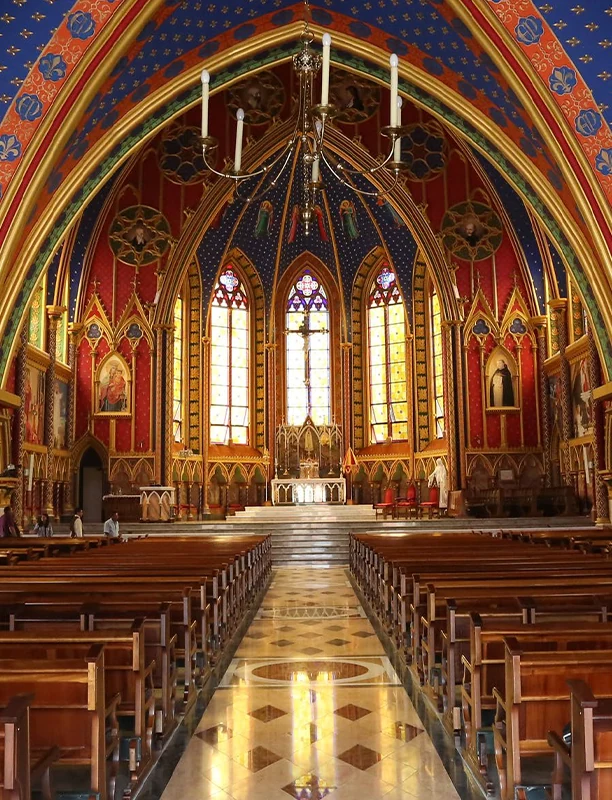 Who are the Heralds of the Gospel?
 Help of Christians
 Christmas Carols






Origin of a tradition
In fact, after these events, Catholic fervour regarding the powerful medal grew dramatically. Starting in Germany, where it was first minted, it quickly spread throughout Catholic Europe, being considered by the faithful as a secure defence against infernal attacks.2 The Holy See soon felt impelled to support this providential movement of grace and, on March 12, 1742, Pope Benedict XIV signed the brief ratifying the use of the pious object and granting it favours and indulgences. With many variations of the medal having spread over time, on August 31, 1877 Blessed Pius IX awarded special indulgences to a new model struck by the Abbey of Monte Cassino on the occasion of the fourteenth centenary of St. Benedict’s birth, which became known as the Jubilee medal. This version is the most widespread to this day.3 However, as was the case in Christianity in the past, the deeper meaning of this powerful sacramental is often forgotten by Christians.May the Holy Cross be my light
The adorable instrument of our salvation is in itself a most effective aid against all kinds of diabolical attacks. If it was by means of a tree that the ancient enemy defeated the human race in Adam, it was also by means of a tree that the God-Man rescued us definitively from infernal tyranny. For this reason, a large Greek-shaped cross covers one side of the medal. In the angles of the cross, four characters appear: C. S. P. B., which stands for “Crux Sancti Patris Benedicti – Cross of the Holy Father Benedict.” Also engraved on the cross itself are the letters C. S. S. M. L. on the vertical beam, and N. D. S. M. D. on the horizontal beam, which allude respectively to the aforementioned phrases: “Crux Sacra sit mihi lux. Non draco sit mihi dux – May the Holy Cross be my light. Let not the dragon be my guide.” And to complete this exorcistic prayer, there is a longer inscription around the outside: V. R. S. N. S. M. V. S. M. Q. L. I. V. B., which means “Vade retro satana; numquam suade mihi vana. Sunt mala quæ libas; ipse venena bibas – Begone Satan, do not suggest to me your vanities. What you offer me is evil; drink your own poison.” These words can be used by Christians whenever they feel disturbed and besieged by the temptations of the enemy; when he suggests his perversities, the false pomps of the world, the delights and pleasures contrary to the Law of God, bad friendships… in short, his poison, sin itself, which brings death to the soul. It must never be accepted! We must throw this cursed “gift” back in the face of the tempter who offers it to us, since he himself has chosen it as his inheritance. However, looking at the other side of the medal, someone might ask: why St Benedict?The figure of the Patriarch of the West
The Holy Patriarch of the West has all the prerogatives to feature in a pious object of an exorcistic nature, and this is above all due to the great victories he achieved against evil spirits by using the sign of the Cross.
St. Benedict - Basilica of St. Dominic, Bologna (Italy)
Infallible aid
So, although the diabolical attacks, temptations and even physical dangers that we face every day may be numerous and constant, the medal of St. Benedict is a powerful sacramental and unfailing aid for Christians, since it brings together the power of the Holy Cross and the remembrance of the victories that the great patriarch won against the infernal dragon. Therefore, in the midst of the tribulations of this life, let us devoutly wear the medal of St. Benedict, not as if it were a mere allegorical amulet, but rather as a supernatural aid and authentic representation of the promises of our Baptism: we firmly believe in Our Lord and the Holy Church, and renounce forever Satan and sin. ◊Notes
1 Cf. GUERÁNGER, OSB, Prosper. A medalha de São Bento. São Paulo: Artpress, 1995, p.37-38.
2 Cf. Idem, p.42.
3 Cf. Idem, p.136.
4 Cf. ST. GREGORY THE GREAT. Vida e milagres de São Bento. Rio de Janeiro: Lumen Christi, 1977, p.38-39; 51-52.