 Heralds of the Gospel Magazine, Vol. 20, nº 226, August 2026
 Heralds of the Gospel Magazine, Vol. 20, nº 225, July 2026
 Heralds of the Gospel Magazine, Vol. 20, nº 224, June 2026
 Who are the Heralds of the Gospel?
 Help of Christians
 Christmas Carols








Like a master “who brings out of his treasure what is new and what is old” (Mt 13:52), the Divine Paraclete always makes new aspects of the Holy Church’s doctrine and spirituality shine forth within her over the course of the centuries.
Thus, from one of the oldest cults of Christendom, such as that of the sorrows suffered by Our Lady during the Sacrifice of the Cross, a new devotion unfolded; born and propagated on Brazilian soil at the beginning of the 20th century…
A unique invocation of the Blessed Virgin
Hidden in the mountains of the city of Petrópolis, in the State of Rio de Janeiro, and guarded by discreet Discalced Carmelite nuns, lies a practically unknown treasure. It is the image of Our Lady of Saudade.
Saudade is a rather peculiar and expressive word in the Portuguese language, which is why it is difficult to define or translate. It expresses a mixture of remembrance, sorrow, and longing, along with nuances specific to Luso-Brazilian psychology, decidedly affectionate, with a healthy note of melancholy.
According to a dictionary of “untranslatables,” published by Princeton University, saudade designates “the memory of a cherished past that is no more and the desire for this happiness, which is lacking.”1
The classical Portuguese author Francisco Manuel de Melo poetically expresses it: “Saudade is an ill that one enjoys and a good that one suffers.”
Thus, the invocation of Our Lady of Saudade takes on quite unique nuances, as it especially honours “the sorrow […] of the Immaculate Heart of Mary, during the thirty-six hours, that is, the three incomplete days, of Jesus’ confinement in the sepulchre.”2
Now, this inclination of the soul, well understood by the Brazilian people, and manifested by this devotion, was a source of abundant blessings and graces for many years.
A devotion inspired by Heaven
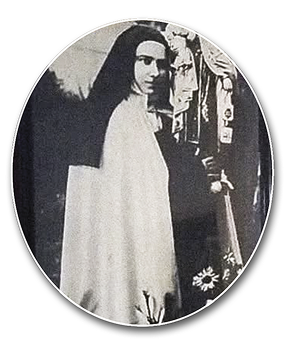
It was on March 30, 1918, a Holy Saturday, at the Carmelite Convent of St. Joseph that Sister Agnes of the Sacred Heart of Jesus3, began the until-then-unknown devotion. under heavenly inspiration.
Before its public divulgation, the Bishop of Niterói, Most Rev. Agostinho Benassi –whose jurisdiction included the city of Petrópolis at the time – submitted the content of the new devotion to the evaluation of an eminent theologian, Fr. João Gualberto do Amaral.
Who declared it orthodox, justifying this position, among other reasons, by the fact that the Summa Theologiæ of St. Thomas Aquinas4 refers to the thirty-six-hour period during which Jesus was buried.
With ecclesiastical approval, the Carmelites began to spread devotion to Our Lady of Saudade, sending pamphlets to various dioceses in Brazil containing a prayer called the Crown of Saudades of the Queen of Martyrs and requesting that those who had received graces send accounts of the graces received back to the convent.
The Crown of saudades
Similar to a Rosary, but with only three mysteries to be contemplated, the Crown of saudades is composed of three Our Fathers and thirty-six Memorares,5 ending with three Hail Marys and a specific prayer.6
In each mystery, one Our Father and twelve Memorares are recited, and one meditates on an aspect of Our Lady’s saudades.
The first mystery recalls the sufferings that welled up in her soul when the stone of the tomb veiled the adorable Body of Jesus from her eyes.
States a meditation composed in 1943 to accompany the crown:
The hour of the burial of a much-loved one is the hour of supreme sorrow for those who mourn.
Although lifeless, the present body seems to deceive the senses, leaving them the sad comfort of a vision, horrible, yes, for love, but which is ultimately an outlet for the last caresses of tenderness, however desolate, before the silence of death.
But when the cruel hour of the final farewell strikes… when the moment arrives for the beloved Body to be hidden from sight, oh! […] In this state of anguish, the bitter thorn of saudade first pierces the breast.7
The second mystery considers the sufferings of the Virgin in the house of St. John, where She made the effort, despite her incomparable suffering, to sustain, strengthen, and enkindle the faith of those present.
The meditation demonstrates that, when sorrow and saudades are excruciating, one instinctively yearns for solitude; nevertheless, at that supreme hour, Our Lady did not want to abandon the Holy Women, the Apostles and disciples, who trusted in her.
The sorrowful Virgin therefore sacrificed this natural inclination for the benefit of the nascent Church.
The third mystery honours the saudades that Mary felt when, the day after the Crucifixion, She returned to Calvary and there recalled the pain that her Divine Son had suffered without a single complaint.
Who can imagine what the martyrdom of the Queen of priests and victims of love was like in that second ascent to the sublime altar of Calvary, stained with the Most Precious Blood!… […]
While Magdalene and the Holy Women prepared aromatics and balms to anoint the Body of the Lord, the Mother of God concentrated in her saudades the quintessence of the most precious perfume that love has ever poured into the wounds of Jesus.8
Intense sorrow behind a smile
To further spread devotion, in 1929 a pious soul, who owed much to the beloved patroness of the Carmelites of Petrópolis, commissioned an image of Our Lady of Sorrows to be made in Paris.
Sculpted in Carrara marble and measuring one metre and sixty-six centimetres, it can still be venerated today in the Carmelite chapel.
With her feet resting on a globe, the statue holds in her right hand a string of beads similar to a rosary, representing the Crown of saudades. Her left hand rests on her chest, pierced by a golden sword.
A crown, also golden and studded with large stones, encircles her head, which remains slightly inclined. Behind her slight smile, this position of her head reminds the faithful who approach her of the intensity of the sorrows suffered in the Passion.
Why is it so little known?
During the period when Petrópolis belonged to the Diocese of Niterói, the local Bishops granted an imprimatur to eleven editions of pamphlets containing the prayer of the Crown of saudades, gradually disseminated throughout Brazil, accompanied by corresponding small rosaries, as well as prints of Our Lady of Saudade and medals minted with her image.
The convent frequently received news of graces obtained through the devotion, which spread and flourished throughout the nation. In 1948, however, the apostolic commitment of the Carmelites was subjected to severe trials.
Shortly before, on April 13, 1946, Pius XII had separated the city of Petrópolis from the Diocese of Niterói, making it the seat of a new ecclesiastical circumscription.
Its first Bishop, Manuel Pedro da Cunha Cintra, who assumed office on April 25, 1948, forbade the Carmelite convent of St. Joseph from spreading devotion to Our Lady of Saudade, restricting the cult to the convent…
That same year, the Carmelites went through another dark night: Fr. João Gualberto do Amaral, who had supported the devotion since its inception, passed away in January, and months later, Sister Agnes of the Sacred Heart of Jesus met the same fate.
Due to the obstacles to spreading the practice, little is known about the invocation and its crown, except for the content of some pamphlets collected by a devotee and compiled in the book on which this article is based.
Our Lady of Saudade and Brazil
If the Blessed Virgin Mary wished to be known in Brazil as Our Lady of Saudade, proposing to the faithful the sorrows of her Immaculate Heart during the hours of desolation and uncertainty that preceded the glorious Resurrection of Jesus, it is because She longs to transmit some teaching to us, on which we may make a conjecture with filial piety.
St. Matthew records in his Gospel this statement of Our Lord: “For as Jonah was three days and three nights in the belly of the whale, so will the Son of man be three days and three nights in the heart of the earth” (12:40).
And in a passage from the account of St. John, the Divine Master asserts, referring to His sacred Body: “Destroy this temple, and in three days I will raise it up” (2:19).
These words suggest that it was fitting for the Saviour to spend three days and three nights in the darkness of the tomb, which would total seventy-two hours.
However, He was buried for exactly half that time: two incomplete nights and one day, that is, thirty-six hours.
It can be assumed, then, that the faith – full of saudades – of Our Lady hastened the moment of the Resurrection because, in that moment of solitude and apparent defeat, She was the only one to maintain the certainty of Christ’s victory over death, thereby constituting the bulwark of the nascent Church.
Does Brazil not have a close relationship with this Marian faith? Could it not be reserved for her the mission of watching over the Mystical Body of Christ in this dark night in which the world is immersed, imploring the anticipation of God’s victory?
If Brazil was once called the Land of the Holy Cross, and if Our Lady asked here for the contemplation of the sorrows of her saudades, fortelling the triumph of her adorable Son, we can suppose that She also expects from this nation, as a requirement for her intervention, a crystal-clear confidence in the victory of the Holy Church and an unlimited willingness to suffer and fight for the renewal of the face of the earth.