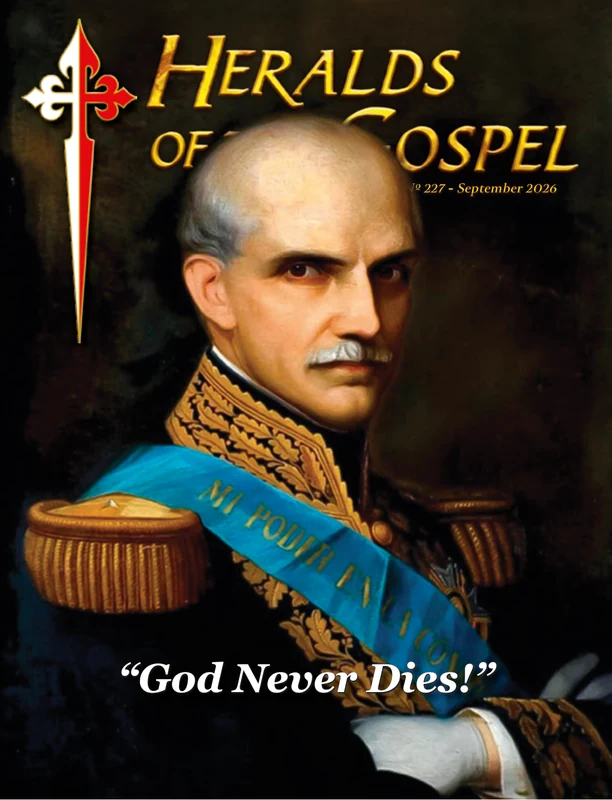
 Heralds of the Gospel Magazine, Vol. 20, nº 227, September 2026
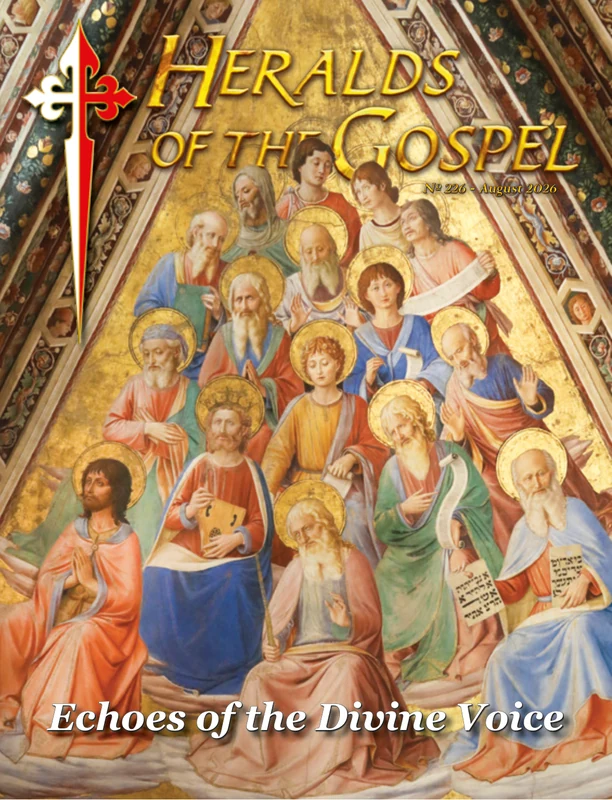 Heralds of the Gospel Magazine, Vol. 20, nº 226, August 2026
 Heralds of the Gospel Magazine, Vol. 20, nº 225, July 2026
 Who are the Heralds of the Gospel?
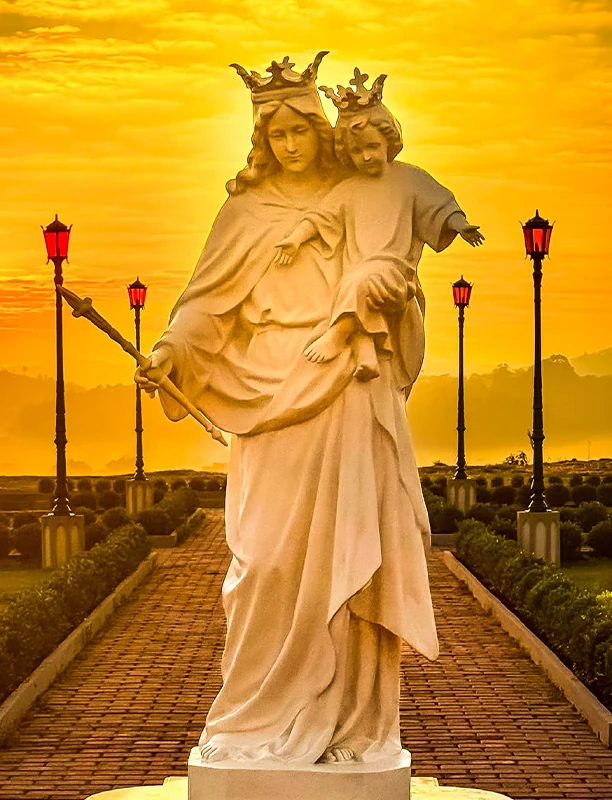 Help of Christians
 Christmas Carols








At school, two worlds collide
A whistle sounded in the courtyard and, as if that sharp, prolonged sound had detonated it, an explosion followed. Overexcited boys, sweating from agitation, ran everywhere, shouting in complete disorder. On the fringes of the confusion, a young boy watched on. It was his first day at school. Plinio Corrêa de Oliveira, who was ten years old at the time, had grown up in a home with deep traditional roots, where education and composure translated into distinction in behaviour and faith bathed the first steps of his life in a golden, supernatural light. “Accustomed to this upbringing, I entered school as if a meteor had abruptly thrown me – from within this cosy, quiet and traditional environment – thirty years forward and headlong into the brutish mare magnum of the Revolution,”1 he would later comment. It was not a matter of mere childish shock as a result of immaturity faced with the unknown; it was a clash of good and evil, of order and disorder, of little Plinio who, living in the “earthly paradise” of innocence, heard the first roars of the Revolution. In those first encounters, however, he was presented with the winds of novelty, apparently as exciting as they were harmless, and only a fine discernment would be able to recognize their evil. As a child, Plinio discerned among his classmates the first roars of the Revolution in the tendencies
Plinio at St. Louis College in the year 1921
Radical changes take hold in society
With the end of the First World War, these changes became even clearer. Coming out of that tragedy exhausted, humanity craved well-being, spontaneity and pleasure, and threw itself eagerly onto the path of novelty. In this context, the cinema played a decisive role in providing something more than distraction or leisure, as Dr. Plinio observed: “I noticed that the cinema had a tendential effect on everyone, shaping their temperament, their customs, their way of being and thinking, in short, transforming their existence. It was the great vehicle of progress and of the Revolution.”2 Comedy films introduced a certain way of laughing, telling jokes and having fun, just as crime dramas created a state of soul intoxicated with excitement, tension and a fever for speed, which seemed to want to maximize the human capacity for sensation.3 However, it was not just any pleasure that was encouraged: those of the spirit were out of vogue. In this new consideration of human life and activities, God no longer had a place: a kind of earthly and materialistic “heaven” was sought, guaranteed to those who possessed health, money and good fortune. And so the concept of evil came to be identified with suffering or pain, the elimination of which was always a good. Little by little, the innovations crossed the boundaries of mere sentiment and invaded the field of ideas and facts. Dr. Plinio was by then a grown man and ready to wage his heroic struggle in defence of the Church and Christian civilization. However, the initial phase of his confrontation with the Revolution would always remain a fertile ground of inspiration for understanding how it worked to fulfil its designs.Disorder in the human spirit
Describing the revolutionary process in mentalities, so subtly carried out by sometimes unsuspected means and with messages contrary to morality and Religion, we arrive at its deepest – and perhaps the most important – field of action as Dr. Plinio described it: “We may also distinguish in the Revolution three depths, which chronologically overlap each other to some extent. The first of them, which is the deepest, consists of a crisis in the tendencies.”4 Before Adam’s sin, human tendencies – originating from the senses of the soul and body – were in complete order: “Owing to original justice, the reason had perfect control over the inferior parts of the soul, while reason itself found its perfection in submission to God.”5 As long as our first parents were docile to God, their spiritual side would predominate over the animal side: they would turn naturally to the things of the spirit more than to the things of the flesh. This disposition governed every aspect of life in Eden, even in commonplace things, as Dr. Plinio explained to his young audience: “Looking at anything in Paradise, or simply sensing it, man knew how to turn his soul above all to God, the Creator of everything. In the heat and the cool breeze, he knew how to see Divine Providence. He was not detained in the delight – like someone at a seaside resort today, opening his arms and trying to catch the wind – but thought: ‘How the heat of the day reminds me of the power of God! How the cool breeze reminds me of the wisdom with which He limits His own power, so that His presence does not become excessive for man whom He loves.’ And he received everything as a gift and a caress from God.”6 The Revolution strives to exacerbate the human weakness that comes from original sin
Eva e a Serpente - Eve and the Serpent - Cathedral of Rheims (France)
The dynamism of the process lies in the tendencies
St. Thomas9 explains that while reason is particularly important in good, in evil, on the other hand, it is the lower part of the soul that comes first. Therefore, the aim of the Revolution in this first stage is to put all the tendencies in disorder. “What does this mean? It means instituting complete intemperance in the human spirit, for more and for less. So that, for example, on occasions when there is a reason for a person to feel thing ‘x’, they feel ‘y’; when there is an occasion to feel ‘y’, they feel ‘z’ or feel nothing at all. And, as a corollary of intemperance, to institute a total disorder in the world of sensation.”10 In general, such disorder will replace Heaven with pleasure as the goal of life. Depending on psychology, character or upbringing, the manifestations of intemperance will take on each person’s own characteristics. For example, there will be those who desire intense and noisy sensations; more mediocre or more refined mentalities will be content with little pleasures, preferring to savour life in little teaspoons. For everyone, in the final analysis, what makes up a life of pleasure? First and foremost, in carefree enjoyment that delights the body, directly and immediately. Secondly, in doing whatever one wants – one’s wish is the law! Unbridled tendencies gradually lead to the abolition of all restraints imposed by morality and good manners; and man, proclaiming himself free, becomes a slave to his passions.The means to affect human tendencies
Once the bad propensities of the generality of individuals have been exacerbated, the Revolution will be in a position to take the next planned steps: “These disorderly tendencies which, by their very nature, struggle for realization, no longer conforming themselves to an entire order of things contrary to them, begin to modify mentalities, ways of being, artistic expressions, and customs without immediately touching directly – at least habitually – on ideas.”11 Once the field has been prepared by this process, doctrines will later find good ground to take form as explicit ideas. Only then will the Revolution be ready to reach the “the terrain of facts, where it begins to work, by bloody or unbloody means, on the transformation of institutions, laws, and customs, whether in the religious realm or in temporal society.”12 The success of the great revolutionary upheavals, therefore, will always be the consequence of a preparation, first tendential and then sophistical. Dr. Plinio exemplifies this reality with the gunpowder that acts as the fuse before the fireworks explode. In order for the explosion to occur, there must have been this “path” beforehand. One of the innumerable historical cases that illustrate this principle is the statement by a certain Spanish public figure who, in the midst of the de-Christianizing march of that Iberian nation, said that it was necessary to put an end to the taboo of virginity in order to abolish the right to property. It should also be noted that this process does not take place overtly, but rather cunningly and discreetly, because the less it is noticed, the more likely it is not to encounter resistance. In fact, the Revolution only progresses “by concealing its complete form, its true spirit, and its ultimate aims.”13 An archetypal example is the Renaissance and Humanism, which, as we have seen, paved the way for the outbreak of the Protestant pseudo-reformation. Sculptures that were perfect from an artistic point of view, representing human strength and excellence, admired indiscriminately, sowed the seeds in humanity of the idea – still widespread – that the era in which man depended on God, as depicted in medieval paintings, was outdated. If anyone were to say this, they would undoubtedly be admonished by the whole of Christendom. But the arts proclaimed it, and everyone went along with it. Already dominated by the fascination of a neo-pagan and often frankly indecent art, souls easily bought into moral degradation in the facts. One could cite examples in all areas of culture over the centuries, to the point of exhaustion. The reader will notice that every great ideological or social explosion has always been preceded by a cultural revolution, and this is no mere coincidence. A vicious circle is thus established which – barring the merciful intervention of Providence – nothing can stop: the tendential Revolution launches man into intemperance; his bad inclinations are both catered to and stimulated, demanding more; a new innovation is offered to him. In short, “errors beget errors, and revolutions open the way for other revolutions.”14The tendential aspect of today’s fight
Until the beginning of the last century, the Revolution used the tendential “weapon” as a remote preparation for the breaking of a principle. Nowadays, however, it has practically ceased to act in the ideological field, or at least devotes much less emphasis to it, focussing its efforts on the different facets of what is called “cultural revolution”. Has its century-long experience taught it that it is enough to stir the passions in order to win, or is the disintegration of the human soul already so advanced that its iniquitous work is much easier? The Counter-Revolution should also employ all legitimate means in the tendential field to combat the Revolution
Church of Our Lady of the Rosary of Fatima, Cotia (Brazil)
Notes
1 CORRÊA DE OLIVEIRA, Plinio. Notas Autobiográficas [Autobiographical Notes]. São Paulo: Retornarei, 2010, v.II, p.40-41.
2 Idem, p.89.
3 Cf. Idem, p.94-103.
4 RCR, P.I, c.5, 1.
5 ST. THOMAS AQUINAS. Summa Theologiae. I-II, q.85, a.3.
6 CORRÊA DE OLIVEIRA, Plinio. Conference. São Paulo, 9/11/1984.
7 Cf. ST. THOMAS AQUINAS, op. cit., q.82, a.3.
8 Cf. Idem, q.74, a.3, ad 2.
9 Cf. Idem, q.82, a.3, ad 3.
10 CORRÊA DE OLIVEIRA, Plinio. Talk. São Paulo: 8/8/1993.
11 RCR, P.I, c.5, 1.
12 Idem, 3.
13 Idem, P.II, c.5, 3, A.
14 Idem, P.I, c.6, 3.
15 Idem, P.III, c.3, 3.
16 CORRÊA DE OLIVEIRA, Plinio. Conference. São Paulo, 9/11/1984.