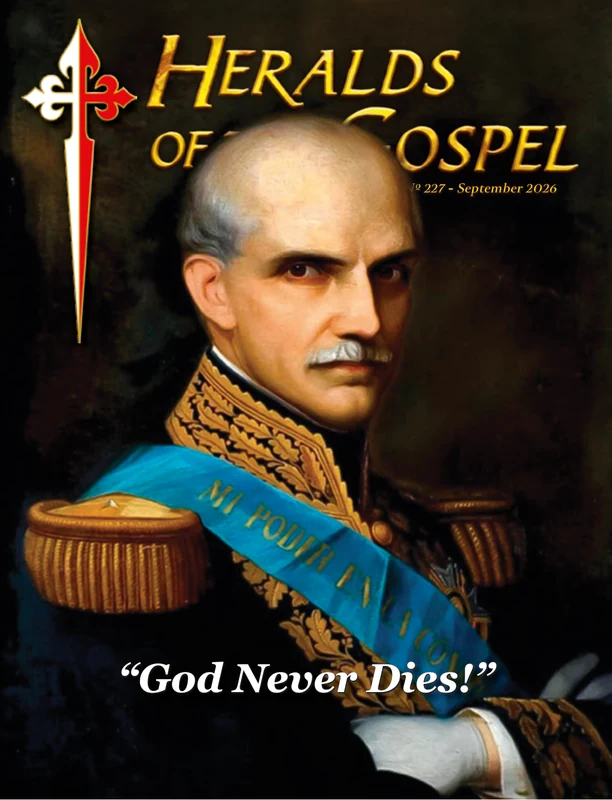
 Heralds of the Gospel Magazine, Vol. 20, nº 227, September 2026
 Heralds of the Gospel Magazine, Vol. 20, nº 226, August 2026
 Heralds of the Gospel Magazine, Vol. 20, nº 225, July 2026
 Who are the Heralds of the Gospel?
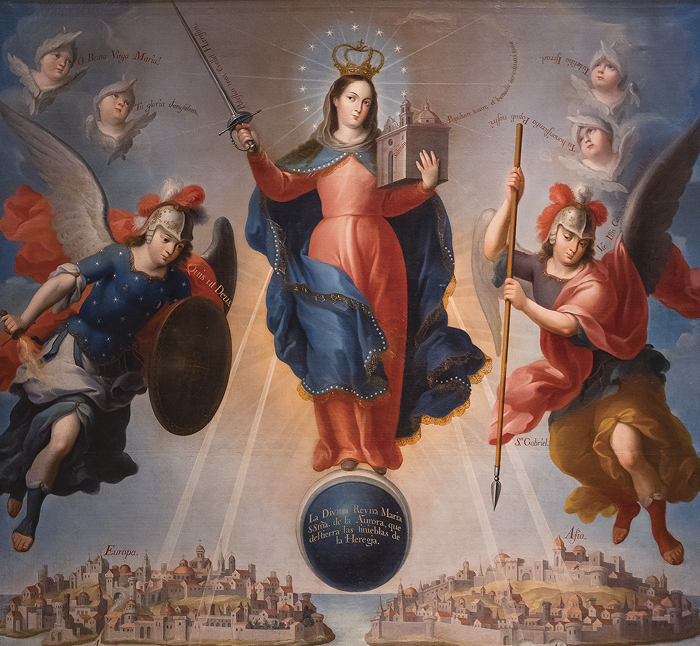
 Help of Christians
 Christmas Carols






Chess has its mysteries. How can it be that a knight can perform an Olympic leap over a rook? That bishops can only glide along on squares of a single colour?
That a pawn, after quite a dash, can even become a queen, right under the nose of the astonished opponent king?
Further: is it not inconceivable that the queen possesses powers and proficiency superior to all other pieces, even to those of her royal spouse?
The latter, constrained by his grandeur, advances solemnly one square at a time; the former, driven by some unknown delirium of zeal for the monarch, sweeps across the battlefield from one end to the other in a single move, becoming the bane of the enemy and the salvation of her soldiers.
How to understand this? Perhaps by considering chess as a metaphor for the way God intervenes in history…
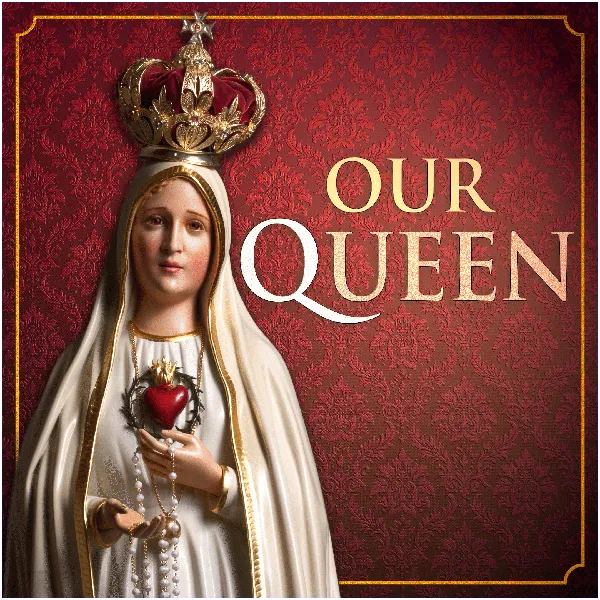
Divine Providence may well have allowed men to bestow such importance upon the chess queen solely so that she might remind us remotely of another: the undoubted and invincible Queen of History, Mary Most Holy.
Truly Queen
Daughter of the Eternal Father, Mother of the King of the Universe, Spouse of the Holy Spirit, Our Lady is Queen of History not merely nominally, but truly.
She is at the origin of the great milestones in the chronology of salvation: in the stable, when She gave birth to the Divine Child who would divide history in two; in the Upper Room, when She attracted the Paraclete at Pentecost; at the epicentre of the Council of Ephesus, marking the dogmatic definitions that would establish the doctrine of the nascent Church.
In the skies over Lepanto and at the Battle of Vienna, watching over Christendom; in the Mantle of Guadalupe, as a pledge of her maternal presence in the New World; in the Miraculous Medal and the grotto of Lourdes, calling a wayward humanity to penance and prayer…
And God, like the chess king, majestic and sovereign, takes pleasure in seeing her present in human history, triumphing and reigning.
But in what sense is Mary Queen of History? What is the centre of History? What, ultimately, is History?
The “unum” of History
According to a clear definition given by Dr. Plinio, History is “a narrative that has the same protagonist and interconnected themes, and whose action is continuous throughout the ages.”1
Someone who set out, for example, to write the history of a hotel, as an institution, narrating only what occurred transitorily in its four hundred rooms, would be unsuccessful in his endeavour, as there is no continuity between the events nor any relationship between the characters.
On the contrary, one can speak of the history of the Brazilian nation, of Philosophy, of languages and, above all, of the History – with a capital “H” – of humanity, by virtue of the aforementioned continuity of agents and themes.
Indeed, there is an unum that links all men, from the dawn of their existence on earth until the Last Judgement. History thus appears as a cathedral which, although composed of many stones, forms a single monument.
It is the “edifice” designed by God before the ages to serve as a throne for His cornerstone (cf. Eph 2:19): the King of creation and Lord of the ages, Jesus Christ.
Writing in golden letters upon the divine “draft”
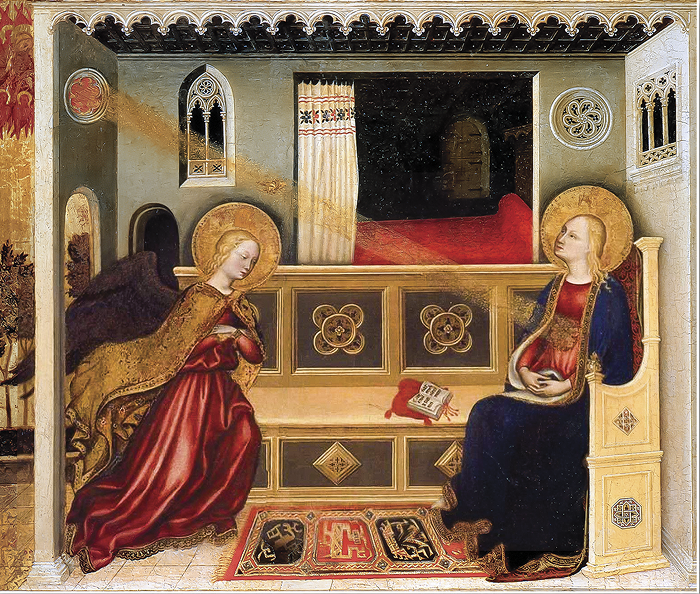
That being said, it can be affirmed that the axis of History is the Incarnation of the Word in Mary’s womb. It was through her that the Most High took the reins of History with human hands, and it is through her that He brings His great conquests to fruition.
By a sublime mystery, her relationship with the unfolding of events began even before She was conceived. Yes, for even in Paradise, the Immaculate One was present as a promise.
With the disobedience of our first parents, God revealed that His plan would continue through a Virgin, who would crush the head of the Serpent (cf. Gn 3:15).
Creation thus received its central theme: the struggle between good and evil. And at the head of the army of light stands Our Lady, She who “knows God’s intentions regarding history.”2
Nevertheless, this action of Mary has a peculiar characteristic. As Dr. Plinio stated, the Most High wished to create
a creature who is entirely human, yet absolutely perfect; […] who is always in a position to refine, at least in part, what men do and, so to speak, to correct – if the word correct were not inappropriate – to reform, to revise, according to the plans of God’s mercy, that which His justice would do.3
In this way, the Creator ordained that, upon the “draft” of His original plan entrusted to mankind, Our Lady would inscribe the true History in golden letters.
Mary’s presence throughout the centuries
We will not mention, in this article, all the occasions on which She has made herself present in human history, in order to demonstrate that the Mother of Jesus guides events with gentle firmness.
That would be like writing an encyclopaedia… But let us briefly recall some of her most decisive acts.
In December 1531, the Mother of all peoples appeared in New Spain, now Mexico, to the indigenous man Juan Diego, revealing a deep affection for the American lands and their native peoples.
One of the main symbols of the apparition is the nahui ollin, which the four-petalled flower depicted directly over the Virgin’s womb refers to and which, for the indigenous peoples, embodied the notion of the “centre of History”.
Through this emblematic manifestation, Mary wished to express her desire to make the New Continent the dwelling place of her Most Holy Son and the heart of her reign.
In the Old Continent, the apparitions of the Most Holy Virgin multiplied in the 19th century, a time of unprecedented rebellions against God’s plans, fuelled chiefly by the French Revolution.
In Paris, when She spoke to St. Catherine Labouré in 1830, Our Lady announced that “the whole world will be shaken by calamities of every kind”;4 nevertheless, with abundant mercy, She entrusted the nun with the Miraculous Medal, which played the role of an invaluable weapon during that historic juncture.
At La Salette, in France, Our Lady of Sorrows lamented once more, in 1846, over the decline of society and the infamies of the clergy, and foretold a chastisement whereby God would strike humanity with both natural disasters and continental wars.
Finally, in Lourdes, the Mother of God appeared to St. Bernadette Soubirous in 1858, announcing: “I am the Immaculate Conception.”
These words marked the beginning of the countless miracles through which She would show to the world the power of her queenly sceptre.
Moving into the 20th century, at two opposite points of the globe, in Fatima, Portugal, and in Akita, Japan, Our Lady shone forth as a sun of hope, promising the salvation of souls and a great period of peace if devotion to her Immaculate Heart were established in the world.
This was, and indeed remains to be, the axis around which the gravest and most universal problems of mankind revolve.
Mary also warned that great punishments would befall humanity if it did not convert: “The good will be martyrized,” prophesied the Queen of Peace, “the Holy Father will have much to suffer, various nations will be annihilated.”5
The checkmate of all History
We could list innumerable apparitions and interventions by the Blessed Virgin Mary. But let us pause here and turn our gaze to our Sovereign.
We, the soldiers who fight under the banner of light in the Virgin’s army, are at the service of her who writes over God’s blueprint in golden letters. With this panorama in mind, what enemies are we to fear?
On the chessboard where legions of virtue clash with the hosts of sin, we have the mighty Queen on our side. As the warriors of such a Lady – even if mere pawns – we know that She will defend us.
And, beyond our personal battlefield, we have in Mary the certainty of the checkmate against the prince of darkness and of the final victory of the Holy Church.