 Heralds of the Gospel Magazine, Vol. 20, nº 227, September 2026
 Heralds of the Gospel Magazine, Vol. 20, nº 226, August 2026
 Heralds of the Gospel Magazine, Vol. 20, nº 225, July 2026
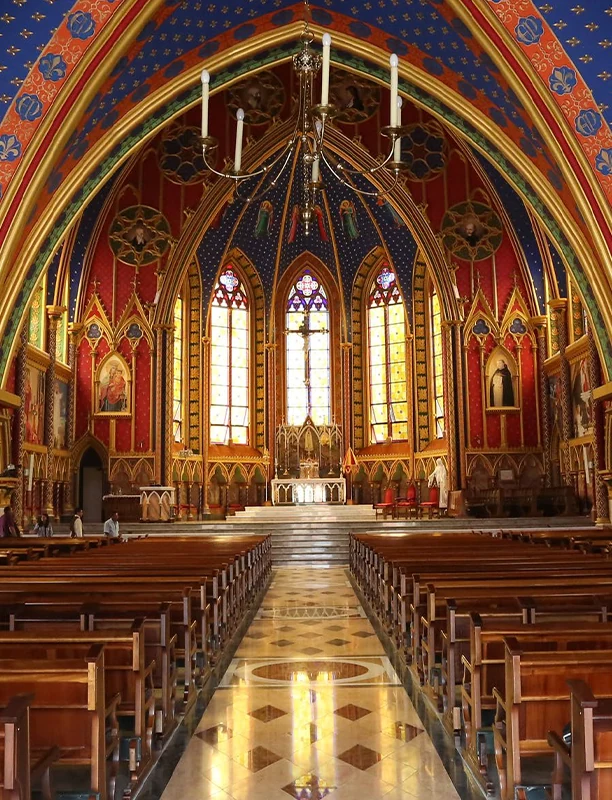 Who are the Heralds of the Gospel?
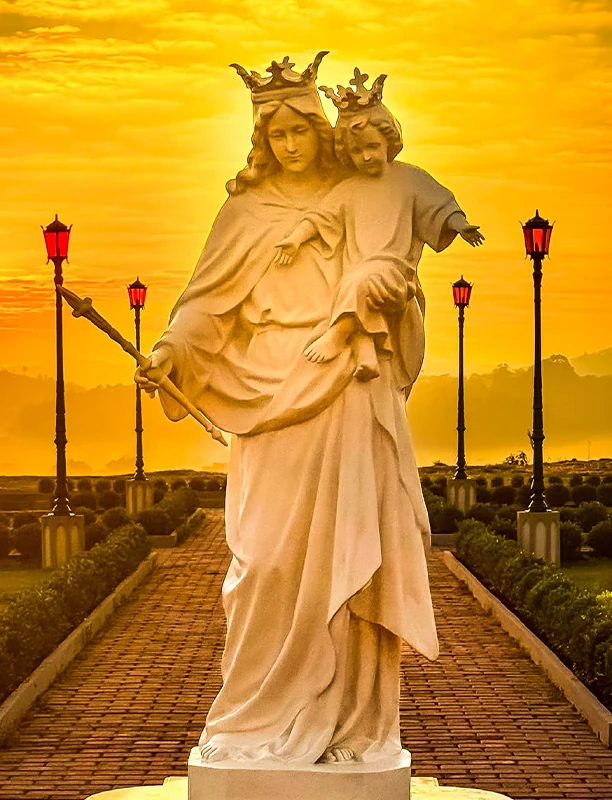 Help of Christians
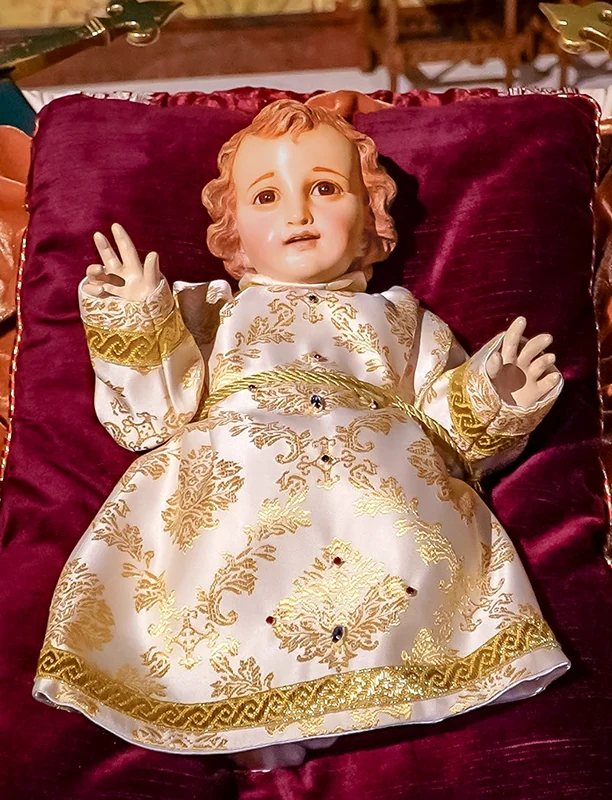 Christmas Carols







Gospel of the Solemnity of the Nativity of St. John the Baptist (Vigil Mass)
5 In the days of Herod, King of Judea, there was a priest named Zechariah, of the priestly division of Abijah; and his wife was from the daughters of Aaron, and her name was Elizabeth.6 Both were righteous in the eyes of God, observing all the commandments and ordinances of the Lord blamelessly.7 But they had no child, because Elizabeth was barren, and both were advanced in years.
8 Once when he was serving as priest in his division’s turn before God, 9 according to the practice of the priestly service, he was chosen by lot to enter the sanctuary of the Lord to burn incense.
10 Then, when the whole assembly of the people was praying outside at the hour of incense offering, 11 the Angel of the Lord appeared to him, standing at the right of the altar of incense. 12 Zechariah was troubled by what he saw, and fear came upon him. 13 But the Angel said to him, “Do not be afraid, Zechariah, because your prayer has been heard. Your wife Elizabeth will bear you a son, and you shall name him John. 14 And you will have joy and gladness, and many will rejoice at his birth, 15 for he will be great in the sight of the Lord. John will drink neither wine nor strong drink. He will be filled with the Holy Spirit even from his mother’s womb. 16 And he will turn many of the children of Israel to the Lord their God. 17 He will go before Him in the spirit and power of Elijah, to turn their hearts toward their children and the disobedient to the understanding of the righteous, to prepare a people fit for the Lord” (Lk 1: 5-17).
I – Predestined From All Eternity
 Apparition of the Angel to Zechariah – Church of St. John the Baptist, Halifax (Nova Scotia)
God conceived us from all eternity
Each of us has a clear notion of having come into the world through the cooperation of a father and a mother, whom we know and love. But we tend to overlook that before being physically begotten by our parents, we were conceived and known by God from a “moment” impossible to determine, since it was eternal. Our poor intelligence is incapable of even imagining the divine mind, in which there is neither past nor future, for everything is present. Having come from the hands of God, who directly creates each soul, it is fitting for us to cultivate a strong relationship with Him, upon Whom we depend for life, as contingent beings. Otherwise our condition is like that of an abandoned child, who may experience moments of joy, yet who lacks the happiness of belonging to a family. For His part, far from being like a cruel mother who forsakes her child, God never abandons us, and wants to establish a close relationship with us, as we read in Scripture: “Can a woman forget her child, that she should have no compassion on the son of her womb? Even these may forget, yet I will not forget you” (Is 49:15). The predestination to a privileged mission is evident at the birth of St. John the Baptist. This is followed by outstanding divine protection, as highlighted by the readings for both the Masses of this Solemnity – that of the Vigil and the Day – which narrate the calling of the prophet Jeremiah and the prophet Isaiah, perfectly applicable to the Precursor: “Before I formed you in the womb I knew you, and before you were born I consecrated you; I appointed you a prophet to the nations” (Jer 1:5); “The Lord called me from the womb, from the body of my mother he named my name” (Is 49:1).II – The Faith Perspective
As we ponder the episodes outlined by the Gospel of this Vigil, a peculiarity strikes us: God’s way of accomplishing great works. “The birth and naming of St. John the Baptist”, by Sano di Pietro - Metropolitan Museum of Art, New York
Events that changed the history of humanity
From man’s creation and life in Paradise down to the Final Judgement, this happening may be counted among one of the most important and transcendent for the history of humanity: St. John the Baptist, the greatest of those born of women, is conceived by a barren mother; moreover, when his parents were already of an advanced age – details that mark the event as entirely prodigious. The very announcement of his conception and birth are shrouded in mystery; St. Elizabeth is assisted in childbirth by the Virgin Mary, who is herself in the third month of the gestation of the Child Jesus, the Second Person of the Blessed Trinity Incarnate. But the Precursor does not come into the world surrounded by the glory, splendour, and power that he now enjoys in eternity, and which would have elicited belief from those who heard him. Rather, he embarked on his mission clothed in camel skin; he fed on locusts, and revealed sui generis characteristics that demanded an act of faith of his contemporaries. All of these impressive particulars were clothed in normality, in the common course of life. While his relatives and neighbours had discussed these things among themselves, they did not seem to fully grasp their supernatural dimension. Nowadays, thanks to hindsight and to the knowledge gleaned from two thousand years of Church Tradition, we more easily discern the mystical, miraculous, and extraordinary aspects of these events. And from them we draw a precious lesson: when God intervenes, He often does not reveal the entire magnitude of the occurrences that we witness. He acts this way to keep us in a state of earthly trial, without which we would live on proof, without the need for faith, thus losing the merit of its practice. For the just to live by faith (cf. Hb 2:4), He lets us cross the valleys of aridity (cf. Ps 83:7). Let us consider the verses chosen by the Liturgy for the Vigil of this Solemnity from this perspective.God rewards a couple’s holiness
5 In the days of Herod, King of Judea, there was a priest named Zechariah, of the priestly division of Abijah; and his wife was from the daughters of Aaron, and her name was Elizabeth.6 Both were righteous in the eyes of God, observing all the commandments and ordinances of the Lord blamelessly.
The public humiliation of barrenness
7 But they had no child, because Elizabeth was barren, and both were advanced in years.
 “The Annunciation to St. Zechariah”, by Pere Mates - Art Museum of Gerona (Spain)
God chooses ceremonies to manifest Himself
8 Once when he was serving as priest in his division’s turn before God, 9 according to the practice of the priestly service, he was chosen by lot to enter the sanctuary of the Lord to burn incense. 10 Then, when the whole assembly of the people was praying outside at the hour of incense offering…
11 …the Angel of the Lord appeared to him, standing at the right of the altar of incense.
 Zechariah and the Archangel St. Gabriel (detail) - Palais Dorotheum, Vienna
Fear resulting from lukewarmness
12 Zechariah was troubled by what he saw, and fear came upon him.
We live in constant contact with the invisible world
The example of Zechariah awakens us to a reality which often slips our mind: accustomed as we are to operating according to strictly human parameters, we easily forget that God did not create a closed universe – a world distinct from the invisible world composed of spiritual creatures. The contrary is true. We are constantly surrounded by good and evil Angels, who form one society with humans. Catholic doctrine teaches us that the Angels are very numerous; St. Thomas,5 echoing the opinion of many Church Fathers, applies the evangelical parable of the one sheep that wanders off as the other ninety-nine remain in the field (cf. Mt 18:12; Lk 15:4-7) as the ratio between men and Angels. Thus, for each man, there are ninety-nine Angels, an uncountable number for our limited minds. Now, both the Angels, with their good inspirations, as well as the demons, by means of temptation, exercise their role within the state of trial in which we are born, for we are merely passing through this life, to be tested here and to attain the glory of the beatific vision. Consequently, we should be careful not to act as though our existence played out on a merely natural plane. Rather, we must keep our gaze fixed on the horizons of faith, fully convinced that at every moment we are prey to the influence of the Angels or the demons. Detail of “The Annunciation”, by Fra Angelico - Diocesan Museum, Cortona (Italy)
God manifests His goodness
13 But the Angel said to him, “Do not be afraid, Zechariah, because your prayer has been heard. Your wife Elizabeth will bear you a son, and you shall name him John.”
A child great before the Lord
 St. John the Baptist in childhood - Church of St. John the Baptist, Figueiró dos Vinhos (Portugal)
14 “And you will have joy and gladness, and many will rejoice at his birth, 15 for he will be great in the sight of the Lord. John will drink neither wine nor strong drink. He will be filled with the Holy Spirit even from his mother’s womb. 16 And he will turn many of the children of Israel to the Lord their God. 17 He will go before Him in the spirit and power of Elijah, to turn their hearts toward their children and the disobedient to the understanding of the righteous, to prepare a people fit for the Lord.”
 St. John the Baptist and St. Elijah, by Andrea di Bonaiuto - Basilica of Santa Maria del Carmine, Florence (Italy)
III – The “Eliatic Line”
The fact that the child would go before the Lord “in the spirit and power of Elijah” clearly shows the constitution of a lineage linking the prophet par excellence to the Precursor of the Messiah, and uniting them by an analogous mission. We may well affirm that this “Eliatic line,” which has its origin in Elijah’s manner, in his patience, his humility and his zeal for God’s cause, could be said to extend to all providential men who, like John the Baptist, fulfil their historic role “with the spirit and power of Elijah.” They carry on through time illuminating the struggles of the Church across centuries. These prophets are chosen and formed by the divine will to mark the horizons of history, so that the holiness, discernment, strength, definition, determination, impetus, impact, and other gifts that adorn their souls are privileges granted by God, because He wills this, in His constant desire to communicate with men. In our turbulent times, which resemble a long, dark night, we should ask for this spirit of Elijah to shine once again over the world. And just as St. John the Baptist announced the arrival of the Saviour, we will see the triumph of Mary proclaimed, and the founding of a new and wonderful historical era. ◊Notes
1 Cf. ST. THOMAS AQUINAS. Summa Theologiæ, III, q.27, a.6.
2 ST. AMBROSE. Expositio Evangelii secundum Lucam, L.I, n.18. In: Obras, vol. I. Madrid: BAC, 1966, p.62-63.
3 Cf. TUYA, OP, Manuel de; SALGUERO, OP, José. Introducción a la Biblia. Madrid: BAC, 1967, v.II, p.318; RENIÉ, SM, Jules-Edouard. Manuel d’Écriture Sainte. Les Évangiles. 4.ed. Paris: Emmanuel Vitte, 1948, t.IV, p.258.
4 Cf. LAGRANGE, OP, Marie-Joseph. Évangile selon Saint Luc. (Ed.4). Paris: J. Gabalda, 1927, p.12-13; RENIÉ, op. cit., p.227-228, 258.
5 Cf. ST. THOMAS AQUINAS, op. cit., I, q.50, a.3; Super Matthæum, c.XVIII, lect.2; Catena Aurea. In Lucam, c.XV, v.1-7.
6 Cf. RENIÉ, op. cit., p.258-259; LAGRANGE, op. cit., p.15, nota 13.
7 Cf. MALDONADO, SJ, Juan de. Comentarios a los Cuatro Evangelios. Evangelios de San Marcos y San Lucas. Madrid: BAC, 1951, v.II, p.269-271.
8 ST. BEDE. Homilías sobre los Evangelios, 2, 23, apud ODEN, Thomas C.; JUST, Arthur A. (Ed.). La Biblia comentada por los Padres de la Iglesia. Evangelio según San Lucas. Madrid: Ciudad Nueva, 2006, v.III, p.50.