 Heralds of the Gospel Magazine, Vol. 20, nº 227, September 2026
 Heralds of the Gospel Magazine, Vol. 20, nº 226, August 2026
 Heralds of the Gospel Magazine, Vol. 20, nº 225, July 2026
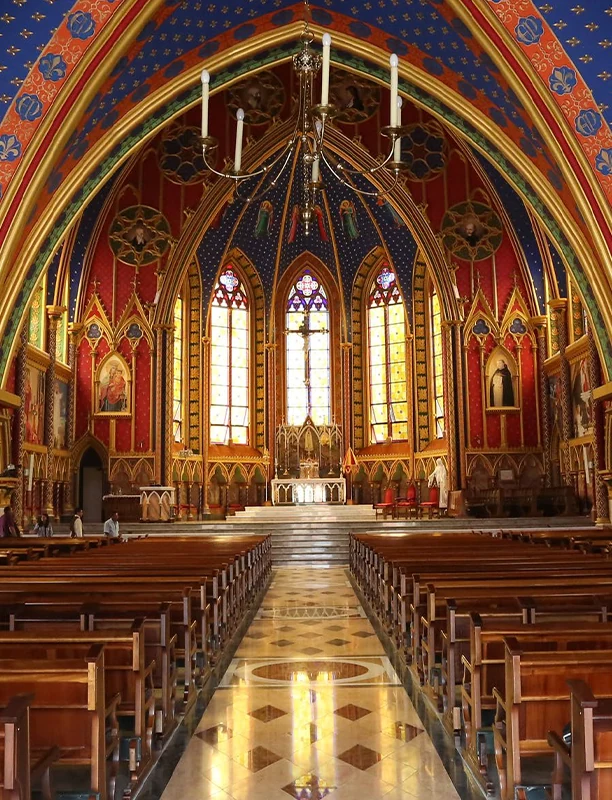 Who are the Heralds of the Gospel?
 Help of Christians
 Christmas Carols





Gospel – Feast of the Chair of Peter
13 When Jesus went into the region of Caesarea Philippi He asked His disciples, “Who do people say that the Son of Man is?” 14 They replied, “Some say John the Baptist, others Elijah, still others Jeremiah or one of the prophets.” 15 He said to them, “But who do you say that I am?” 16 Simon Peter said in reply, “You are the Christ, the Son of the living God.”
17 Jesus said to him in reply, “Blessed are you, Simon son of Jonah. For flesh and blood has not revealed this to you, but my heavenly Father. 18 And so I say to you, you are Peter, and upon this rock I will build my Church, and the gates of the netherworld shall not prevail against it. 19 I will give you the keys to the Kingdom of Heaven. Whatever you bind on earth shall be bound in Heaven; and whatever you loose on earth shall be loosed in Heaven” (Mt 16:13-19).
I – The Chair that No Human Power Can Destroy
It is a centuries-old and venerable custom to commemorate the Chair of Peter, exalted by the Fathers of the Church in their writings.1 The city of Antioch pioneered this feast in memory of its first bishop, the very Prince Apostles himself. Later, Rome, his last diocese, also began to celebrate it, later extending it to the universal Church. In referring to the Chair, we mean the stable seat from which the bishop teaches words of salvation to his faithful. The Chair of Peter, refers to the infallible teaching of the Pope, the universal shepherd of the Church, from whose lips the flock of Christ must receive the pure and holy food of divine truth.
St. Patrick’s Parish, Roxbury (MA)
Nevertheless, across history, unfortunate events highlighting the frailty of some Popes and the misuse of their magisterium have not been lacking. For fear of prevailing opinion, the Faith has been shamefully jeopardized on occasion. Let us recall – in addition to the cases of Vigilius and Liberius – the defection of Honorius, condemned for heresy by the Third Council of Constantinople, with the subsequent confirmation of Pope St. Leo II. The Pontiff’s solemn sentence runs thus: “We anathematize […] Honorius, who has not enlightened this Apostolic Church [of Rome] with the doctrine of the apostolic tradition, but has allowed the immaculate Church to be stained by impious treachery.”4 Add to this the long list of antipopes who sowed confusion in the Church for years on end, through the illegitimacy of their appointment or the doctrinal and disciplinary confusions spread under their auspices. Do these scandals jeopardize the guarantee of the veracity of the Chair of Peter? No, because in none of them – or in similar cases over the centuries – did the Pontiffs resort to infallibility. Such episodes only show the weakness inherited from original sin and, concurrently, the indestructible strength of the Chair that even its occupants, however weak or perverse they may be, cannot destroy. In contrast, history yields abundant examples of holy and intrepid Popes, who declared the truth in a definitive and binding way without fear of occasionally dramatic personal consequences. Some even gave their lives out of fidelity to the gift of faith, reinforcing with their blood the chair entrusted to them by the Divine Master. Thus, the Catholic Faith is tested time and again by the mayhem provoked by false doctrines spread by agents of evil in the Church, but they invariably meet with the obstacle of the infallible Chair of Peter, ever imperturbable and immutable in its fidelity to the truth of Christ. It is always the sure criterion for distinguishing the voice of authentic shepherds from the pernicious plots of wolves disguised as ministers. With these principles in mind regarding the Chair of Peter, we are well-equipped to explore the famous Gospel of the confession of the Prince of the Apostles, that is ever rich and filled with new insights.Through the Petrine ministry, the Pope possesses a power conferred by Christ, not to divulge new doctrines, but to assure Catholics of the fundamental truths
II – The Foundation of the Catholic Church
13 When Jesus went into the region of Caesarea Philippi He asked His disciples, “Who do people say that the Son of Man is?”
Mount Hermon, mentioned several times in Scripture, is of an imposing altitude, and in winter is usually capped with snow. Its elevation makes it the centrepiece of the panorama, but its broad and amenable expanses give it a note of noble delicacy. It is a beautiful symbol of the grandeur of the Father of Lights, who will inspire Peter on this occasion regarding the messiahship and divinity of His Son.At Mount Hermon, a symbol of the Father of Lights, St. Peter is inspired by God with respect to the messiahship and divinity of Our Lord Jesus Christ

An incomplete perspective
14 They replied, “Some say John the Baptist, others Elijah, still others Jeremiah or one of the prophets.”
A deeply theological question
15 He said to them, “But who do you say that I am?”
The core of the Faith
16 Simon Peter said in reply, “You are the Christ, the Son of the living God.”
The inspiration of the Father
17 Jesus said to him in reply, “Blessed are you, Simon son of Jonah. For flesh and blood has not revealed this to you, but my heavenly Father.”
Two rocks, two foundations?
18 “And so I say to you, you are Peter, and upon this rock I will build my Church, and the gates of the netherworld shall not prevail against it.”
However, St. Matthew’s account focuses on a more prominent character than the Prince of the Apostles. It is Our Lord Himself, for it is He who makes Simon the cornerstone of the Church and who promises to make it invincible against the assaults of the evil one. In theological disputes, the Protestants argued that it was incongruous to claim that the Bride of Christ had two foundations, namely Jesus and the Apostle Peter. Based on scriptural references to Our Lord as the cornerstone of the Church, they attempted to dismiss the mission of the Pope, the Successor of St. Peter and their sworn enemy. They often quoted St. Paul’s famous assertion: “For no other foundation can anyone lay than that which is laid, which is Jesus Christ” (1 Cor 3:11). How to clarify this apparent dichotomy? Does the Church have two distinct foundations?St. Peter is established as the rock on which Our Lord will build His Church, and to this gift the Redeemer adds the promise that it will remain ever indestructible

“And then, have you well considered the words of St. Paul? He will not have us recognize any foundation besides Our Lord, but neither is St. Peter nor are the other Apostles foundations besides Our Lord; they are subordinate to Our Lord. Their doctrine is none other than that of their Master, but their very Master’s itself. […] “Our Lord then is foundation and St. Peter also, but with so notable a difference that with respect to the one the other may be said not to be it. For Our Lord is foundation and founder, foundation without other foundation; foundation of the natural, Mosaic and Evangelic Church, foundation perpetual and immortal, foundation of the Militant and Triumphant, foundation by His own nature, foundation of our faith, hope and charity, and of the efficacy of the Sacraments. “St. Peter is foundation, not founder, of the whole Church; foundation but founded on another foundation, which is Our Lord; foundation of the Evangelic Church alone, foundation subject to succession, foundation of the Militant, not of the Triumphant, foundation by participation, ministerial not absolute foundation. In fine, administrator and not lord, and in no way the foundation of our faith, hope and charity, nor of the efficacy of the Sacraments.St. Peter and the other Apostles are not foundations distinct from Our Lord, but dependent on Him, and their doctrine does not differ from their Master’s
 São Pedro - St. Peter - Cathedral of Viseu (Portugal)
The power of the keys
19 “I will give you the keys to the Kingdom of Heaven. Whatever you bind on earth shall be bound in Heaven; and whatever you loose on earth shall be loosed in Heaven.”
III – Catholicism: The Certainty of the Truth
The feast of the Chair of Peter recalls to the Church’s mind the priceless gift of pontifical infallibility, which is the foundation of the Catholic Faith, making it possible for the faithful to trust with complete certainty in the words of truth declared by the Popes in a solemn or definitive way.This is the rock chosen by Christ to build His Church. And though men may attack the most precious deposit of the Faith, seeking to obscure or destroy it, they will not succeed. The pontifical teachings will always resound as the voice of the authentic Shepherd in the interior ears of the sheep chosen by the Lord. Therefore, even in times of crisis and bewilderment, let us fly from discouragement, certain that individuals pass away, with their fallacies and deceptions, but the truth remains. Our Lord Jesus Christ, who founded the Church on Peter, and built it as an impregnable fortress, continues to guard and guide His Church. The victory will go to those who trust Him! ◊Our Lord Jesus Christ, who founded the Church on Peter, and built it as an impregnable fortress, continues to guard and guide it. The victory will go to those who trust Him!
Notes
1 The great St. Jerome, addressing the Bishop of Rome, expressed himself thus: “I thought I should consult the Chair of Peter and the faith praised by the apostolic mouth, and seek nourishment for my soul there where I once received the garment of Christ. […] I, who follow no other primacy than that of Christ, unite myself in communion with Your Holiness, that is, with the Chair of Peter. I know that the Church is built on this rock” (ST. JEROME. Epístola 15. a Dámaso, n.1-2. In: Obras Completas. Madrid: BAC, 2013, t.Xa, p.73; 75).
2 FIRST VATICAN COUNCIL. Pastor æternus: DH 3074.
3 Idem, 3070.
4 ST. LEO II. Carta “Regi regum” ao Imperador Constantino IV: DH 563.
5 ST. FRANCIS DE SALES. The Catholic Controversy. P.II, art. 6, ch.2. In: Library of St. Francis de Sales. London: Burns & Oates, 1909, Vol.III, p.245-247.