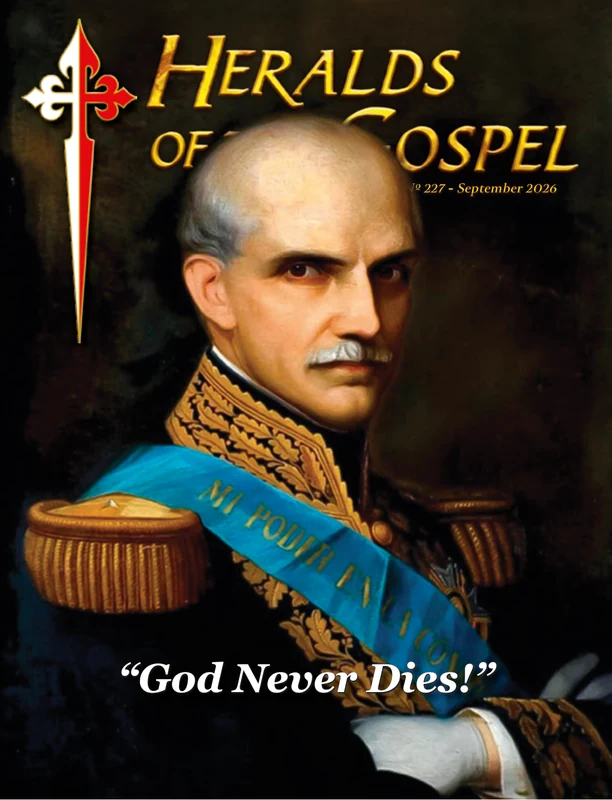
 Heralds of the Gospel Magazine, Vol. 20, nº 227, September 2026
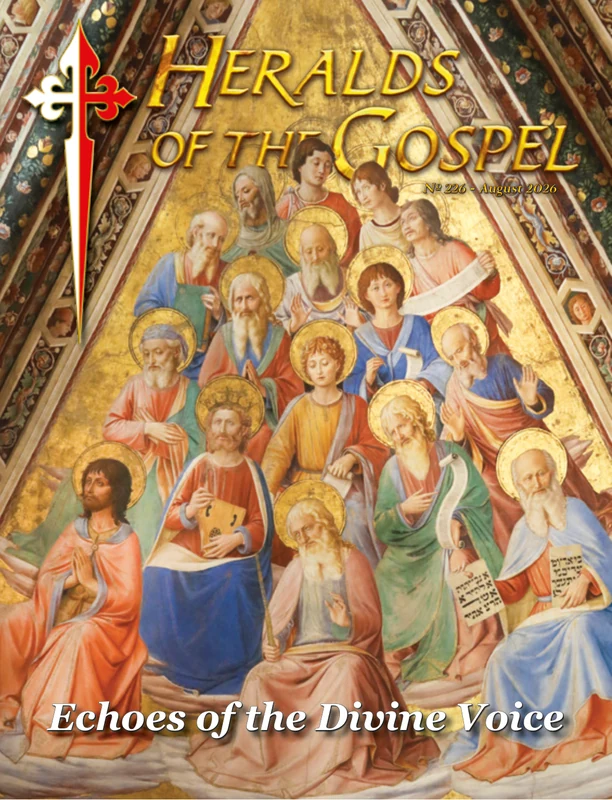 Heralds of the Gospel Magazine, Vol. 20, nº 226, August 2026
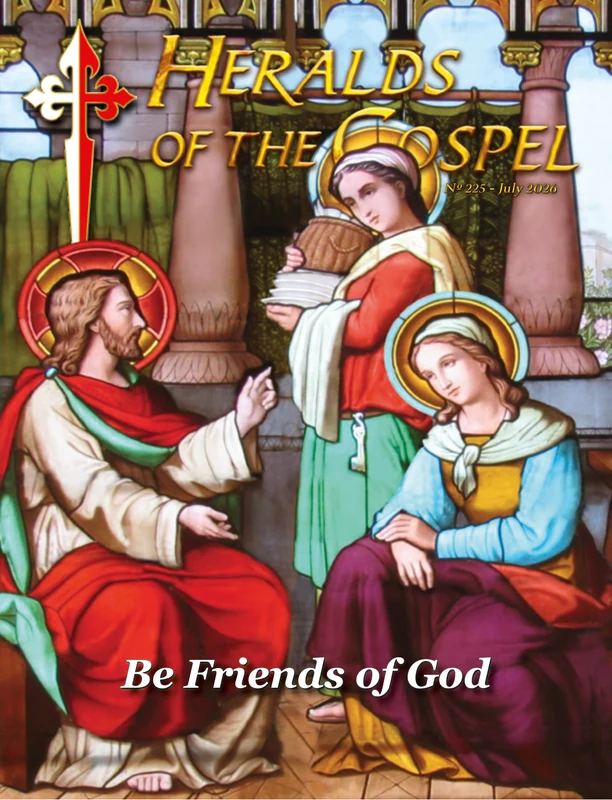 Heralds of the Gospel Magazine, Vol. 20, nº 225, July 2026
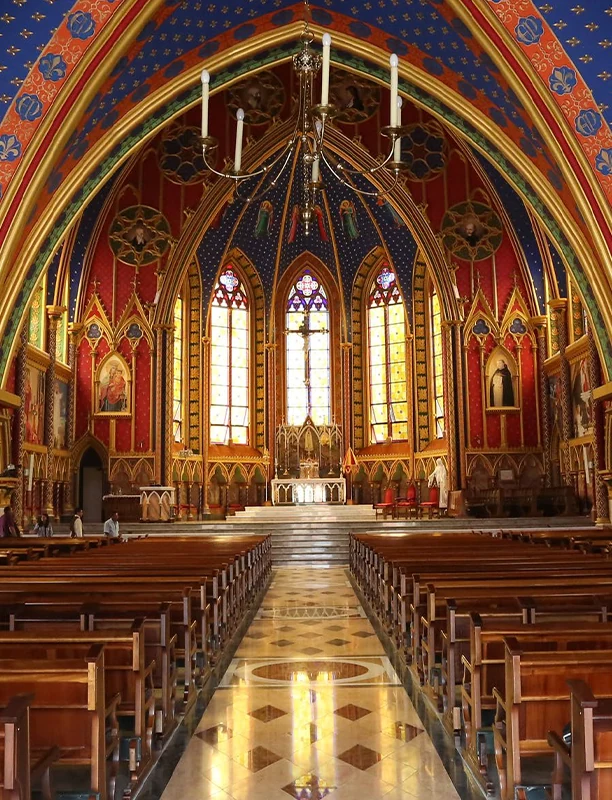 Who are the Heralds of the Gospel?
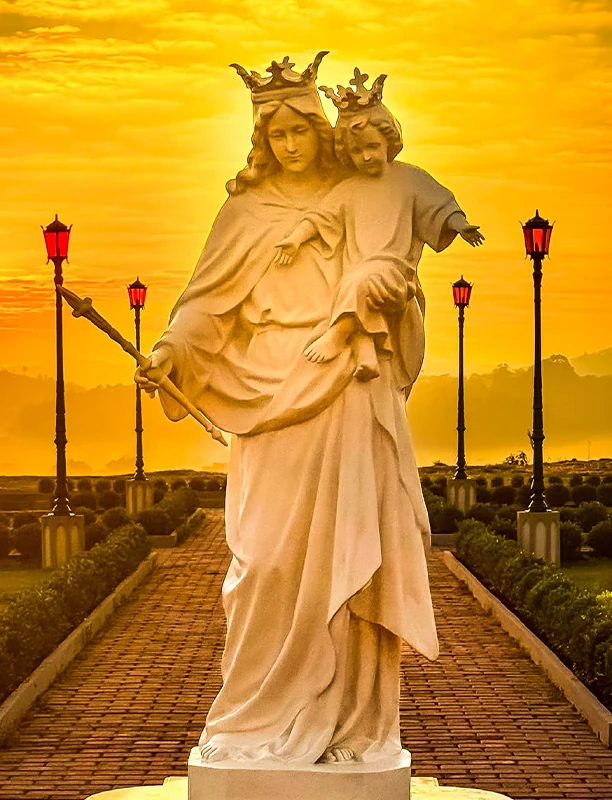 Help of Christians
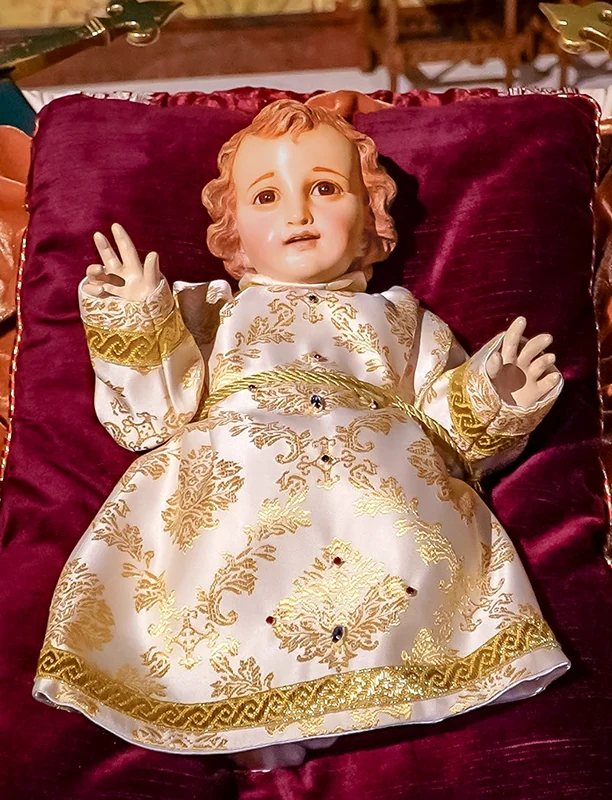 Christmas Carols








Gospel – Fifth Sunday of Lent
20 Some Greeks who had come to worship at the Passover Feast 21 came to Philip, who was from Bethsaida in Galilee, and asked him, “Sir, we would like to see Jesus.” 22 Philip went and told Andrew; then Andrew and Philip went and told Jesus.
23 Jesus answered them, “The hour has come for the Son of Man to be glorified. 24 Amen, amen, I say to you, unless a grain of wheat falls to the ground and dies, it remains just a grain of wheat; but if it dies, it produces much fruit. 25 Whoever loves his life loses it, and whoever hates his life in this world will preserve it for eternal life. 26 Whoever serves Me must follow Me, and where I am, there also will my servant be. The Father will honour whoever serves Me. 27 I am troubled now. Yet what should I say? ‘Father, save Me from this hour’? But it was for this purpose that I came to this hour. 28 Father, glorify your Name.” Then a voice came from Heaven, “I have glorified it and will glorify it again.”
29 The crowd there heard it and said it was thunder; but others said, “An Angel has spoken to Him.” 30 Jesus answered and said, “This voice did not come for my sake but for yours. 31 Now is the time of judgment on this world; now the ruler of this world will be driven out. 32 And when I am lifted up from the earth, I will draw everyone to myself.”
33 He said this indicating the kind of death He would die (Jn 12:20-33).
I – Wherein Lies True Glory?
The deformations introduced into the modern mentality from the influence of Hollywood cinema, marked by the invariable “happy ending” – that imaginary rosy outcome that only happens on-screen – have heightened in recent decades, to extreme levels. This includes the tendency to detest any kind of suffering, as if suffering or sacrifice spelled the worst misfortune. Parallel to this, a fervid desire for the enjoyment of life is generated, unscrupulously amassing possessions to gain access to a series of the most eccentric and excessive pleasures. Do not the celebrities of this world live such lives, surrounded by apparent luxury? Advanced technology, especially in the field of cutting-edge cybernetics, enfeebling conveniences, extravagant fashions, in short, a gamut of frenetic entertainment is within the reach of this class of people. This is the contemporary fantasy: to gain a place in these ranks so as to achieve a supposedly unimaginable degree of happiness. The goal is to live a kind of fairy-tale dream, but stripped of the charms of aristocratic finery and dressed, instead, in the scrupulously torn, worn and grimy trappings of the wastelands of ugliness. However, is this where true glory lies?The teaching of the Divine Master
Our ancestors thought differently. The worth of each person was measured by their virtues: honour, courage, courtesy, honesty and perseverance, to name but a few. And these attributes became even more meritorious when they were supernaturalized by grace, carefully preserved from the risk of being lost through sin. Thus, praiseworthy figures distinguished themselves by having given their lives for a higher cause, for having been capable of facing peril and of making courageous renunciations.Think of the honour paid to soldiers who bravely shed their blood for the good of their country, the consideration given to heads of families who led an austere existence in order to provide better conditions for their descendants, or the admiration aroused by the example of the knights of old, who stood ready, at the cost of their lives, to defend the weakest and neediest and, above all, the most sublime interests of the Holy Church. The Gospel for this fifth Sunday of Lent sheds light on this question. For Jesus, the supreme model of humanity, true glory consists in the Cross, in the virile and serious acceptance of holocaust taken to its final consequences. Our Lord corroborated this teaching with the most explicit example given in the Passion and, accordingly, He now confronts and destroys the myths and fantasies with which the devil seeks to entrap in his sordid clutches the spirits created for a higher glory. No, man was not born to wallow in the muddy quagmire of this world, but to conquer the sacrosanct heights of heroism. To do this, he must be willing to abandon the narrow confines of egoism and arm himself with the weapons of light in order to wage a magnificent combat. As Dr. Plinio Corrêa de Oliveira taught, “the life of the Church and the spiritual life of every believer are an incessant struggle. At times God gives His Bride days of splendid, visible and even palpable grandeur. He gives souls moments of marvellous interior or exterior consolation. But the true glory of the Church and of the faithful comes from suffering and struggle. It is an arid struggle, without sensible beauty or tangible poetry; a struggle in which one advances, at times, during the night of anonymity, in the mire of disinterest or incomprehension, under the storms and bombardment unleashed by the combined forces of the devil, the world and the flesh. But it is a struggle that fills the Angels of Heaven with admiration and draws God’s blessings.”1 That is why he crowned his words with the epigraph: “True glory can only be born of pain.” And here is the key to interpreting today’s Gospel.For Jesus, supreme model of humanity, true glory consists in the Cross, in the virile and serious acceptance of holocaust taken to the very end
II – Glory Is the Cross!
The context of the passage from St. John chosen for this Liturgy could not be more decisive and, at the same time, more critical in the life of Our Lord. In the eleventh chapter of this Gospel, He had already restored Lazarus to life, shattering the dome of silence under which the Sanhedrin sought to shroud His action. Consequently,the Jewish leaders decided to sacrifice Him for the good of the nation: “So from that day on they took counsel how to put Him to death” (Jn 11:53).Nevertheless, “like a man of war, he stirs up his fury” (Is 42:13). After a rapid strategic retreat Jesus returns to Bethany, where Mary anoints Him a second time with precious perfume of nard. On the following Sunday He triumphantly enters Jerusalem, cheered by the crowds who line the road with palm branches. The provocation could not have been more daring! The Divine Knight hastened towards His dolorous Passion, provoking this commentary among the Pharisees: “You see that you can do nothing; look, the world has gone after Him” (Jn 12:19).Jesus enters Jerusalem amid cheers. The provocation to the Sanhedrin could not have been more daring! The Divine Knight hastened towards His Passion
 “Entry of Christ into Jerusalem”, by Pietro Lorenzetti -Basilica of St. Francis, Assisi (Italy
The reward for worship
20 Some Greeks who had come to worship at the Passover Feast…
Humility and love
21…came to Philip, who was from Bethsaida in Galilee, and asked him, “Sir, we would like to see Jesus.” 22 Philip went and told Andrew; then Andrew and Philip went and told Jesus.
The hour of glory
23 Jesus answered them, “The hour has come for the Son of Man to be glorified.”
 “Lamentation”, by Giotto di Bondoni - Cappella degli Scrovegni, Padua (Italy)
Jesus is the divine seed
24 “Amen, amen, I say to you, unless a grain of wheat falls to the ground and dies, it remains just a grain of wheat; but if it dies, it produces much fruit.”
St. Thomas3 comments that Our Lord shows Himself to His followers as the seed destined to bear fruit: if He did not die, the effects of the Redemption would not be realized. Among these, the Angelic Doctor lists three: the remission of sins – “For Christ also died for sins once for all, the righteous for the unrighteous, that He might bring us to God” (1 Pt 3:18); the conversion of the Gentiles – “And when I am lifted up from the earth, I will draw everyone to myself” (Jn 12:32); and the opening of the gates of Heaven, access to glory for a humanity regenerated by the power of His Blood – “Therefore, brethren, since we have confidence to enter the sanctuary by the Blood of Jesus, by the new and living way which He opened for us through the curtain, that is, through His Flesh” (Heb 10:19-20).Our Lord shows Himself as the seed destined to bear fruit: if He did not die, the effects of the Redemption would not be realized, and His glory would not be revealed to the nations
Lose one’s life to preserve it?
25 “Whoever loves his life loses it, and whoever hates his life in this world will preserve it for eternal life.”
He Himself would put this teaching into practice, facing an ignominious Death to conquer the triumphant Resurrection, as St. Paul reminds us: “Let us run with perseverance the race that is set before us, looking to Jesus the pioneer and perfecter of our faith, who for the joy that was set before Him endured the Cross, despising the shame, and is seated at the right hand of the throne of God” (Heb 12:1-2). But which life is lost and which gained? Temporal life is lost, and eternal life gained. A person gives up the passing pleasure of a good reputation, comfort, security, and illicit pleasures that oppose angelic virtue to shoulder an austere life marked by struggle and persecution, which is equivalent to dying to the world while remaining in it. True life awaits those who embrace this kind of death: Heaven. Those who, on the other hand, cling to the pleasures of a voluptuous existence will forever lose their souls in the terrible and sinister depths of hell.There is a principle that terrifies the carnal and mediocre: it is necessary to die to the world and its pleasures in order to conserve eternal life and to attain Heaven
There is no greater glory
26 “Whoever serves Me must follow Me, and where I am, there also will my servant be. The Father will honour whoever serves Me.”
Jesus’ sublime and tragic hour
27 “I am troubled now. Yet what should I say? ‘Father, save Me from this hour’? But it was for this purpose that I came to this hour.”
The Cross and glory
28 “Father, glorify your Name.” Then a voice came from Heaven, “I have glorified it and will glorify it again.”
Not everyone recognizes the Father’s voice
29 The crowd there heard it and said it was thunder; but others said, “An Angel has spoken to Him.” 30 Jesus answered and said, “This voice did not come for my sake but for yours.”
 “Crucifixion”, by Fra Angelico - Metropolitan Museum of Art, New York
The Cross judges, conquers, attracts and triumphs
31 “Now is the time of judgment on this world; now the ruler of this world will be driven out. 32 And when I am lifted up from the earth, I will draw everyone to myself.”
33 He said this indicating the kind of death He would die.
The Cross also manifests the defeat of the devil, prince of this world. On it, the Son of God humbled Himself, becoming obedient unto death. With His perfect submission tinged with blood, Our Lord repaired the sin of our first parents and destroyed the empire of the ultimate impostor, satan. From then on, whoever embraced the Cross with faith and determination could never be defeated; on the contrary, he would crush and trample the infernal enemy underfoot. Finally, the Evangelist speaks of the mesmerising beauty of the Divine Victim nailed to the Cross, with the power of drawing everyone to Himself. The attractive force of love is incalculable, and there has never been, nor is there now, nor will there ever be a love so radical, so generous, and so heroic as that of the Lamb that was slain. Why, then, do so many people reject Him? This is the mystery of iniquity: who can comprehend sin? (cf. Ps 19:12).As the most refulgent manifestation of love, the Cross would become the yardstick of the radicalism required of man for fulfilling the two commandments that sum up the entire Law
Love is something serious and requires renunciation and self-giving. Not everyone is willing to pay this tribute, preferring to remain comfortably installed within the narrow confines of selfishness. Woe to those who reject the love of the Crucified, shown to us so clearly! Woe to those who choose not to imitate Him in loving God and neighbour! It would be better had they not been born, as was said of Judas the traitor (cf. Mt 26:24). But blessed are those who love the Cross, for they will triumph with Jesus now and forever!Love is something serious and requires renunciation and self-giving. Not everyone is willing to pay this tribute, preferring to remain comfortably installed within the narrow confines of selfishness.
III – The Glory of Suffering with a Supernatural Spirit
To a large extent, our existence in this world consists of suffering. The Cross was undoubtedly a challenge of immense proportions for Jesus himself, but He faced it with the courage of the most audacious of warriors, trusting in the Father’s love. Let us imitate our Saviour.He is our model, our guide, and the path traced by God for us to reach Heaven. He is also our invincible strength and our inseparable companion. No one carries their cross alone, for Jesus becomes our Divine Cyrenian. Let us, then, confide in His help and that of His Blessed Mother, the Coredemptrix of the human race, who with Him saved us from our sins. ◊Let us imitate our Saviour, who faced sufferings of immense proportions with the courage of the most audacious of warriors, trusting in the Father’s love
True Glory Can Only Be Born of Pain
Plinio Corrêa de Oliveira
From a distance, a crowd watches – with the usual delight, of course – a parade of the Queen’s Grenadier Guard in their full dress uniform. Military tactics have long since rendered uniforms like this useless: black trousers, red tunics with white belts and ornaments, white gloves and a large bearskin cap. But it is kept for moral purposes: to maintain the tradition of the army and to allow the people to experience the splendour of military life. In fact, glory must be expressed through symbols. God uses them to show His own grandeur to man. And in this, as in everything else, we must imitate God. Now, the uniform of the grenadiers, their impeccably cadenced and aligned march, the enthusiasm with which the standard bearer carries the national flag and the marshal signals the direction of the march, the drum roll and the clarion call, everything in a word, expresses the moral beauty inherent in military life: high sentiments, self-sacrifice unto bloodshed, the strength to undertake, risk and conquer, discipline and gravity, in short, heroism. The 2018 “Trooping the Colour”
 Soldier analysed by Dr. Plinio
Taken from: Catolicismo. Campos dos Goytacazes. Year VII. N.78 (June, 1957); p.7
Notes
1 CORRÊA DE OLIVEIRA, Plinio. Ambientes, Costumes, Civilizações: A verdadeira glória só nasce da dor [Ambiences, Customs and Civilizations: True Glory Can Only Be Born of Pain]. In: Catolicismo. Campos dos Goytacazes. Year VII. N.78 (June, 1957); p.7.
2 Cf. ST. AUGUSTINE. Contra Maximinum arianorum episcopum. L.II, c.13, n.2: PL 42, 770.
3 Cf. ST. THOMAS AQUINAS. Lectura super Ioannem, c.XII, lect.4.
4 Idem, ibidem.