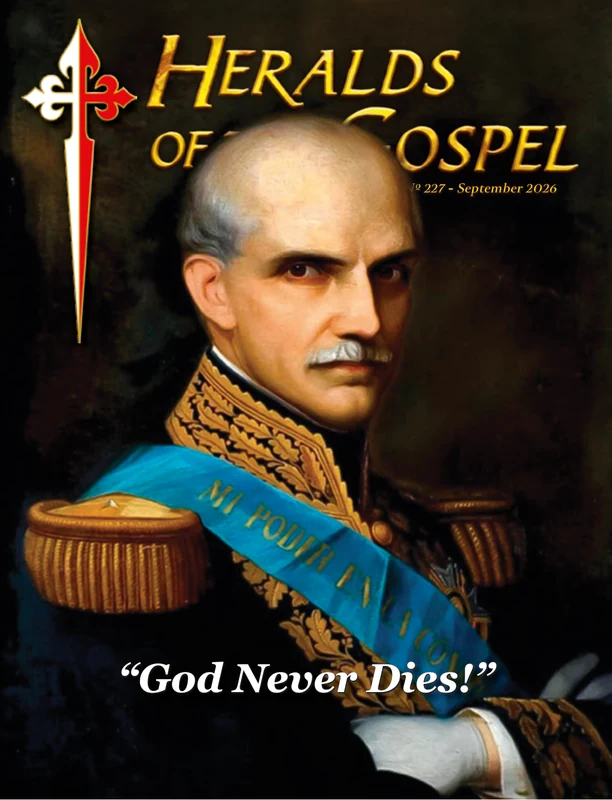
 Heralds of the Gospel Magazine, Vol. 20, nº 227, September 2026
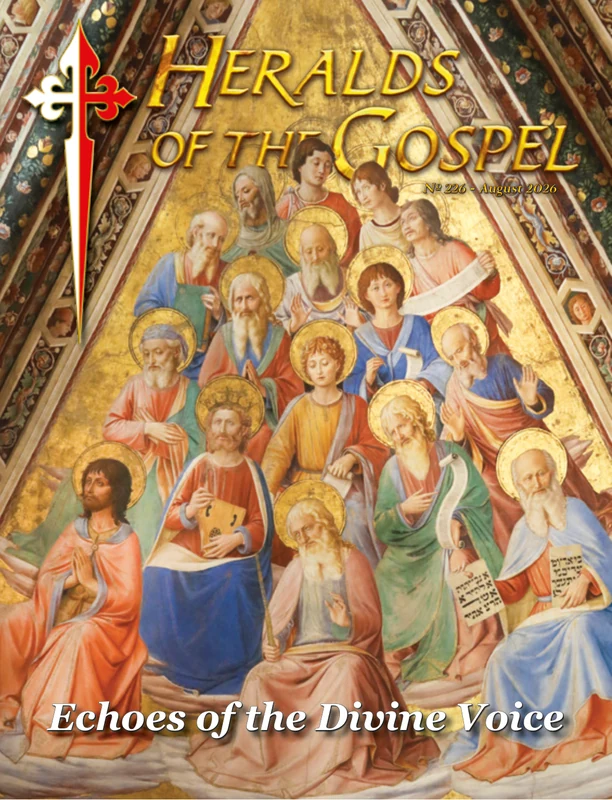 Heralds of the Gospel Magazine, Vol. 20, nº 226, August 2026
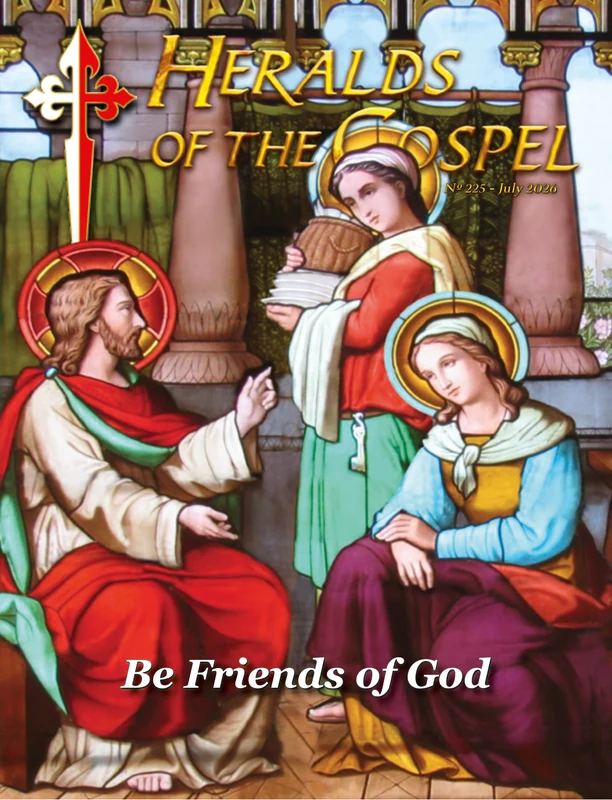 Heralds of the Gospel Magazine, Vol. 20, nº 225, July 2026
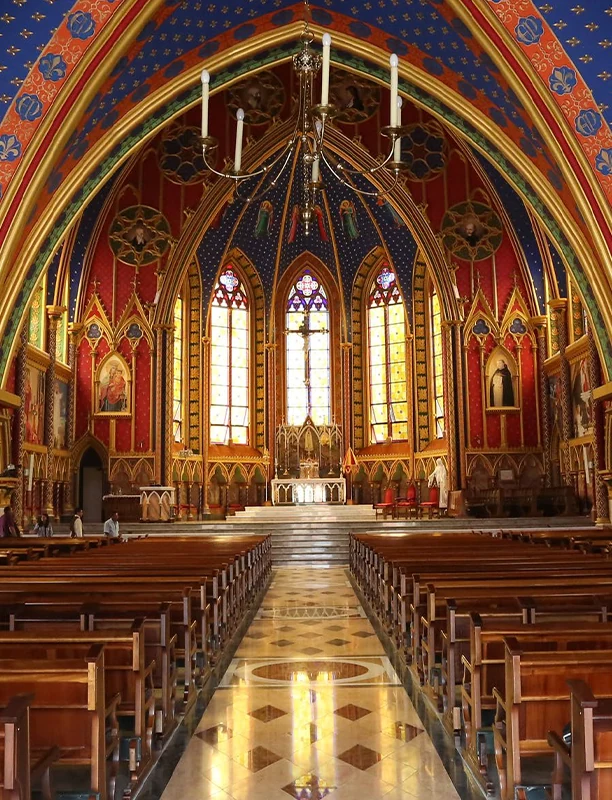 Who are the Heralds of the Gospel?
 Help of Christians
 Christmas Carols






Gospel – Memorial of Our Lady of the Rosary
26 The Angel Gabriel was sent from God to a town of Galilee called Nazareth, 27 to a Virgin betrothed to a man named Joseph, of the house of David; and the Virgin’s name was Mary.
28 And coming to her he said, “Hail, full of grace, the Lord is with You!”
29 But She was greatly troubled at what was said, and pondered what sort of greeting this might be.
30 Then the Angel said to her, “Do not be afraid, Mary, for You have found favour with God. 31 Behold, You will conceive in your womb and bear a Son, and You shall name Him Jesus. 32 He will be great, and will be called Son of the Most High; and the Lord God will give to Him the throne of David His father, 33 and He will rule over the house of Jacob forever; and of His Kingdom there will be no end.”
34 But Mary said to the Angel, “How can this be, since I have no relations with a man?”
35 And the Angel said to her in reply, “The Holy Spirit will come upon You, and the power of the Most High will overshadow You. Therefore the Child to be born will be called holy, the Son of God. 36 And behold Elizabeth, your relative has also conceived a son in her old age; and this is the sixth month for her who was considered barren; 37 for nothing will be impossible for God.”
38 Mary said, “Behold, I am the handmaid of the Lord. May it be done to me according to your word.” Then the Angel departed from her (Lk 1:26-38).
I – A Providential Devotion
In modern times, devotion to the Rosary gained an ardent apostle: St. Louis-Marie Grignion de Montfort, a zealous and tireless missionary, an upright priest, a Marian theologian and founder. Among the various works he wrote as the basis of his prolific missions was The Admirable Secret of the Rosary, in which he explains, with doctrinal soundness and abundant examples, the great spiritual value of this centuries-old practice, which has produced countless conversions and miracles. In this book, the French saint states: “I beg of you to beware of thinking of the Rosary as something of little importance – as do ignorant people, and even several great but proud scholars. Far from being insignificant, the Rosary is a priceless treasure which is inspired by God.”1 In villages that received him, and particularly in the Diocese of La Rochelle, he always founded confraternities of the Rosary: “This is a holy practice, which God, in His mercy, has set up in places where I have preached missions, in order to safeguard and increase the good brought about by the mission and to prevent further sin. Before the Rosary was established in these little towns and villages, dances and parties of debauchery went on; dissoluteness, wantonness, blasphemy, quarrels and feuds flourished; one heard nothing but evil songs and double-meaning talk. But now nothing is heard but hymns and the chant of the Our Father and Hail Mary. The only gatherings to be seen are those of twenty, thirty or a hundred or more people who, at a fixed time, sing the praises of God as religious do. There are even places where the Rosary is said in common every day, at three different times of the day. What a blessing from Heaven that is!”2However, like any good and effective practice, the Rosary encountered serious opposition. St. Louis-Marie himself was persecuted and outraged in various dioceses still infested with the mephitic vapours of Jansenism. This devotion can well be considered a true rock of scandal, capable of separating the wheat from the chaff in the Lord’s fields: “As there are wicked people everywhere, do not expect to find that the place you live in is free of them; there will be people who avoid going to church for the Rosary, who may even make fun of it and do all they can, by what they do and say, to stop you from going. But do not give up. As those wretched people will have to be separated from God and Heaven forever, already here on earth they have to be separated from the company of Jesus and His servants.”3The devotion of the Rosary could well be considered a true rock of scandal, capable of separating the wheat from the chaff in the Lord’s fields
 Our Lady of the Rosary - Church of St. Charles Borromeo, Liverpool (England)
II – Mary, Golden Link Joining Heaven and Earth
The Gospel of the liturgical memorial of Our Lady of the Rosary brings to light the foundation of this prayer: the angelic greeting with which the Annunciation begins. St. Gabriel, God’s ambassador to the Virgin, and St. Elizabeth, a woman filled with the Holy Spirit, pronounced great praises to Mary, which deserve to be repeated one hundred and fifty times a day, in remembrance of the one hundred and fifty Psalms. After the Our Father – the princeps prayer of Christianity – the Hail Mary occupies a privileged place in Catholic piety, since God is especially glorified in Our Lady by the fact that He sanctified her to the highest degree, making her full of grace. Let us now meditate closely on this Gospel scene of unrivalled beauty.St. Gabriel, God’s ambassador to the Virgin, and St. Elizabeth, pronounced great praises to Mary, which deserve to be repeated one hundred and fifty times a day
When Heaven knocked on the door of time
26 The Angel Gabriel was sent from God to a town of Galilee called Nazareth, 27 to a Virgin betrothed to a man named Joseph, of the house of David; and the Virgin’s name was Mary.
Archetype of maturity for today’s youth
28 And coming to her he said, “Hail, full of grace, the Lord is with You!” 29 But She was greatly troubled at what was said, and pondered what sort of greeting this might be.
 “Annunciation”, by Fra Angelico - Diocesan Museum, Cortona (Italy)
Accustomed to angelic company
Still in the same Gospel passage, St. Gabriel addresses Our Lady by calling her “full of grace”, an expression that could be more accurately translated as “made grace” or “graced”, that is, one who has been transformed completely and forever by God’s grace. Just as fire set to combustible material turns it into flames, so grace set Mary’s Immaculate Heart on fire, uniting it fully to God.On hearing the angelic salutation, the Most Pure Virgin was troubled. Humility is the daughter of the fear of God, a gift that leads man to be fully aware of his nothingness in the face of the Creator’s greatness. As a result, when She heard praise of which She did not feel worthy, She experienced the modesty of the poor in spirit, who blush when exalted, and this was the reason for her perturbation. Therefore, far from having her lucidity clouded or being frightened by the presence of the Angel, Mary began to reflect, with the loftiest wisdom, on the meaning of those mysterious praises.Far from having her lucidity clouded or being frightened by the presence of the Angel, Mary began to reflect upon the meaning of those mysterious praises
The promise of royalty
30 Then the Angel said to her, “Do not be afraid, Mary, for You have found favour with God. 31 Behold, You will conceive in your womb and bear a Son, and You shall name Him Jesus. 32 He will be great, and will be called Son of the Most High; and the Lord God will give to Him the throne of David His father, 33 and He will rule over the house of Jacob forever; and of His Kingdom there will be no end.”
Ever Virgin
34 But Mary said to the Angel, “How can this be, since I have no relations with a man?”
By proposing such a difficulty, Our Lady was making it clear that She had taken a vow of continence, which St. Joseph enthusiastically accepted. In fact, since She was already married, what other reason would She have to question the Angel about the conception of the Child, except that She was prevented, for a higher reason, from consummating the marriage union? This moment of the Annunciation highlights Our Lady’s particular love of virginity and her desire to safeguard it at all costs, even in the face of the prospect of being the Mother of God! For this clear and unsurpassable purity, the Word chose her as the sealed fountain and the enclosed garden (cf. Sg 4:12) in which He would take on human flesh. And such was His delight in Mary’s perfect chastity that, as well as preserving her at the moment of conception, He also did so during and after childbirth, making His Mother ever virgin, as the Liturgy sings.The mysteries of Mary’s life reveal to us the greatness of divine omnipotence acting upon her. Could a kind of new Marian Pentecost be in store for humanity?
For God nothing is impossible
35 And the Angel said to her in reply, “The Holy Spirit will come upon You, and the power of the Most High will overshadow You. Therefore the Child to be born will be called holy, the Son of God. 36 And behold Elizabeth, your relative has also conceived a son in her old age; and this is the sixth month for her who was considered barren; 37 for nothing will be impossible for God.”
 Pentecost - Alberto Sampaio Museum, Guimarães (Portugal)
The Magnificat proclaims the marvels with which the Queen of the universe was honoured by the Most High, some of which we hear today through the lips of St. Gabriel. Among the most sublime is undoubtedly the supernatural bond that the Holy Spirit established with her, making her His Spouse and making her as fruitful as the dew that gives life to the most fragrant, beautiful and noble lily. This mystical espousal of Love itself generated an incalculable union between the Two that, perhaps in the near future, will be better known and appreciated by the Saints of the latter times, as St. Louis Grignion prophesied. Something similar can be said about the Eternal Father, who overshadowed her, communicating His creative power to her in a certain way. To what degrees of dignity did this immense gift elevate her? Who knows if, sooner rather than later, these theological horizons will gain new clarity, arousing enthusiasm for Our Lady and obtaining a new Marian Pentecost from God for humanity?We should expect grandiose interventions involving the victory of good over evil, knowing that the Rosary will bring us the triumph of the Immaculate Heart of Mary
The decisive “yes”
38 Mary said, “Behold, I am the handmaid of the Lord. May it be done to me according to your word.” Then the Angel departed from her.
 Virgin of the Rosary - San Francisco Museum, Santiago (Chile)
III – The Future, Dependent on the Rosary
In these times of darkness and misery, Catholics need to strengthen their bonds of love and submission to Mary Most Holy, so that true miracles can be worked in their hearts through her. Nothing is more conducive to this than the recitation of the Holy Rosary, by which we meditate, during its Our Fathers and Hail Marys, on the mysteries of the life, Passion and glorification of the Son of God. The pious repetition of the angelic salutation will prepare our souls to receive the Marian graces that will transform us into humble slaves of Jesus, trusting children of the Heavenly Father and daring warriors of the Virgin. Through her, the world will be shown that everything is possible for God, even the restoration of Christendom, which has been under the yoke of vices and corrupt customs for centuries. Devotees of the Rosary should expect grandiose interventions along the lines of the victory of good over the forces of evil that seem to rule world events. The Rosary will bring us the triumph of the Immaculate Heart of Mary! ◊Notes
1 ST. LOUIS-MARIE GRIGNION DE MONTFORT. The Secret of the Rosary, n.1. In: God Alone. Bay Shore, NY: Montfort Publications, 1987, p.152.
2 Idem, n.135, p.218.
3 Idem, ibidem.