 Heralds of the Gospel Magazine, Vol. 20, nº 227, September 2026
 Heralds of the Gospel Magazine, Vol. 20, nº 226, August 2026
 Heralds of the Gospel Magazine, Vol. 20, nº 225, July 2026
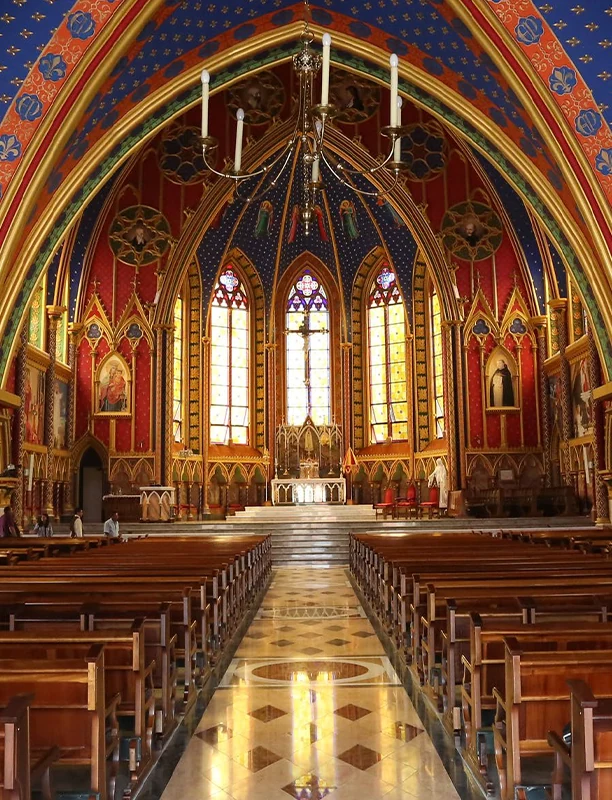 Who are the Heralds of the Gospel?
 Help of Christians
 Christmas Carols








In the cave of Subiaco, thinking of God alone
We can imagine St. Benedict, still young – as it is said he was – comely, well endowed with the qualities of a senatorial family and, detached from all these natural gifts, leaving his father’s house on his way to Subiaco. It was a mountain, a kind of wild palace of caves, one above the other, as if forming floors. He chose one of them on what we might call the first floor and entered. He may not have been aware of it, but in one of the upper openings, another much older hermit, St. Romanus, had been living in complete isolation for many years. He spotted the young ascetic coming and immediately saw the sign of God in that soul. They did not speak to each other, each maintaining his secluded existence. St. Romanus lived only on a loaf of bread that a raven brought him daily. St. Benedict went there without any concern for food, trusting in God. But from that day on, the raven brought two loaves. St. Romanus immediately understood who the second loaf was for, devised a basket with a rope tied to it and lowered the extra ration brought by the bird. Seeing the basket and its contents, St. Benedict realized that from that then on his nourishment would be assured by eating the bread miraculously sent by God. His only contact with the outside world was when he saw the rope coming down. He had renounced everything, forgotten himself, thinking only of divine things.In the thorns, victory over the flesh
From what I am able to fathom, I would say that St. Benedict, while not fully aware of what would be born of Subiaco, perceived that something very great was being played out in Heaven every time he took an ascending step on the path of fidelity. The Angels sang and the demons roared. He felt all the devil’s hatred for him – and therefore the malevolence of the deceitful temptations with which he was constantly harassed, and which he was obliged to resist. At one point, through no fault of his own, the temptations against purity increased dramatically. It was, of course, the fury of the impure spirit unleashing itself on such an extraordinary man! In order to overcome these attacks, St. Benedict got up and threw himself on a briar bristling with thorns, so that the painful sensation they caused would stifle the evil desires of the flesh. In memory of their founder’s heroic and victorious act, the Benedictines have always preserved this briar with extraordinary veneration and care. Centuries later, the great St. Francis of Assisi prayed there and was moved by the sight of those thorny bushes. And to signify how pleasing St. Benedict’s gesture was to God, the Poverello planted a rose bush in the same place. From then on, the rose bush and the briar grew together, intertwining and perpetuating in that grotto the gentleness of St. Francis and the noble austerity of St. Benedict.Through St. Benedict, God watched over Europe
And so, with successive triumphs over the world, the devil and the flesh, the young hermit led the life of virtue that would make his soul the moulding force of an entire religious family, which would extend for centuries to come. He became a saint of the first magnitude, the patriarch of the monks of the West, a man equalled by few in the history of the Church, for human nature is not capable of producing so many men of such spiritual stature. It should be noted that if St. Benedict only took care to give himself entirely to God, God took complete care of His faithful servant, so that through him He could watch over Europe. In fact, St. Benedict had countless spiritual sons, the Benedictine religious who spread across the continent and had a prodigious influence on the formation and advance of the Middle Ages. It was they who worked for the conversion of the barbarians, especially in the most difficult regions where Christianity had not yet penetrated.The starting point of Christian Civilization
But what was the method of the holy patriarch’s sons? Providence chose St. Benedict to be the tree from which would come the seeds for the future Christendom
“St. Benedict”, by Nardo de Cione - National Museum, Stockholm (Sweden)
Taken, with minor adaptations, from: Dr. Plinio. São Paulo. Year III. N.24 (Mar., 2000); p.12-17