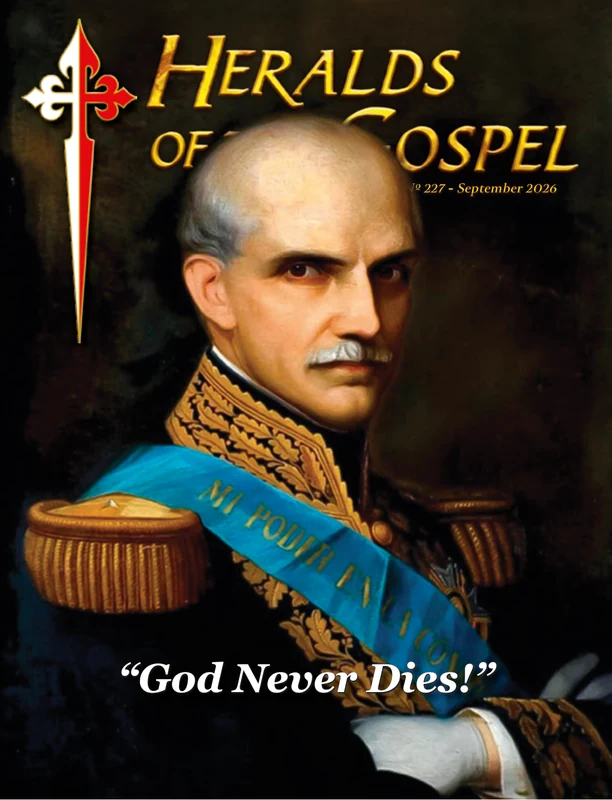
 Heralds of the Gospel Magazine, Vol. 20, nº 227, September 2026
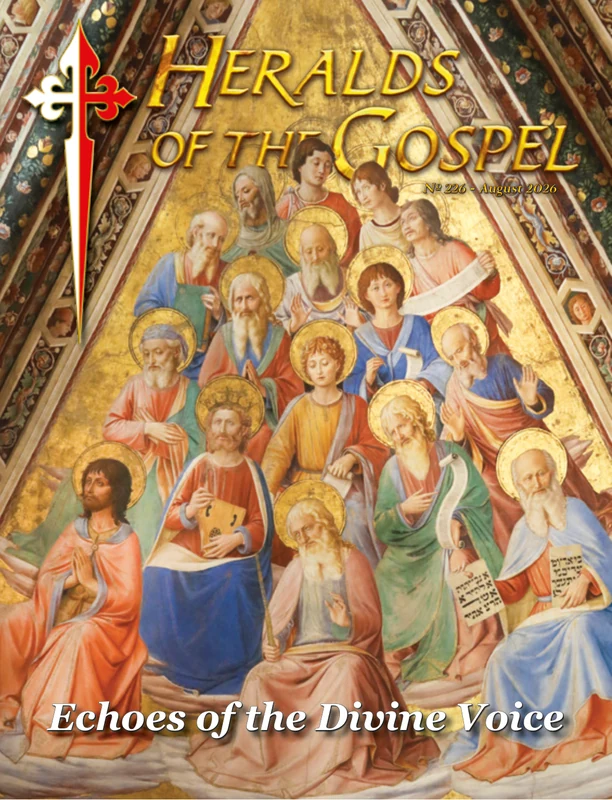 Heralds of the Gospel Magazine, Vol. 20, nº 226, August 2026
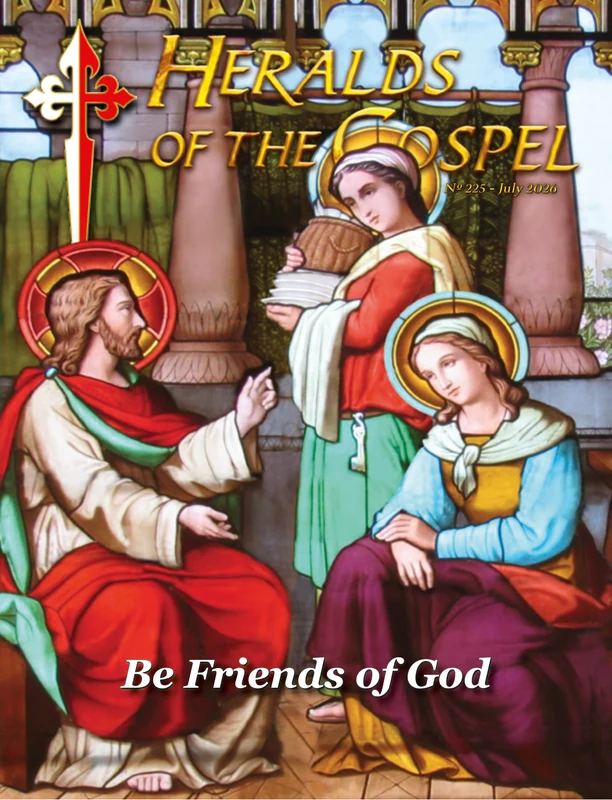 Heralds of the Gospel Magazine, Vol. 20, nº 225, July 2026
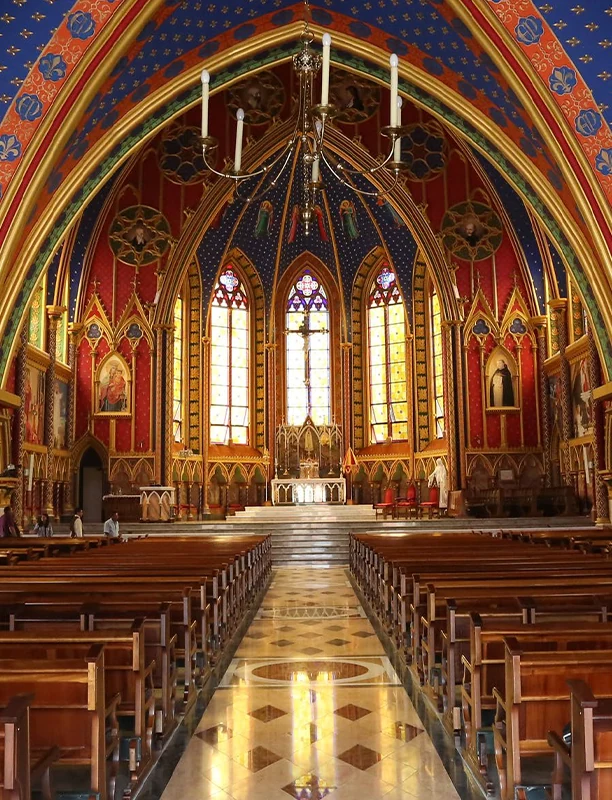 Who are the Heralds of the Gospel?
 Help of Christians
 Christmas Carols





A cycle of inexhaustible love
It would not be profitable to delve into the subject without first considering some theological presuppositions that can aid us in grasping such a lofty topic. Of course, explanations of the Trinitarian mystery are almost always based on analogies, since, as we have already noted, the human vocabulary lacks sufficient terms to explain the Most High. As St. Augustine2 rightly put it, if we were able to understand Him perfectly, He would not be God.In order to explain the relationship between the Three Persons of the Most Holy Trinity, theology began to use the Greek term perichoresis, which literally means circlular movement, and is translated into Latin as circuminsessio. Why was this term adopted by theologians? According to the words of St. John the Evangelist, “God is love” (1 Jn 4:8). And for this reason He is not just one Person, but three. In fact, someone who loves only himself cannot possess true charity. Since God’s love is infinite and supreme, no creature could ever be the recipient of such goodness. Furthermore, it was necessary for God to love someone of equal dignity and supremacy, who could only be a Divine Person.3 It follows that between the Divine Being and His Trinity of Persons there is a true perichoresis, in the original sense of the term: a cycle of inexhaustible love.4“God is love”, and for this reason He is not just one Person, but three. In fact, someone who were to love only himself could not possess true charity
Eternal and sacred coexistence
We have taken from one of the works by Msgr. João Scognamiglio Clá Dias, EP, a beautiful and accessible explanation of this relationship between the Father, the Son and the Holy Spirit. “The Incarnation of the Word revealed to men a mystery reserved for the fullness of time: the existence of Three Persons in the divine unity. […] Such a sublime reality transcends human criteria, and is illuminated by faith alone: the sole essence of God is the Father who eternally begets the Son in the perfect and full knowledge of Himself, causing the Holy Spirit to proceed from the love between Them. […] “The title of Father befits the First Person alone, for begetting; for being begotten, only the Second Person merits the name Son or Word; and for proceeding from both, the Third Person is called Holy Spirit, thus closing this mysterious circuit, resplendent with light and glory, which is the Trinity. No other difference distinguishes the Three who are One! […] “The Father is the beginning of the whole deity, according to the expression of St. Augustine. Fully able to know Himself, He would be ‘unhappy,’ so to speak, if He did not make Himself entirely explicit, for there is no perfect happiness when nature does not realize what is proper to it. “Knowing Himself, the Father expresses Himself completely in His eternal Word, which is so perfect an Image of the Father (cf. Heb 1:3) that it would be an error to affirm that They constitute two incommensurable, two uncreated and two almighty beings. On the contrary, the Two are just one incommensurable, one uncreated and one almighty being, as the ancient and poetic profession of faith attributed to St. Athanasius teaches us. […] “As concerns the Son, St. Thomas defines Him as the ‘intellectual emanation’ of the Father. Since, in God, being and understanding are identical to the divine essence, the Second Person is generated from the Father’s act of intelligence, and the titles of Son and Word are proper to Him. For this reason, in the first public manifestation of the Trinity to men during the Baptism of Jesus in the Jordan, as well as on the height of the Transfiguration mount, the Father desired to manifest Himself vocally, indicating that right there, before the very eyes of all present, was His Word, with whom He was well pleased. Representation of the Holy Spirit - Church of Our Lady of Glory of Outeiro, Rio de Janeiro (Brazil)
Unity in the Trinity
To summarize, in the Trinity there is only one divine nature, which constitutes the unity of God. Nevertheless, each of the Persons is distinguished from the others according to the mysterious operations that take place in the intimate life of God and the contrasting relationships derived from these operations: the Father begets the Son, the Son is begotten by the Father, and the Holy Spirit proceeds from both. This doctrine was solemnly proclaimed at the Council of Florence, in the famous aphorism “omniaque sunt unum, ubi non obviat relationis oppositio.”6Thus, although it is possible to distinguish between the Divine Persons, Church Magisterium teaches that when the Trinity works externally – which theology calls ad extra operations, such as the creation of the world and the Incarnation of the Word – the Three Persons act together, since the source of all these works is the divine nature itself, which is indivisible.7 However, God wants us to glorify not only His unity, but also His trinity. For this reason, the Holy Church attributes to each of the Persons works which, although they are common to all three, have a special connection or intimate affinity with the place that each occupies in the Trinity, that is, with the properties that are specific and exclusive to that Person. Hence, for example, since the Father is unbegotten, beginning without beginning, we attribute the creation of the world to Him. Having made these considerations on Trinitarian life, we can turn to the main theme of our article, the Paraclete.From the sublime relationship of full knowledge and of love between the Father and the Son proceeds the Holy Spirit, Love in Person
Holy Spirit, Gift and Love
According to the teaching of St. Thomas Aquinas,8 the names proper to the Third Person of the Trinity, derived from His operations in the intimate life of God, are: Holy Spirit, Gift and Love. Let us analyse each one of them, based on the comments of Fr. Antonio Royo Marín, OP.9 Considering the words Holy Spirit separately, they are applicable to the Three Persons, since all three are holy and spirit. However, taken together, they form the name that applies only to the Third Person, who proceeds from the other two by a common and infinitely holy spiration of love. For this very reason, the Paraclete is also our sanctifier. The term Gift, in its essential sense, designates everything that is freely given by God to rational creatures, whether of the natural or supernatural order. As a proper name, it is applied to the Third Person, who, by virtue of His origin, is fittingly the proximate reason for every divine gift and who is himself freely given to rational creatures. Thus, Gift corresponds exclusively to the Holy Spirit, who proceeds by way of love, since love is the first gift we give to a person whenever we give them something. Finally, the name Love. In its personal sense, it is properly used only for the Holy Spirit, because He is the passive term, in other words, the fruit of the relationship between the Father and the Son. There are also many attributes derived from the names mentioned above, which have been expressed by Tradition, in Sacred Scripture or even in the Liturgy of the Holy Church. They are: Paraclete, Spirit of Christ, Spirit of Truth, Spirit of the Most High, Principle of creation, Finger of God, Sweet Guest of the Soul, Seal, Union, Living Source, Fire, Charity, Blessed Light, Father of the poor, Giver of the seven gifts and Light of hearts.Soul and heart of the Church
The Divine Paraclete is also the heart and soul of the Mystical Body of Christ, the Holy Church, which has Our Lord Jesus Christ as its Head (cf. Eph 1:22-33).In the human body, the head is vivified by the beating of the heart, an organ as hidden as it is indispensable. Something similar happens with the Church: Christ is her Head, since He is above every creature; however, the Holy Spirit, whose mission is the sanctification of men, invisibly enlivens and unites the Church, and for this reason is called her heart.10 Cardinal Charles Journet,11 a great expert of the Second Vatican Council, makes a beautiful analogy by affirming that, just as Christ is, in time, the repercussion of the eternal generation of the Word in the bosom of the Trinity, so the Church, by her co-redemptive mission, is the reflection in time of the eternal procession of the Holy Spirit.After the battles fought in defence of Jesus Christ’s divinity, the Church came up against those who denied that the Holy Spirit is God
The Holy Spirit is God!
The treasures of doctrine and elucidations on the Divine Holy Spirit are a gift from God to His Church given, however, amidst great struggles and difficulties. For “there must be also heresies: that they also, who are approved, may be made manifest among you” (1 Cor 11:19). “Most Holy Trinity”, by Andrés López - Andrés Blaisten collection, Mexico City
Spouse of Mary Most Holy
In its fundamental symbol, the Church recognizes the Divine Holy Spirit as “Dominum et vivificantem”, the Lord and giver of life. As Fr. Royo Marín reminds us,14 the dependence of our supernatural life on the power that comes from the Paraclete is a fundamental principle of religion. And yet how many people, since they do not bother to properly adore and know the Third Person of the Trinity, place an insurmountable obstacle between Him and their souls! There is no one who wants to get in touch with us more than the Holy Spirit, our God, Lord and Sanctifier; let us not fall into the tragic error – unfortunately very common in our day – of considering Him as an inaccessible and incommunicative Being.And let us remember that Mary Most Holy is not only the Daughter of God the Father and Mother of God the Son, but also the Spouse of the Holy Spirit. For this reason, in the words of St. Louis Grignion de Montfort,15 all the Saints who have existed and will exist until the end of the world are the fruit of this heavenly espousal. Let us not hesitate to turn to Our Lady to intercede for us with the Paraclete. By doing so, we can be sure that He will continually send us the rays of His light and His grace.All the saints who have ever existed and will ever exist are the fruit of the heavenly espousal between Mary Most Holy and the Paraclete
 “The Annunciation”, by Bartolomeo Caporali - National Gallery of Umbria, Perugia (Italy)
Notes
1 Cf. BENEDICT XVI. Angelus, 11/6/2006.
2 Cf. ST. AUGUSTINE OF HIPPO. Sermo LII, n.16. In: Obras Completas. Madrid: BAC, 1983, v.X, p.62.
3 Cf. RICHARD OF ST. VICTOR. La Trinidad. Salamanca: Sígueme, 2015, p.123-125.
4 Cf. FERNÁNDEZ, Aurelio. Teología Dogmática. Madrid: BAC, 2009, p.295.
5 CLÁ DIAS, EP, João Scognamiglio. Mary Most Holy: The Paradise of God Revealed to Men. São Paulo: Heralds of the Gospel, 2022, v.II, p.29-31.
6 DH 1330. From the Latin: “[In the Trinity] everything is a unity, where no opposition of relationship interferes.”
7 Cf. DH 3814.
8 Cf. ST. THOMAS AQUINAS. Summa Theologiæ. I, q.36-38.
9 Cf. ROYO MARÍN, OP, Antonio. El gran desconocido. Madrid: BAC, 2004, p.27-32.
10 Cf. ST. THOMAS AQUINAS, op. cit., III, q.8, a.1, ad 3.
11 Cf. JOURNET, Charles. Teología de la Iglesia. 2.ed. Bilbao: Desclée de Brouwer, 1962, p.89.
12 Those who followed the heretic Macedonius were dubbed Macedonians.
13 Cf. LLORCA, Bernardino. Historia de la Iglesia Católica. Edad Antigua. 7.ed. Madrid: BAC, 1996, v.I, p.437.
14 Cf. ROYO MARÍN, op. cit., p.10-11.
15 Cf. ST. LOUIS-MARIE GRIGNION DE MONTFORT. Prayer for Missionaries. In: God Alone. Bay Shore, NY: Montfort Publications, 1987, p.404.
16 Idem. p. 404-405.