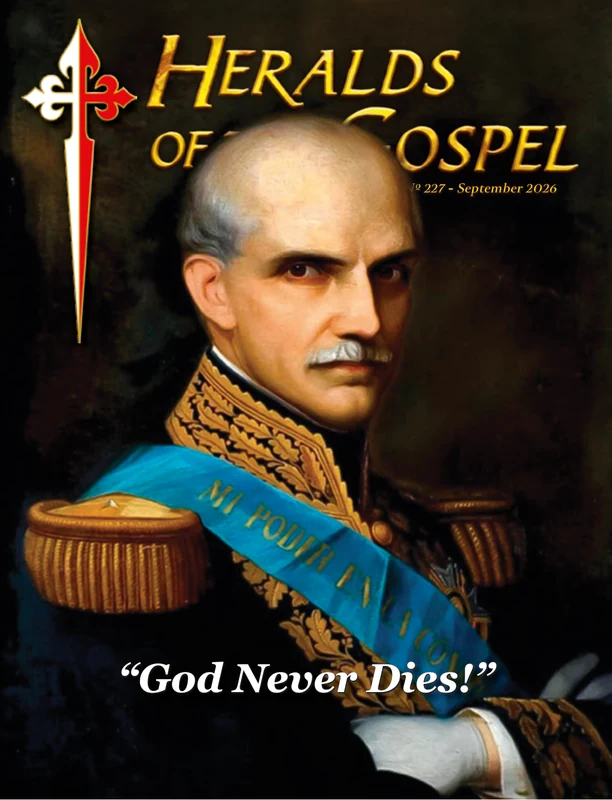
 Heralds of the Gospel Magazine, Vol. 20, nº 227, September 2026
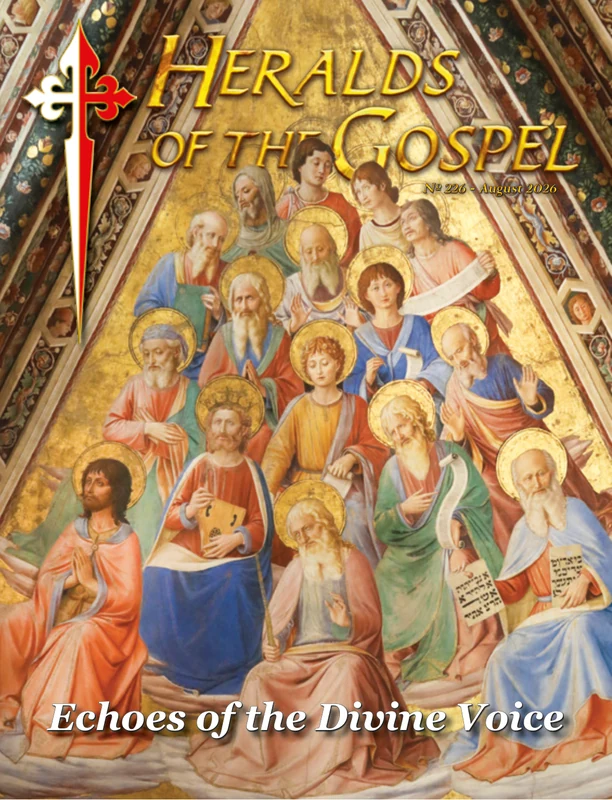 Heralds of the Gospel Magazine, Vol. 20, nº 226, August 2026
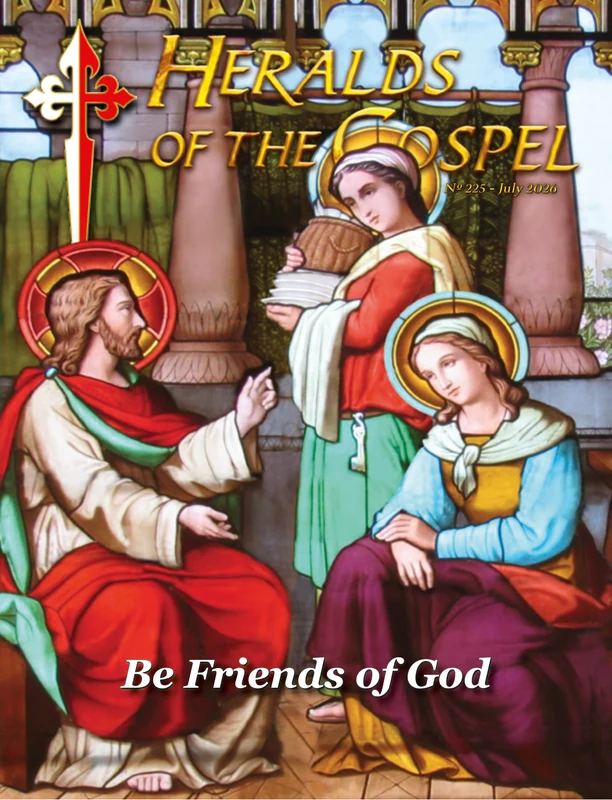 Heralds of the Gospel Magazine, Vol. 20, nº 225, July 2026
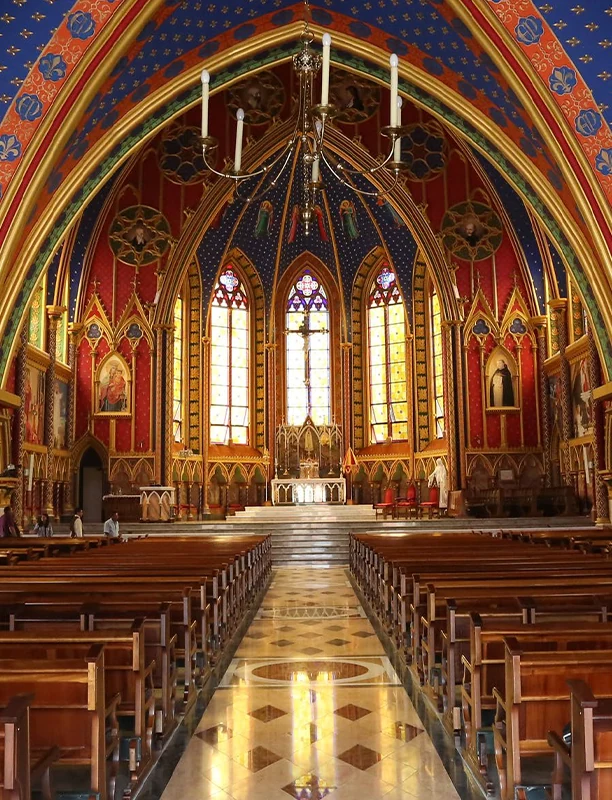 Who are the Heralds of the Gospel?
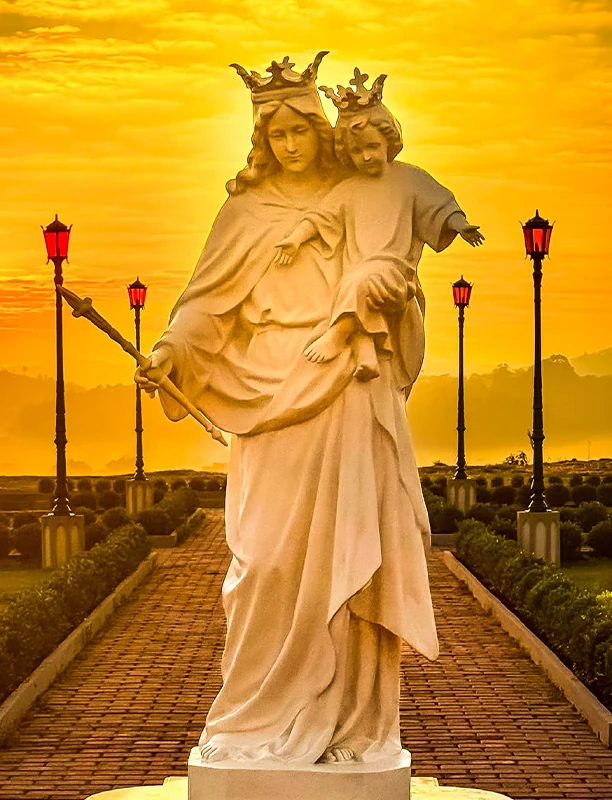 Help of Christians
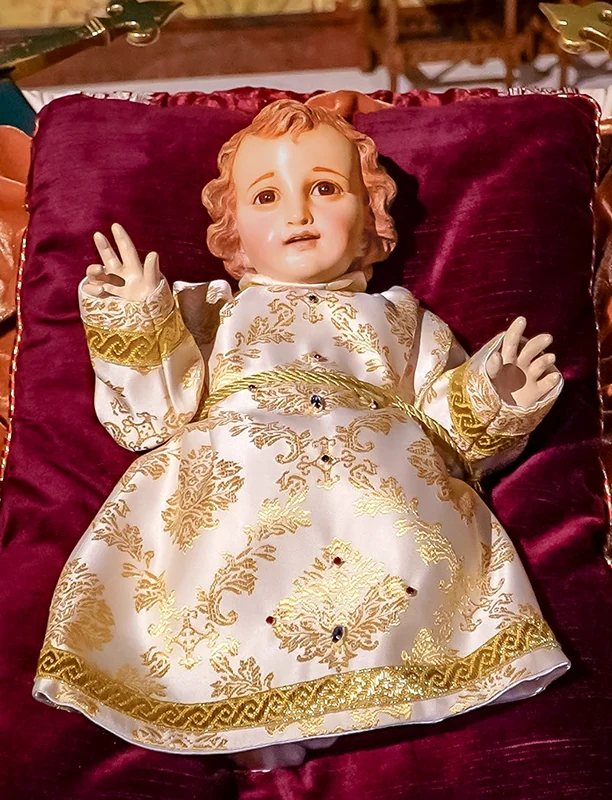 Christmas Carols








One of the most influential men in his land
Dante Alighieri was born in Florence, probably in 1265. His life was an extremely eventful one. Of remarkable intelligence, he studied all areas of culture with excellent teachers and soon became one of the most influential men in his land, which led him to take on an important political role in the famous dispute between the Ghibellines, who defended the supremacy of the emperors over the papacy, and the Guelphs, who defended pontifical authority. The Italian poet belonged to the latter – and more precisely to the more moderate “White Guelphs”. After many conflicts, he was exiled from his native Florence in 1302 by the “Black Guelphs”. After many journeys and attempts at repatriation, he took refuge in Ravenna. There, plunged into sadness at his exile, Alighieri consoled himself with the study of theology until his death on September 14, 1321. It was in this context that, analysing his life, he realized he was entangled “in a gloomy wood, astray/ Gone from the path direct.”2 He went on to write his masterpiece, the Divine Comedy.An incentive to love Christian truths
Undoubtedly, it is in the literary aspect that most of the glory of this universal writing lies. The story is pervaded with elements from all areas of the culture of the time: “Dante is complete in the Divine Comedy, not because it is the best of his works, but because of its totality.”3 What is more, in it the Italian poet exhausted his knowledge and talent, which were immense for his time. The Divine Comedy was written entirely in hendecasyllable verse – eleven syllables – with an innovative rhyming system in tercets, and is divided into three parts: Hell, Purgatory and Paradise. In perfect mathematical balance, each of these parts is made up of thirty-three cantos, plus an introductory canto attached to Hell. This brings the total to one hundred. Notwithstanding such literary excellence, this work was not initially intended for scholars and literati, but for everyone. Hence the fact that it was not written in Latin – the language then spoken in universities and used in scholarly works – but in the Tuscan vernacular. Furthermore, the original title Commedia was indicative of a literary style characterized by “living speech”, different from the illustrious speech of the elegies. Boccaccio only gave it the qualification of Divina with which it was consecrated years later. It is worth recalling, however, that “if it captivates the reader through the singular variety of images, the beauty of the colours, the grandeur of the expressions and the thought, it is to enrapture him and excite him to a love of Christian truth.”4Hell
The plot that fills the pages of the Divine Comedy takes place in the year 1300 and begins with Virgil appearing to Dante in the gloomy wood in which he had lost himself, an image of his life of sin. The Roman poet claims to have been sent by the Virgin Mary at the behest of Beatrice – a name that means blessed or beatific, and which in the work represents faith or theology – to guide Alighieri through hell and Purgatory until he reaches Paradise, where Beatrice herself will lead him. Thus begins the descent into hell, which is shaped like a funnel, with concentric “circles” that go all the way to the centre of the Earth and hold punishments that are worse the lower they are. On reaching its gates, travellers are met with a sign that reads: “All hope abandon, ye who enter here.”5 Dante and Virgil in hell - Musei di San Domenico (Italy)
Purgatory
In the Dantesque vision, Purgatory is an island in the Southern Hemisphere, which is evident from the appearance of the Southern Cross. From it rises a great conical mountain that is climbed in ascending circles: the higher they are, the shorter the route to be travelled and the lighter the sins to be purged there. Entrance of Dante in Purgatory - Medicea Laurenziana Library, Florence (Italy)
Paradise
Dante envisions Heaven as nine concentric spheres, each corresponding to one of the angelic choirs. Above these spheres is Empyrean Heaven, which is immovable and where God’s throne is located. This division is based on Ptolemy’s astronomical system, which was in vogue at the time. In other words, all the spheres revolve around the Earth, and their speed of movement is greater the farther they are from our planet. Beatrice explains to him how holy souls are elevated to Heaven and how Dante will similarly rise: God’s love unfailingly attracts them when they contemplate Him. And so they begin their ascent. In the first sphere, that of the Moon, they meet those who, although virtuous, have not fully fulfilled their vows and are insufficient in fortitude. When asked if they did not wish for greater glory, one of the souls replies to the poet: “If we should wish to be exalted more, / Then must our wishes jar with the high will / Of Him, who sets us here.”10 In other words, in Heaven the blessed have such a union of wills with God that their happiness consists of fulfilling His designs, not longing for anything other than what He wants. In the second Heaven, that of Mercury, are those who have acquired worldly fame lawfully, but who have desired it too ardently, to the detriment of justice. Raised to the Heaven of Venus, the travellers see the amorous, who have been excessive in this passion, lacking in temperance. There they find souls who have practised love imperfectly. In the sphere of the Sun are the doctors of theology, who have shone for their prudence. Several doctors approach Dante, including St. Thomas Aquinas and St. Bonaventure. Then they both began to sing the glory of the Mendicant Orders: St. Thomas praises the Franciscans, while St. Bonaventure extols the Dominicans. The fifth sphere is that of Mars, made up of the militants, examples of fortitude. They are organized in the shape of a large cross. The heaven of Jupiter is that of the just, who form, in a celestial choreography, the phrase of Scripture: “Diligite iustitiam, qui iudicatis terram” (Wis 1:1).11 From the final “M” rises the eagle of the Roman Empire, for there we find those who have exercised government over the nations in a holy manner. Dante in Paradise, by Philipp Veit - Casino Massimo Lancellotti, Rome
Why read the “Divine Comedy”?
At this juncture, the reader may have wondered: “what is the point of reading the Divine Comedy if it is just a fictional narrative?” As an answer to this question, the words of Benedict XV are apt: “His comedy – which has well-earned the appellation divine – even in its elements of fiction and imagination and in the allusions to mortal life present in numerous passages, has no other purpose than to exalt the justice and providence of God, who rules the world in time and eternity, and distributes to individuals and societies rewards or punishments according to their merits.”13 Therefore, by beautifully singing the principles of the Catholic Faith, the Divine Comedy serves as a meditation for us on the Novissima, inciting us to a greater love of God, the One who is substantially, according to the last words of the work, the Love “that moves the sun in Heav’n and all the stars.”14 ◊Notes
1 BENEDICT XV. In præclara summorum.
2 Hell, I, 2-3. All quotes from the Divine Comedy have been taken from the English version: DANTE ALIGHIERI. The Divine Comedy. New York: Grolier, 1990.
3 RUIZ, Nicolás González. Introducción general. In: DANTE ALIGHIERI. Obras Completas. 5.ed. Madrid: BAC, 2002, p.8.
4 BENEDICT XV, op. cit.
5 Hell, III, 9.
6 Hell, III, 51
7 Hell, XXXIV, 139.
8 Purgatory, IX, 113-114.
9 Purgatory, XXXIII, 144-145.
10 Paradise, III, 73-75.
11 From the Latin: “Love righteousness, you rulers of the earth.”
12 Paradise, XXXIII, 49-51.
13 BENEDICT XV, op. cit.
14 Paradise, XXXIII, 145.