 Heralds of the Gospel Magazine, Vol. 20, nº 227, September 2026
 Heralds of the Gospel Magazine, Vol. 20, nº 226, August 2026
 Heralds of the Gospel Magazine, Vol. 20, nº 225, July 2026
 Who are the Heralds of the Gospel?
 Help of Christians
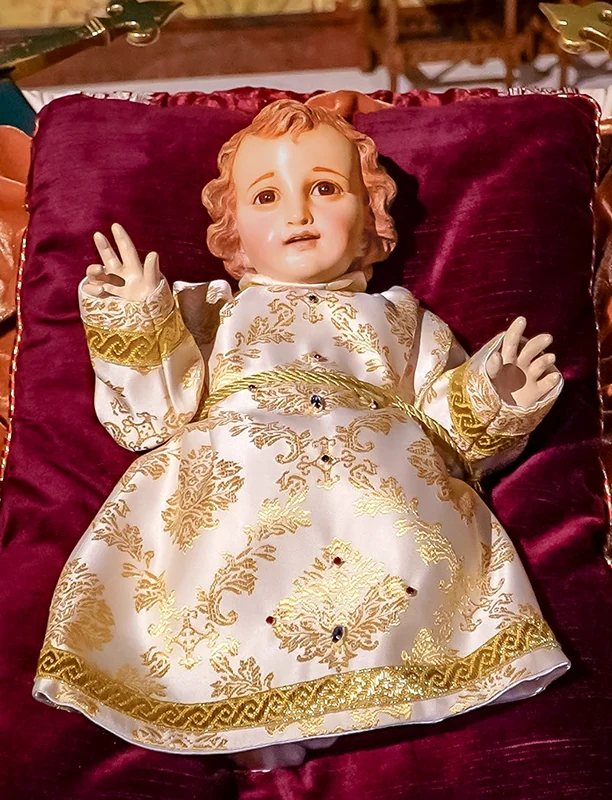 Christmas Carols









A new art to adorn sacred places
At the turning of the first millennium of the Christian era it became customary to adorn churches and cathedrals with large embroidered textiles, in a variation of the wall paintings and mosaics traditionally used until then. Scenes from the Gospel began to stand out in magnificent embroidered works, thanks to large numbers of noble ladies skilled in needlework, who were able to coordinate groups of embroiderers in major projects. Popes, bishops, abbots, queens and duchesses became fond of the new art, encouraging its development in the sacred places entrusted to their jurisdiction or influence. From there, the production of sacred motifs became widespread and evolved into complex representations composed of various scenes, characters and settings that depicted entire stories from the Old and New Testaments. This saw the flourishing of a trend of the time, reflected also in stained glass, which was moving towards prodigious narratives with didactic aims to display to the illiterate what they could not learn from the scarce and very costly books. It is within this context of fertile creativity that embroidery ended up branching out of the religious sphere to portray the most notable events of the time, both social and military. And so a masterpiece was born, unique in the world for its extraordinary historical importance, its imposing size and fascinating wealth of detail, surprisingly well preserved to this day: the Tapestry of Queen Matilda, also called the Bayeux Tapestry.The complete narrative of an epopee
The extensive linen cloth, almost seventy metres long, was like a sui generis blank book, prepared to contain the complete narrative of an epopee whose consequences were decisive in shaping the West as we know it today. In the 11th century, Bayeux was an important city in the Duchy of Normandy, governed by William the Conqueror, and the episcopal see of Bishop Odo, his brother. “Queen Matilda working on the Bayeux
Tapestry”, by Alfred Guillard - Baron Gérard Museum, Bayeux (France)
The Norman conquest of England
But what historical threads went into producing this singularly famous tapestry? It all began with St. Edward the Confessor, King of England. He was a man of integrity in the eyes of God, committed to governing in observance of the Commandments and to guiding his subjects on the path of justice. His lack of descendants made him apprehensive about the future of the throne, the instability of the territory in the prospect of Viking invasions and the assimilation of the Catholic Faith by the Anglo-Saxons, who were still very close to barbarism and had not yet been fully moulded by the spirit of the Gospel. At this crossroads, he turned his attention to the blessed lands of Normandy, where Christian Civilization was flourishing before his very eyes. Being himself the son of a Norman noblewoman and having spent twenty-five years in exile in that duchy during the invasion of the Danish Vikings in England, St. Edward had never tried to concealed the admiration that this land aroused in his soul. There, the graces emanating from Mont-Saint-Michel seemed to shape the hearts of men who, while possessed of an indomitable warrior temperament, also showed themselves to be devoted sons of the Holy Church. These qualities prompted King Edward, over the course of his reign, to entice to England all the Norman nobles he could, and as his successor, he finally chose Duke William. And here began the adventure, the first scene of which was the sending of his nephew Harold to communicate the important news to the Conqueror. After various adventures and risks, Harold met the Duke, gave his account and swore an oath of allegiance, but when he returned to London to present himself with the mission accomplished, he found St. Edward on the verge of death. After the solemn funeral in Westminster Abbey, Harold, who was the main representative of the Anglo-Saxon dynasty, betrayed his sovereign’s wish and had himself crowned king. Detail of the Bayeux Tapestry portraying the coronation of Harold II as King of England - Bayeux Tapestry Museum (France)
An ancient monument created with needle and thread
All these episodes are rendered with luxurious detail in the tapestry, which can hold the attention of its viewers for long hours, from the most scholarly specialists to the merely curious. With scenes ranging from the dramatic to the picturesque, along with the innocent and pious, nothing is wasted in this work of embroidery, the fruit of the patience and zeal of a people determined to preserve their own memory. The woollen threads dyed in eight colours have held out to this day in the 58 scenes portrayed, with plenty of figures vying for our attention in it, for it counts no less than “626 characters, 190 horses and mules, 35 dogs, 506 various animals, 37 boats, 33 buildings and 37 trees.”1 All this in a piece subjected to the inclemencies of the centuries and even used to wrap goods during the French Revolution! When the Bayeux Tapestry came out of anonymity and became the appreciated masterpiece that we know today, a scholar remarked when contemplating it: “What a singular thing, when so many solid buildings have collapsed, this fragile strip of fabric has come to us intact through centuries, revolutions and every sort of vicissitude. A piece of cloth has conquered eight centuries!”2 Detail of the Bayeux Tapestry
Notes
1 LEVÉ, Albert. La Tapisserie de la Reine Mathilde dite la Tapisserie de Bayeux. Paris: H. Laurens, 1919, p.11.
2 Idem, p.22.