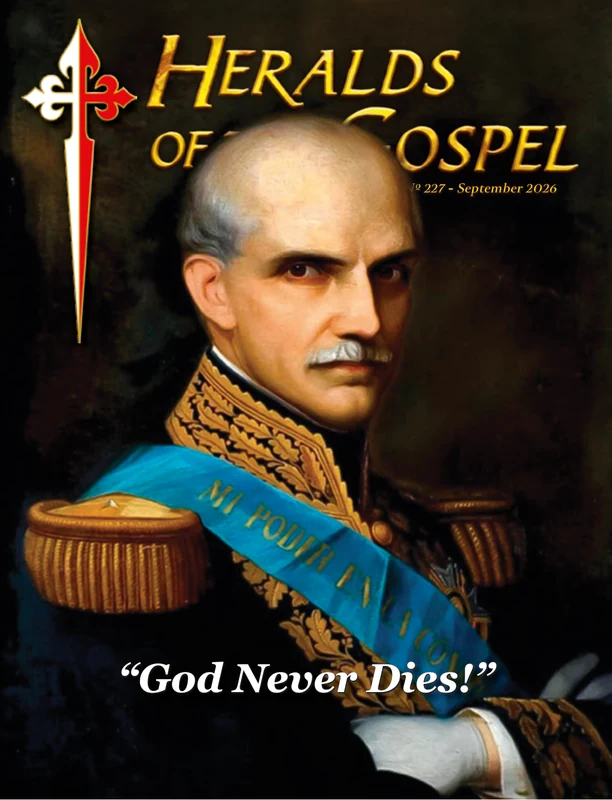
 Heralds of the Gospel Magazine, Vol. 20, nº 227, September 2026
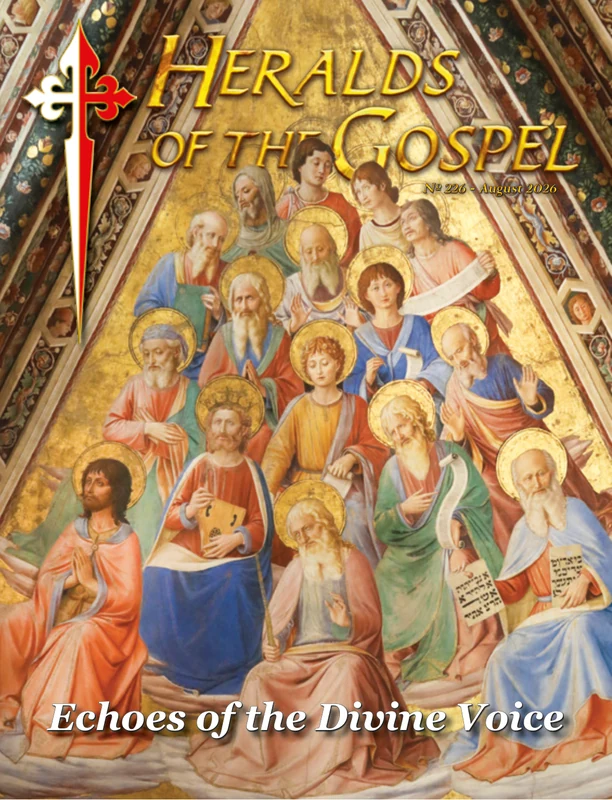 Heralds of the Gospel Magazine, Vol. 20, nº 226, August 2026
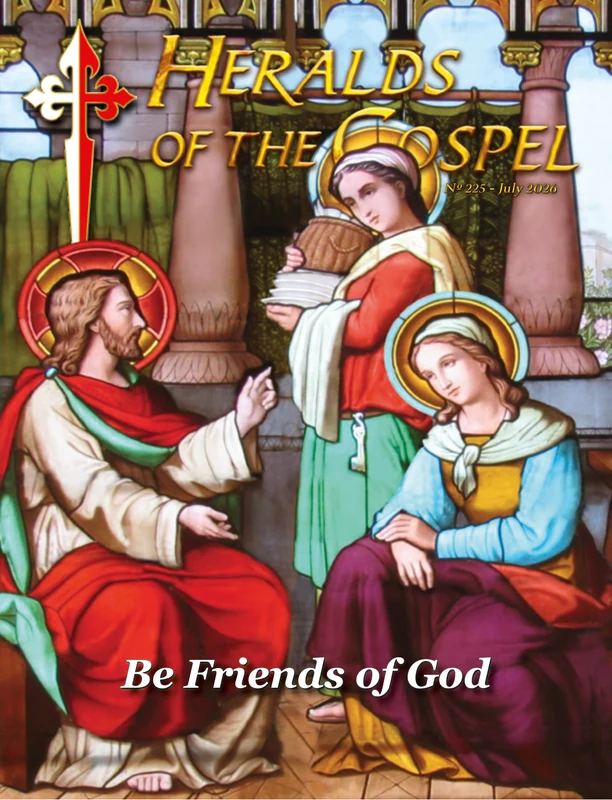 Heralds of the Gospel Magazine, Vol. 20, nº 225, July 2026
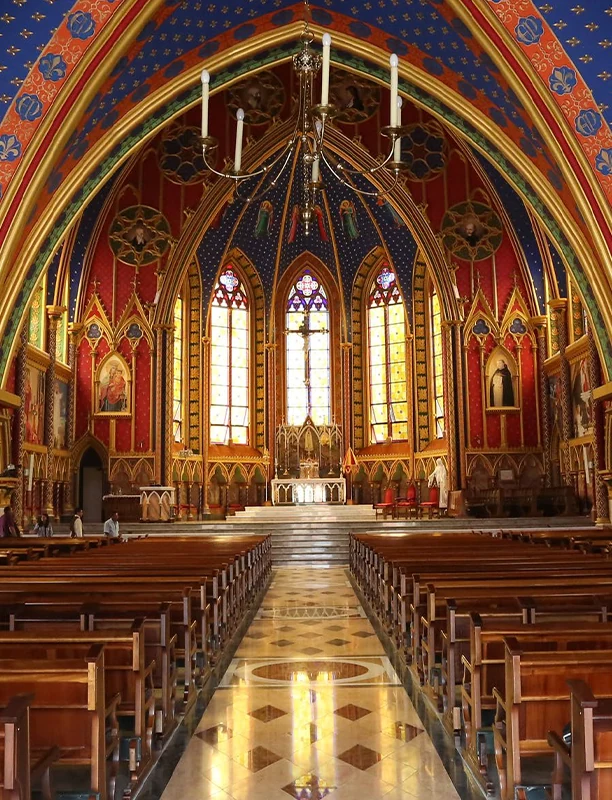 Who are the Heralds of the Gospel?
 Help of Christians
 Christmas Carols






 St. Michael, by Fra Angelico - San Marco Museum, Florence (Italy)
Archangel of Israel… and of the “New Israel”
He, the “great prince” (Dn 12:1), had the mission of guarding the chosen nation. This excellent patron was the sustenance of the patriarchs, the inspiration of the prophets, the consolation of the just, in short, the defence of the children of Israel. What a privilege, even for an Angel, to have the task of guarding the people from whom Mary Most Holy would be born, and from Her, the “First-born of all creation” (Col 1:15)! Yes, what a privilege and, forgive us St. Michael, what woe… How to fathom that from the same chosen nation would emerge the assassins of the Messiah? For the unthinkable happened: the Archangel saw his Lord crucified and killed by those of whom he was the guardian. At this height of wickedness, the Patron of Israel was still there, inspiring sorrow and repentance in those hardened hearts. Darkness fell during broad daylight; there were terrible earthquakes and the veil of the Temple was rent in two. Why should we not also see in these events St. Michael’s indignation against the infamous sin of deicide? Such calamities seemed to be an echo on this earth of that cry which resounded in the heavenly realm and struck fear into the rebellious angels, precipitating the once “light-bearing” spirit, Lucifer, into the abyss. For it was now the unfaithful Jews who, imitating the attitude of the leader of the demons, cried out: “I will not serve” (Jer 2:20). Like the revolted angel, the authorities of the deicidal people would lose the honour of radiating the light of Divine Revelation to the world, and would be cast into the darkness of error, for “a veil lies over their minds” (2 Cor 3:15). Nevertheless, at the moment when blood and water gushed forth from the open side of the Saviour, the people of the Eternal Covenant was born, the “New Israel”: the Holy Roman Catholic Church, of which St. Michael became the protector.Zealous defender of Holy Church
A unique figure by the name of Hermas, a former Greek slave and brother of Pope Pius I, wrote one of the earliest works of Christian literature, called The Shepherd. St. Michael presents souls to St. Peter, by Miguel Alcañiz-
Museum of Fine Arts, Lyon (France)
“By this sign you shall conquer!”
It was the year 312. The throne of the Roman Empire hung in the balance between two men: Constantine and Maxentius. Although both were pagans, the former was born of a Christian woman: St. Helena. He decided to advance against Rome in order to take the throne from his rival. After several days of forced march, his small army of forty thousand men was not in the most favourable conditions to launch the attack against an adversary that was numerically far superior. Unsure, Helena’s son decided to turn to help from above: he prayed to the God of his mother. When he finished his prayer, he beheld an immense luminous cross in the sky, on which was written this sentence in Greek: “By this sign you shall conquer.” The following night, the vision was repeated in a dream and Constantine, realizing that a supernatural event was afoot, ordered a banner to be made in the shape of a cross to head the ranks of his army. The battle took place on October 28 and, despite the unfavourable odds, Constantine crushed Maxentius’ troops. A year later, in 313, as a sign of gratitude for the miraculous victory, the sovereign signed the Edict of Milan, by which he put an end to persecution of the Church and granted freedom of worship to Christians. At last, the true Religion could breathe a different air from that of the catacombs. It was not until 314, however, that Constantine fully understood the cause of his success. In a dream, a figure enveloped in light appeared to him and said: “I am the Archangel Michael, commander of the heavenly militia, protector of the Faith of Christians. It was I who, while you were fighting against the wicked tyrants, made your weapons victorious.”4 Battle of the Milvian Bridge, by Giulio Romano - The Walters Art Museum, Baltimore (Maryland)
A Woman clothed with the sun
There are yet countless examples of the unfailing action of the Archangel throughout history, but it is impossible to enumerate them all here. Fortunately, the Holy Spirit has given us an admirable compendium in this respect, in a scene described in the Book of Revelation. At the beginning of chapter twelve, St. John relates a momentous vision: a Woman appears in the firmament, clothed with the sun, crowned with twelve stars and having the moon under her feet. She is expecting a child and is groaning in labour pains. Then another great sign appears: a dragon, the colour of fire, stands before the Woman, in order to devour her child as soon as it is born. She flees into the desert, where God has prepared a refuge for her. Immediately following this description, the Virgin Apostle adds: “Now war arose in Heaven, Michael and his Angels fighting against the dragon; and the dragon and his angels fought, but they were defeated and there was no longer any place for them in Heaven” (12:7-8). These are enigmatic scenes – as, indeed, is the whole Book of Revelation – but it is remarkable that St. John narrates them together. The dragon pursuing the Woman is the same one defeated by St. Michael, and the battle between them takes place on her account: the former attacks while the latter defends her. Who is this mysterious Woman? The Virgin Mary herself? Many affirm this, and it is a traditional and beautiful application, but not the only one. Some Church Fathers and ecclesiastical authors had reason to add another interpretation: that which identifies the Woman with the Holy Church.5 Just as the Lady of the Apocalypse was persecuted by the dragon, the Church is attacked by the devil and his followers. And, just as St. Michael defeated the monster that threatened the Woman, he also demonstrates great zeal when it comes to the protection of the Mystical Bride of Christ, especially in the moments of greatest danger.Final victory of St. Michael
 St. Michael defeats the demon - St. Michael’s Church, Ghent (Belgium)
 The fall of the rebellious angels, by Neri di Bicci - Boijmans Van Beuningen Museum, Rotterdam (Netherlands)
Notes
1 Cf. MAYNARD, Michel-Ulysse. La Sainte Vierge. Paris: Firmin-Didot, 1877, p.352.
2 Cf. ST. AUGUSTINE. De civitate Dei. L.XI, c.19. In: Obras. Madrid: BAC, 1958, t.XVI, p.746; ST. THOMAS AQUINAS. Summa Theologiæ. I, q.63, a.5, ad 2.
3 HERMAS. Le Pasteur, c.69, n.3: SC 53, 266-269.
4 BERNET, Anne. Enquête sur les Anges. Paris: Perrin, 1997, p.137. Perhaps this is the reason that led the emperor to build the oldest shrine in Constantinople dedicated to St. Michael, as well as consecrating the entire empire to the Archangel.
5 Cf. BARTINA, SJ, Sebastián. Apocalipsis de San Juan. In: NICOLAU, SJ, Miguel et al. La Sagrada Escritura. Nuevo Testamento. Madrid: BAC, 1962, v.III, p.711-713.
6 BLESSED ANNE CATHERINE EMMERICH. Life and Revelations. Rockford (IL): TAN, 1967, v.I, 566-657.
7 Idem, v.II, p.294.